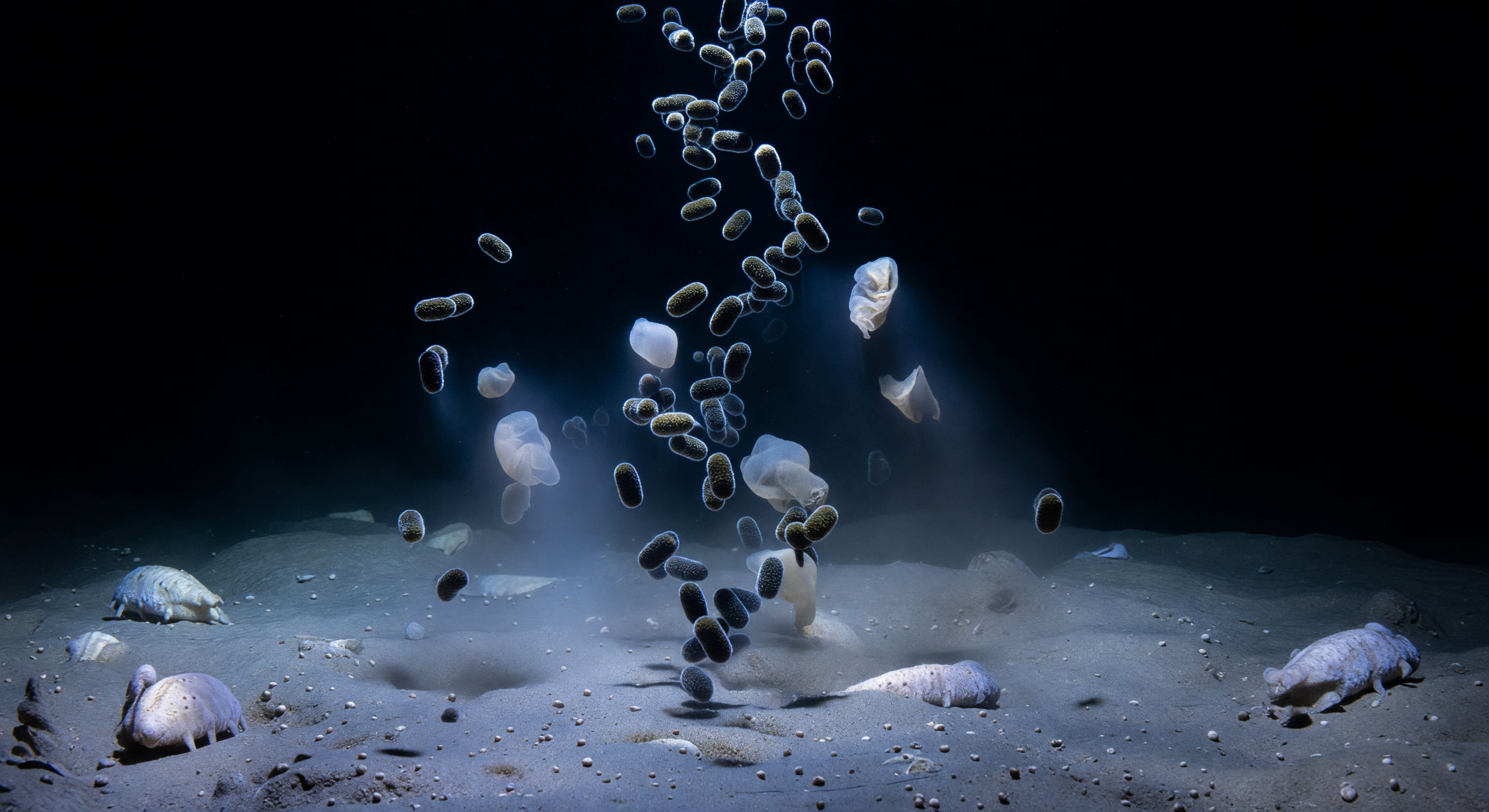
You are lying against the abyssal plain at 3,000 meters, your perspective flush with the sediment surface, gazing upward into a darkness so complete it registers less as an absence of light than as a physical presence pressing downward. The pale gray-tan biogenic ooze beneath you — a compressed record of foram shells and radiolarian tests accumulated over millennia — stretches outward to where holothurian bodies the color of old ivory lie half-dissolved into the sediment margin, their surfaces catching the only illumination available: a sourceless, monochromatic blue wash that seems less like light than like the idea of light, coloring everything within a single cold frequency somewhere between cerulean and void. Into this upward gaze descends the biological pump's slow currency: salp fecal pellets, dense olive-brown to near-black cylinders of 0.5 to 2 millimeters, each one a membrane-wrapped capsule of compressed picoplankton wrapped in a living bacterial biofilm that gives its surface the texture of dark velvet, falling in unhurried spirals that will take days to complete the final meters of a journey begun weeks ago at the sunlit surface. Between them drift the structural failures of salp carcasses — collapsed gel architectures whose muscle bands have dissolved into rumpled translucent sheets, each trailing a diffuse halo of dissolved organic matter, a faint chemical breath spreading outward at the speed of molecular diffusion into halos that overlap and intermingle, creating subtle turbid veils at successive depths. This is not emptiness but a slow rain of fixed carbon arriving in near-monochrome silence onto a pale and patient floor, each impact registered only as a microscopic crater in the ooze.
Other languages
- Français: Neige Organique Abyssale
- Español: Nevada Orgánica Abisal
- Português: Neve Orgânica Abissal
- Deutsch: Organischer Schneefall Tiefsee
- العربية: ثلج عضوي في الأعماق
- हिन्दी: जैविक हिमपात रसातल तल
- 日本語: 深海有機雪の降下
- 한국어: 심해 유기 눈송이
- Italiano: Neve Organica Abissale
- Nederlands: Organische Sneeuw Diepzeebodem