Scientific confidence: High
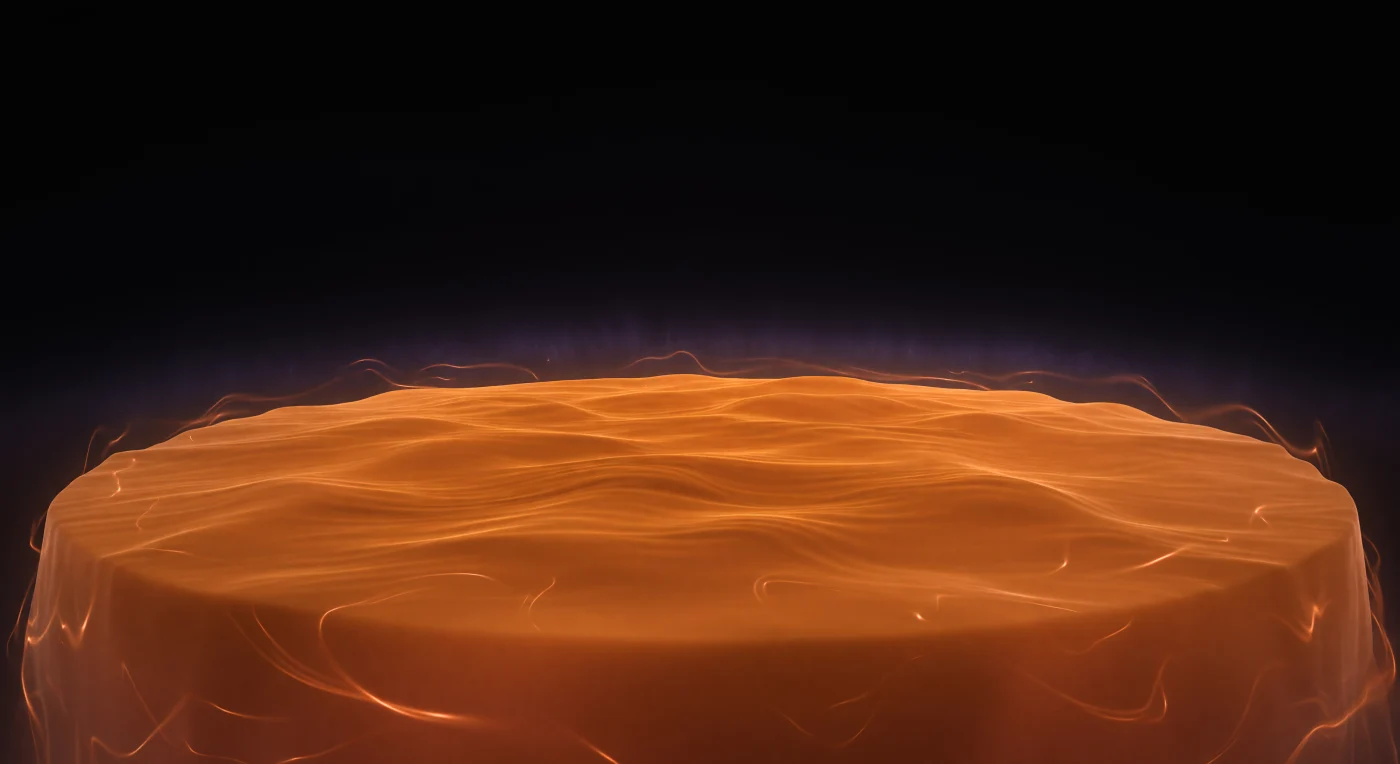
You stand at the outermost edge of a nickel-60 nucleus, on a curved skin so tight that the horizon bends visibly within arm's reach, the world dropping away in every direction like the surface of an asteroid smaller than a thought. Beneath your feet, the ground radiates a deep molten amber — not reflected light but energy bleeding outward from nuclear saturation density, some 2.3 × 10¹⁷ kilograms per cubic meter, a density so absolute it constitutes the densest stable matter in the observable universe — and across this luminous surface, slow quadrupole waves roll with tectonic patience, each crest a fraction of a nucleon diameter high, the entire nucleus breathing in collective oscillation modes governed by the quantum shell structure of its 28 protons and 32 neutrons. Within three or four steps outward, the amber thins through the Woods-Saxon skin, a diffuse boundary zone where nuclear density falls from saturation to near-zero across a distance smaller than a single proton's width, copper wisps of thinning nuclear density curling upward in zero-point eddies before dissolving entirely into the surrounding void. Beyond the last translucent tendril of that boundary, an ontological blackness extends for a hundred thousand nuclear diameters in every direction, featureless and total, the nearest electron cloud so impossibly remote at this scale that the vacuum between nucleus and atom reads not as space but as negation itself — broken only by the faintest deep-violet shimmer of the QCD vacuum, virtual quark-antiquark pairs flickering in and out of existence at timescales no instrument could resolve, leaving a ghost of luminescence pressed against the dark like aurora seen through coal.
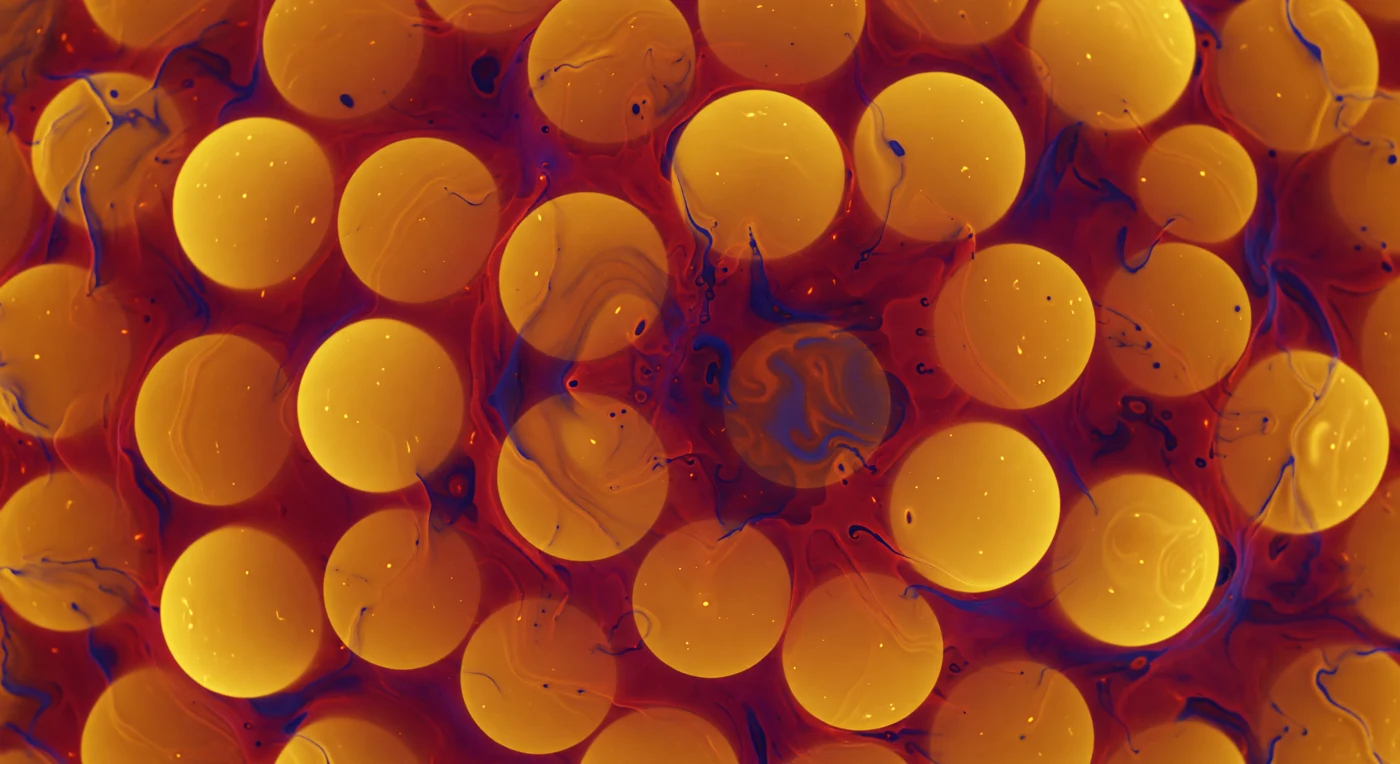
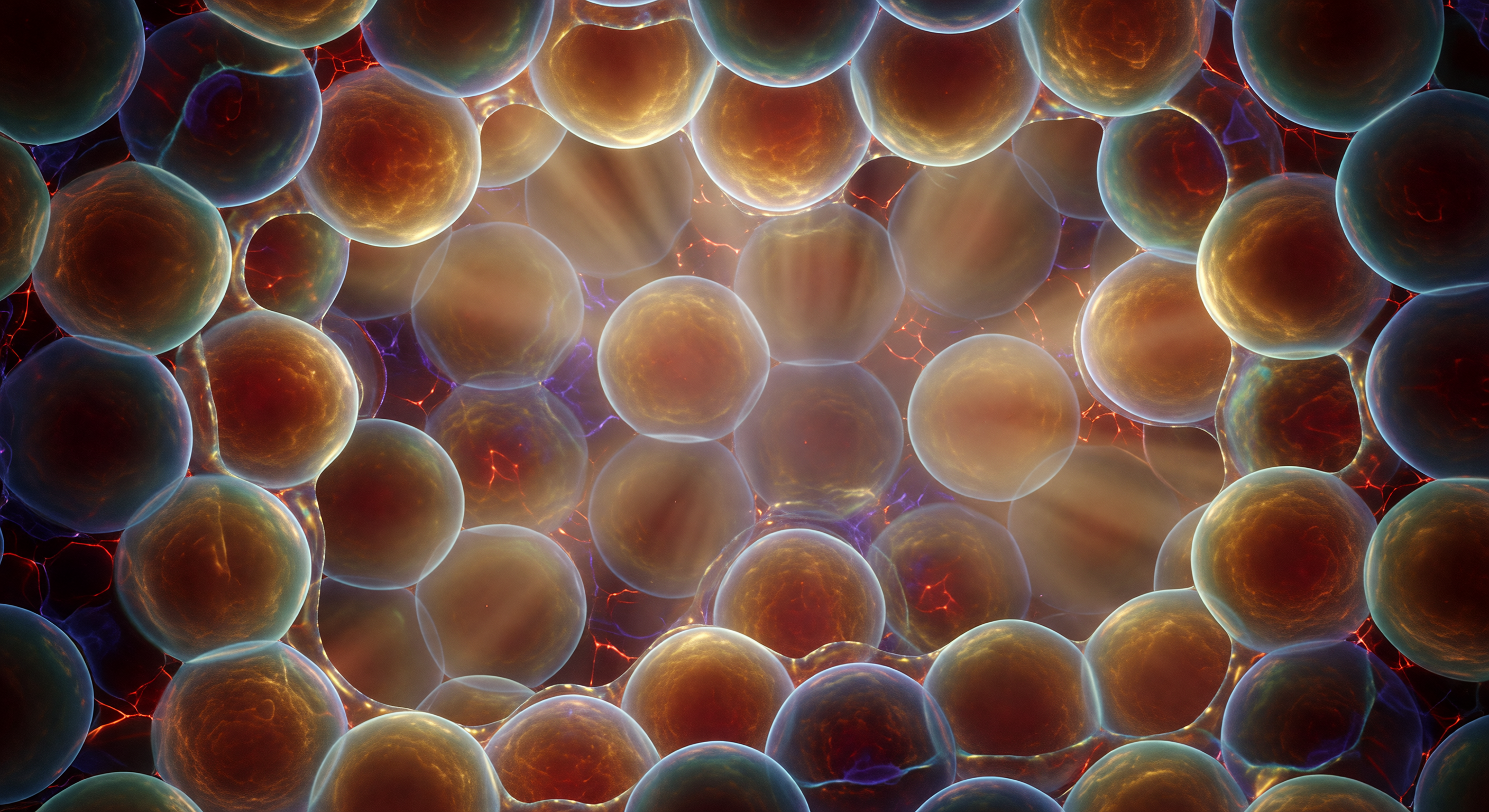
At the geometric center of a lead-208 nucleus, there is no outward view — only inward, in every direction simultaneously, an absolute enclosure of overlapping amber-gold volumes pressing from no more than two femtometers away, their softly dissolving edges bleeding into one another the way candlelight diffuses through translucent mineral wax. These are the nucleon probability densities of 82 protons and 126 neutrons, each not a hard sphere but a smeared quantum presence with definite spin and isospin, arranged by shell-model structure yet packed to nuclear saturation density — approximately 2.3 × 10¹⁷ kilograms per cubic meter, the densest stable configuration of matter in the observable universe short of a neutron star. The interstices between these lobes are not empty: the QCD vacuum itself is a churning condensate of deep crimson and burnt sienna, threaded with momentary veins of cold indigo where virtual quark-antiquark pairs and gluon fields pool and dissolve, the vacuum energy not zero but seething at a scale of hundreds of MeV per cubic femtometer. There is no shadow here because there is no external source of illumination — every amber mass glows with intrinsic ochre radiance, every interstice pulses with its own condensate luminescence, and the entire medium trembles at a frequency corresponding to nuclear vibration periods of roughly ten sextillionths of a second, too fast to resolve into discrete events, felt only as a geological stillness that is simultaneously violent beyond all ordinary measure.
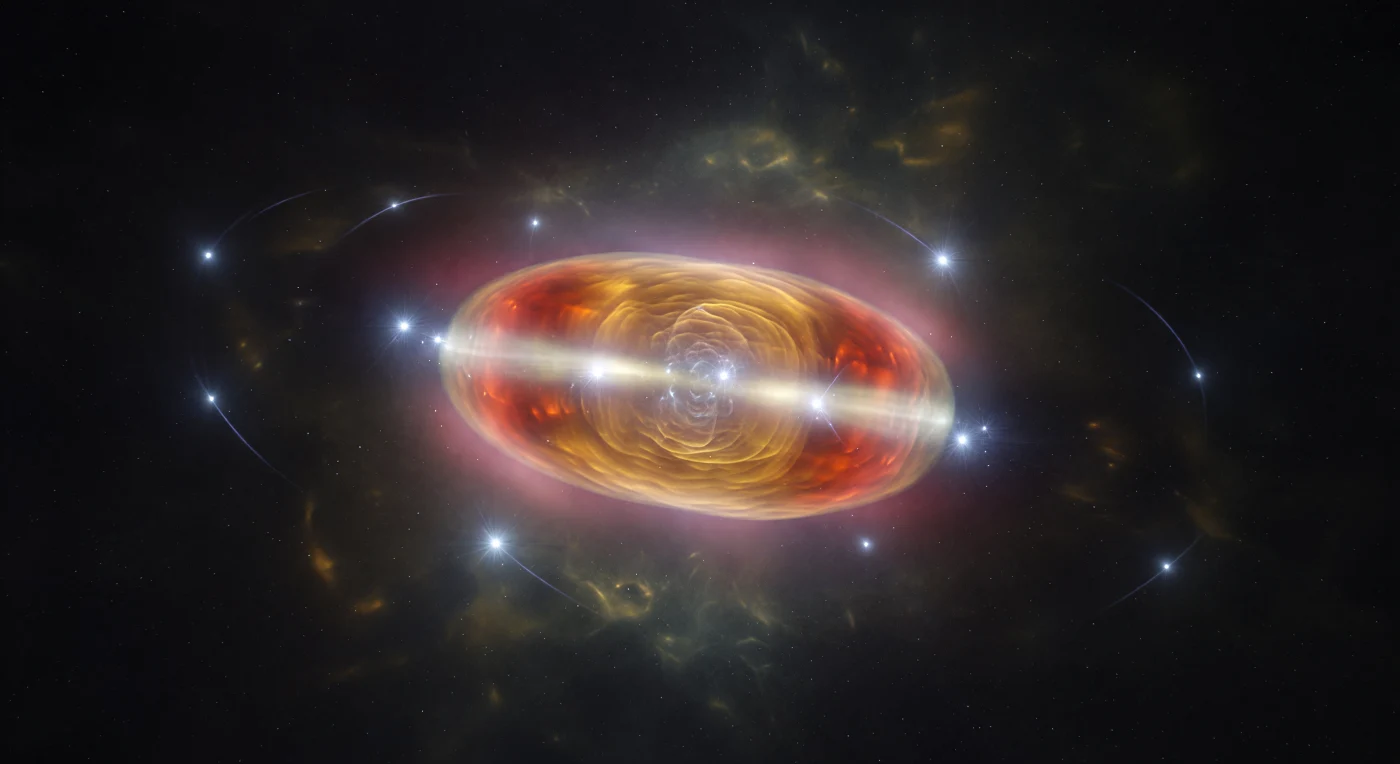
Hanging in the absolute dark of nuclear space, you face an elongated body of self-luminous matter — an erbium-168 nucleus stretched along its rotational axis into a form somewhere between a rugby ball and a burning drop of superheated mercury, its amber-gold surface rippling with the slow pulse of confined nuclear fluid. The nucleus is a deformed prolate rotor, its asymmetric shape arising from the collective behavior of 68 protons and 100 neutrons whose shell-structure filling favors an elongated equilibrium geometry; spinning at angular momenta exceeding forty units of ℏ, it rotates so rapidly that the equatorial belt smears into a continuous pale gold-white band while the poles retain a deeper, compressed crimson-amber density. Around the equatorial plane, needle-sharp blue-white detonations appear and vanish in fractions of a yoctosecond — gamma-ray photons emitted as the nucleus cascades sequentially down its rotational energy band, each electromagnetic transition carrying away two units of angular momentum and leaving a faint curved afterimage arc dissolving into the surrounding vacuum. That vacuum is not empty: a diffuse violet-rose nuclear halo bleeds outward a few femtometers from the surface, and the space between the afterglow arcs shimmers with the barely-visible granularity of the QCD vacuum — gluon condensate threading the dark like greenish-gold veins of light pressed into the fabric of nothingness itself.
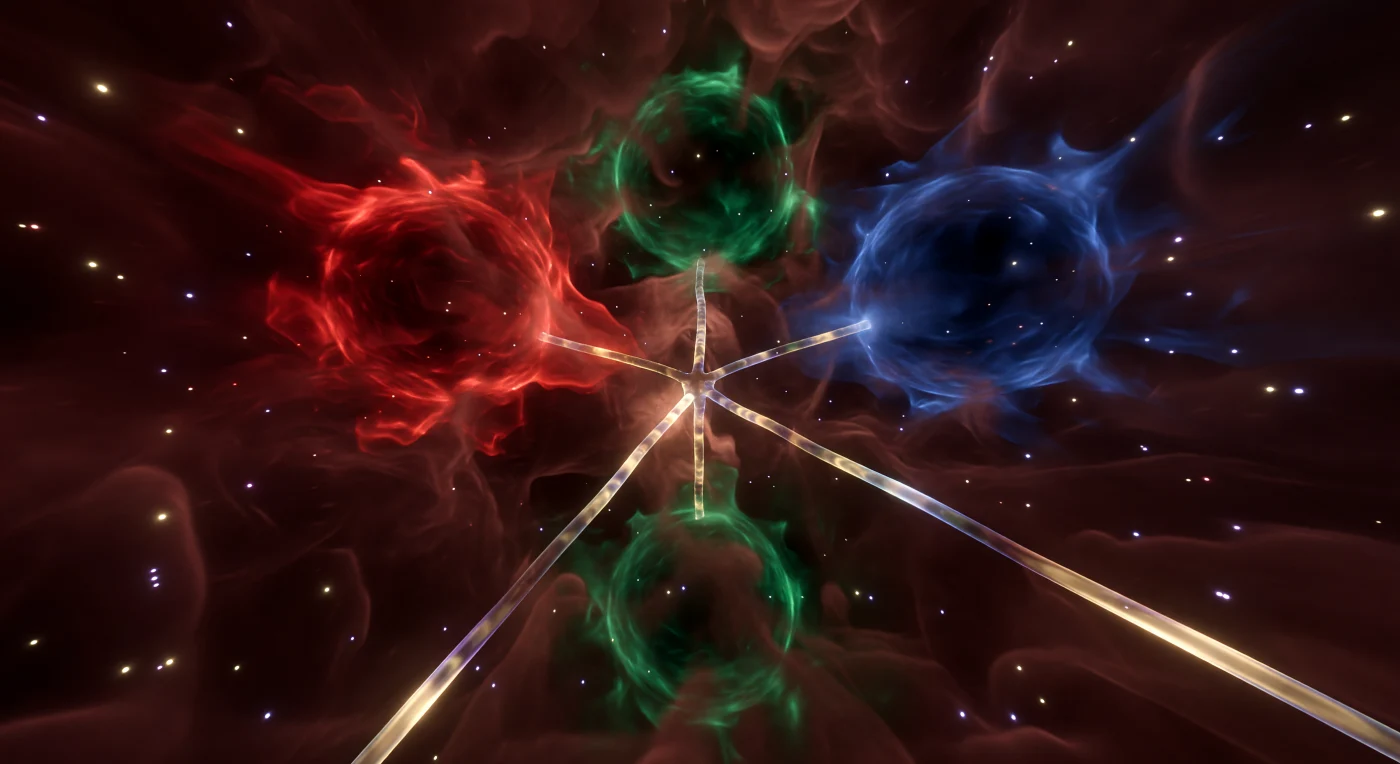
Three colossal presences fill the surrounding space — one hemorrhaging crimson, one the deep verdigris of ancient copper lit from within, one a cobalt so saturated it borders on void — their edges dissolving into luminous tendrils that converge at a Y-shaped junction of gold-white incandescence, the whole arrangement connected by taut, iridescent flux tubes whose surfaces shimmer between amber and ivory like superheated mineral under compression. This is the interior of a single proton, and what anchors these three presences are the up, up, and down quarks themselves, each carrying one of the three color charges of quantum chromodynamics — red, green, blue — bound together by the exchange of gluons whose collective field energy forms the flux tubes visible here as luminous cylindrical ropes, the confinement mechanism ensuring that separating these quarks would cost more energy than simply creating new ones, making escape thermodynamically impossible. The surrounding medium is not vacuum but the QCD gluon condensate, a churning burgundy and umber sea of virtual glue that constitutes most of the proton's mass, its turbulence operating on timescales of 10⁻²³ seconds while virtual quark-antiquark pairs flash into and out of existence throughout its volume like bioluminescent sparks in a lightless trench — white-gold paired with pale violet, each annihilation complete before any classical observer could register it. The sense of crushing depth and pressure that radiates from every direction is not metaphor: nuclear matter density here reaches 2.3 × 10¹⁷ kilograms per cubic meter, and the energy density stored in these few cubic femtometers exceeds anything in stable matter anywhere in the observable universe.
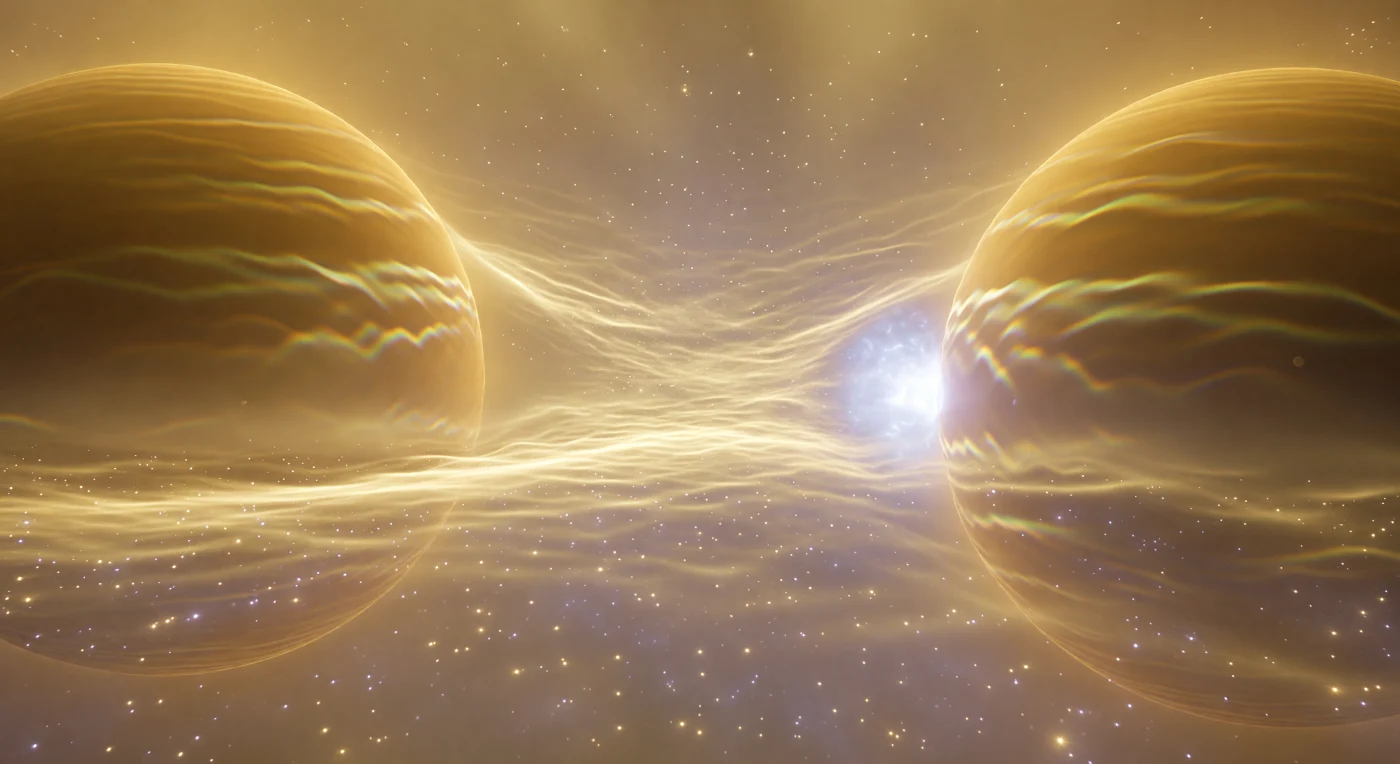
Between two colossal nucleon-worlds separated by barely two femtometers, the visual field is consumed by a pair of immense amber-gold spheres whose softly diffuse surfaces bleed into the surrounding medium through layers of honey-colored haze, their boundaries dissolving rather than ending, their interference fringes shifting like iridescent laminations across molten bronze. The intervening space between them is anything but empty — the QCD vacuum presses through as a faint violet-gray corpuscular granularity, flickering with transient sparks of cream and lilac that appear and vanish before resolving into anything definite, the visible texture of a ground state seething with virtual quark-antiquark pairs and gluon condensates. Threading through this restless medium, a pale-yellow compression wavefront travels as the signature of virtual pion exchange — the Yukawa mechanism that provides the intermediate-range attraction of the nuclear force — its leading edge sharpened to a white-gold ridge, its passage subtly refracting the dim glow behind it, the intervening space bowing gently inward as though the vacuum itself were under tension along the axis binding these two masses together. Then, at closest approach, a sudden hard bloom of white-blue radiance erupts from the nearest point between the surfaces — the repulsive flare of omega-meson exchange, the short-range force that prevents nucleon collapse — blazing ice-white at its core and diffusing outward through rings of pale cobalt before the amber continuum reclaims everything. This is nuclear matter at its most intimate: two of the densest stable objects in the observable universe, each containing nearly a billion tonnes per cubic centimeter, held apart by the same exchange forces that bind them.
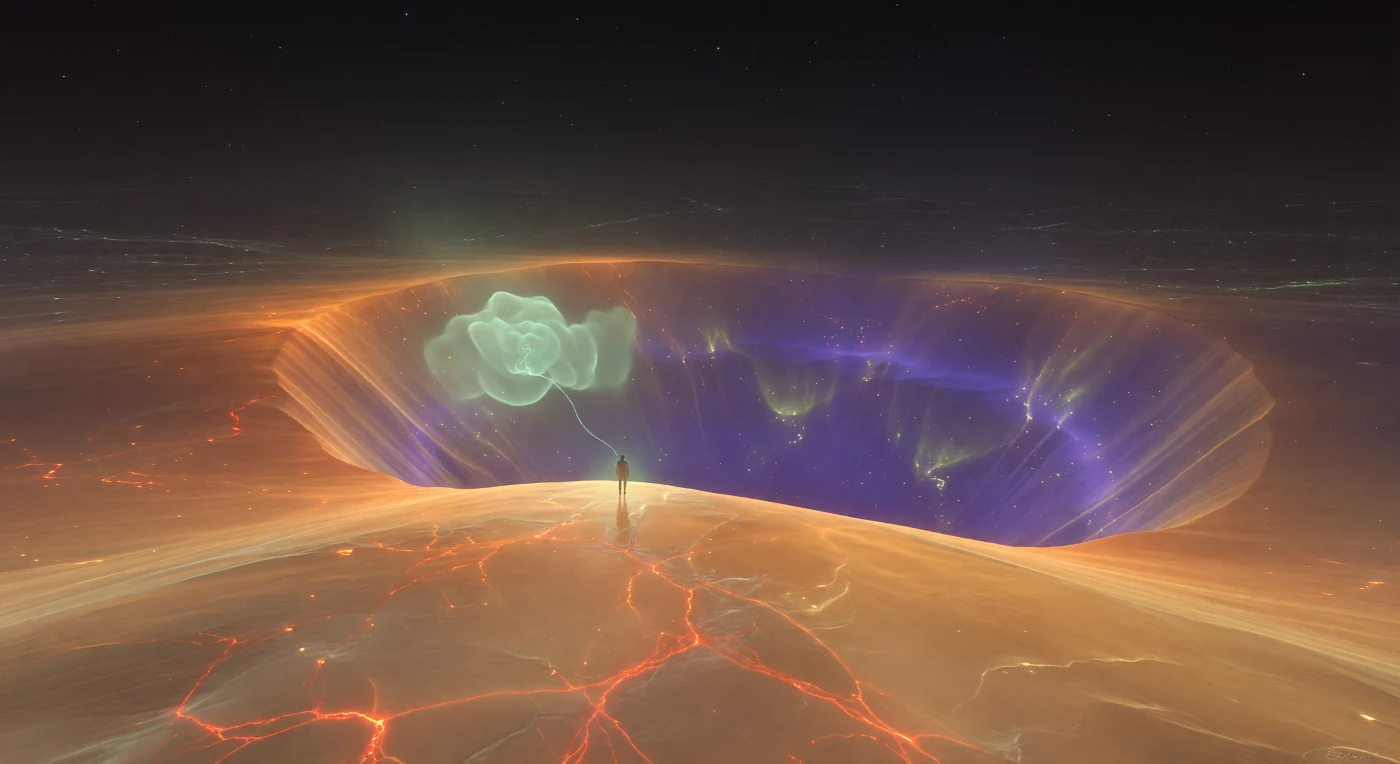
You stand at the crest of a ridge that is not made of stone but of frozen repulsion — the Coulomb potential of a uranium-238 nucleus made visible, glowing amber-orange with the residue of electromagnetic force between 92 protons compressed into a sphere barely seven femtometers across. Behind you the ground plunges away in a near-vertical caldera, its inner walls radiating cold violet and indigo light that emanates not from any surface but from the nuclear medium itself, a material at densities of 2.3 × 10¹⁷ kilograms per cubic meter where nucleons move at roughly a third the speed of light and the fundamental clock tick of the world runs at ten-septillionths of a second. Ahead, the ridge descends through warm saffron into pale amber and then into the chromatic near-black of the quantum vacuum, which is not emptiness but a seething condensate of virtual quarks and gluon fields held just below the threshold of permanence — the faint granular shimmer at the far horizon is the vacuum fluctuating, not resting. Below you on the inner wall, a semi-transparent cluster of pale jade light drifts against the amber barrier, its edges dissolving into the surrounding medium without ever forming a true surface, because it is not a particle in any classical sense but an alpha cluster whose wavefunction — two protons, two neutrons bound in a helium-4 configuration — extends a cool jade tendril directly through the solid-seeming Coulomb barrier, occupying the same space as the warm orange rock in a quantum superposition that, given enough time measured in anything from microseconds to billions of years, will resolve into escape: tunneling, the process by which uranium slowly becomes lead, one ghost-green tendril at a time.
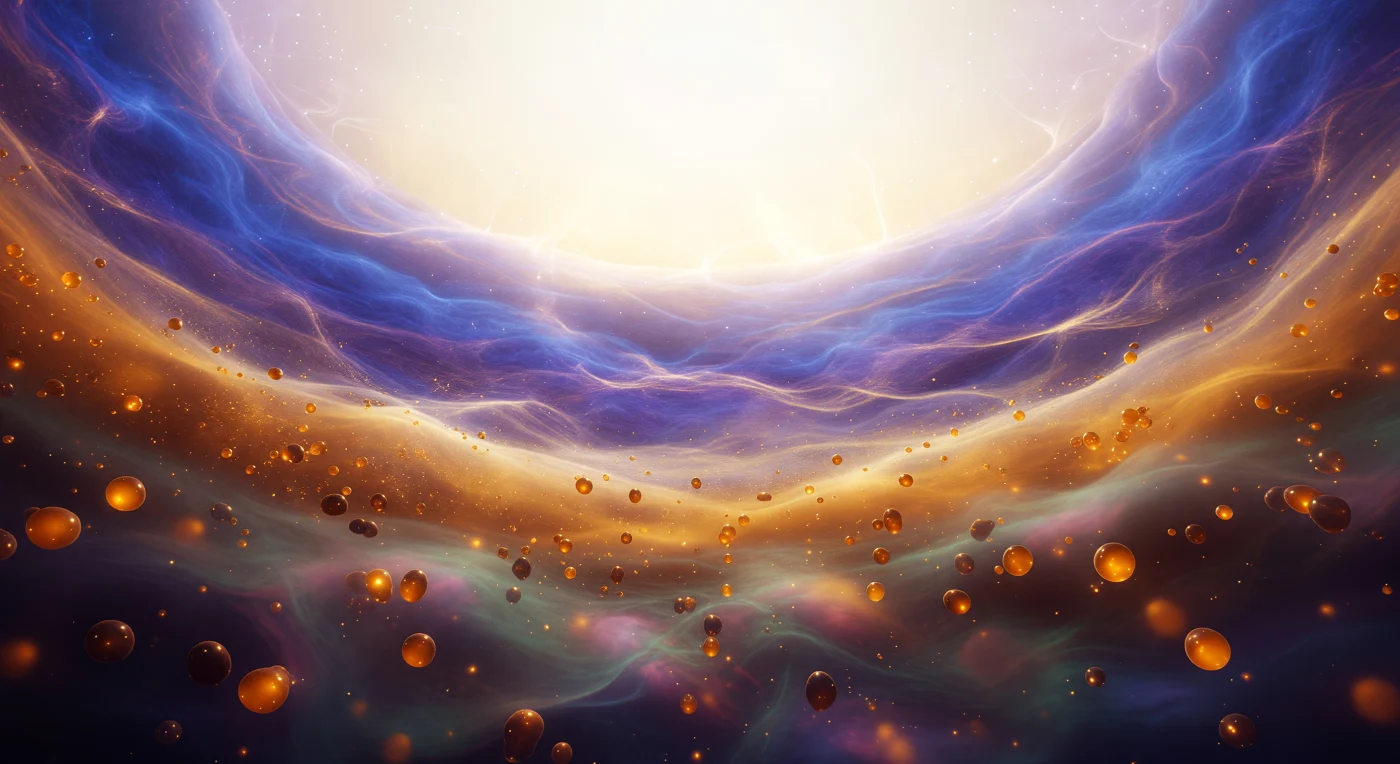
You stand at the inner surface of a boundary that should not exist — the curved, self-luminous threshold where a quark-gluon plasma, hotter than any state the present universe sustains, surrenders its formlessness and condenses into the first coherent nucleons and pions ever to exist. The plasma interior blazes overhead in white-gold obliteration, cooling through electric violet across distances measured in fractions of a femtometer, a temperature gradient so steep it encompasses the entire history of matter's emergence within a spatial span smaller than a single proton diameter. At the curved amber shell of the hadronization boundary, nascent nucleons crystallize out of the luminous heat-haze with an almost botanical patience — asymmetric, still trembling with thermal memory, their lit faces glowing caramelized orange where the plasma blazes against them and fading into near-shadow on their cooler sides. Between them, the inter-nucleon medium is never truly void: the QCD vacuum seethes with a faint iridescent condensate of virtual quark-antiquark pairs and gluon fields, a structured jade-and-rose mist that pulses at a grain scale finer than the nucleons themselves, a visible reminder that at this depth of reality, empty space carries negative energy density and the distinction between matter and vacuum is a question of temperature alone. This is the most extreme phase transition the universe performs — not a freezing but a becoming, formlessness learning, in the span of yoctoseconds, to have mass.
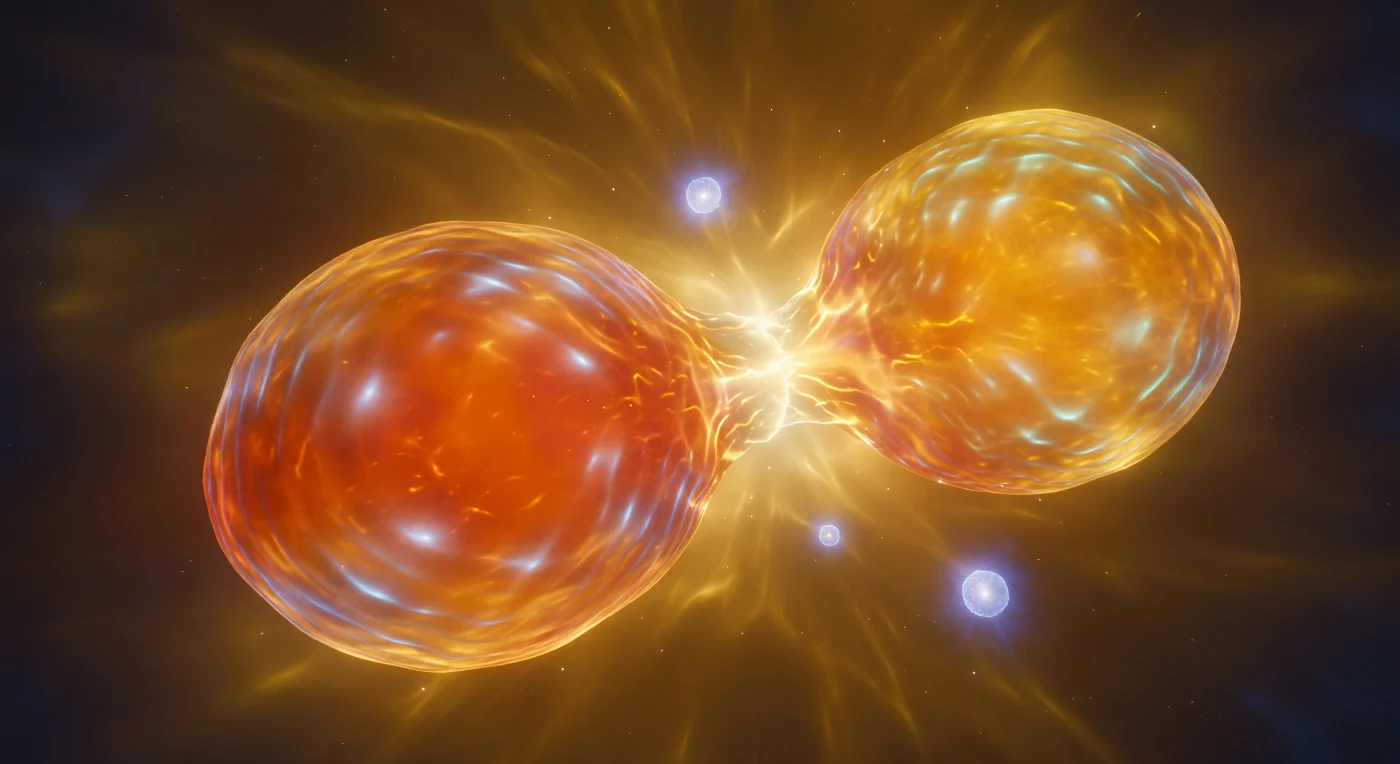
Before you, a colossus of nuclear matter dominates every direction — a uranium-235 nucleus caught in the final convulsion of fission, its bulk stretched into two enormous lobes of incandescent amber-orange connected by a neck of nuclear fluid so constricted it has become nearly transparent, a membrane of quark-gluon matter thinned to its absolute limit before the laws of QCD can hold it no longer. The scission flash erupts at that waist with the violence of two hundred million electron-volts of Coulomb repulsion releasing in a single yoctosecond pulse — a white-gold detonation that is less an outward explosion than a fundamental severing, the point where the strong force's reach simply runs out and electromagnetism takes catastrophic command. The two asymmetric fragments — a deep orange-red behemoth and a smaller, more frantically oscillating yellow-orange body — are already accelerating apart on their mutual electric hatred, their surfaces rolling with quadrupole oscillations as they shed the excess energy of their own deformation in cold blue-white gamma ripples, the nuclear matter within them still sloshing like a fluid that has never decided whether it is liquid or quantum field. Drifting outward in random directions, two or three compact spheres of brilliant blue-white light — free neutrons, carrying no charge and therefore no obligation to anything — move through a vacuum that is not empty but faintly luminous, threaded with gluon condensate energy, the seething QCD ground state that fills every cubic femtometer of this primordial, mass-saturated space.
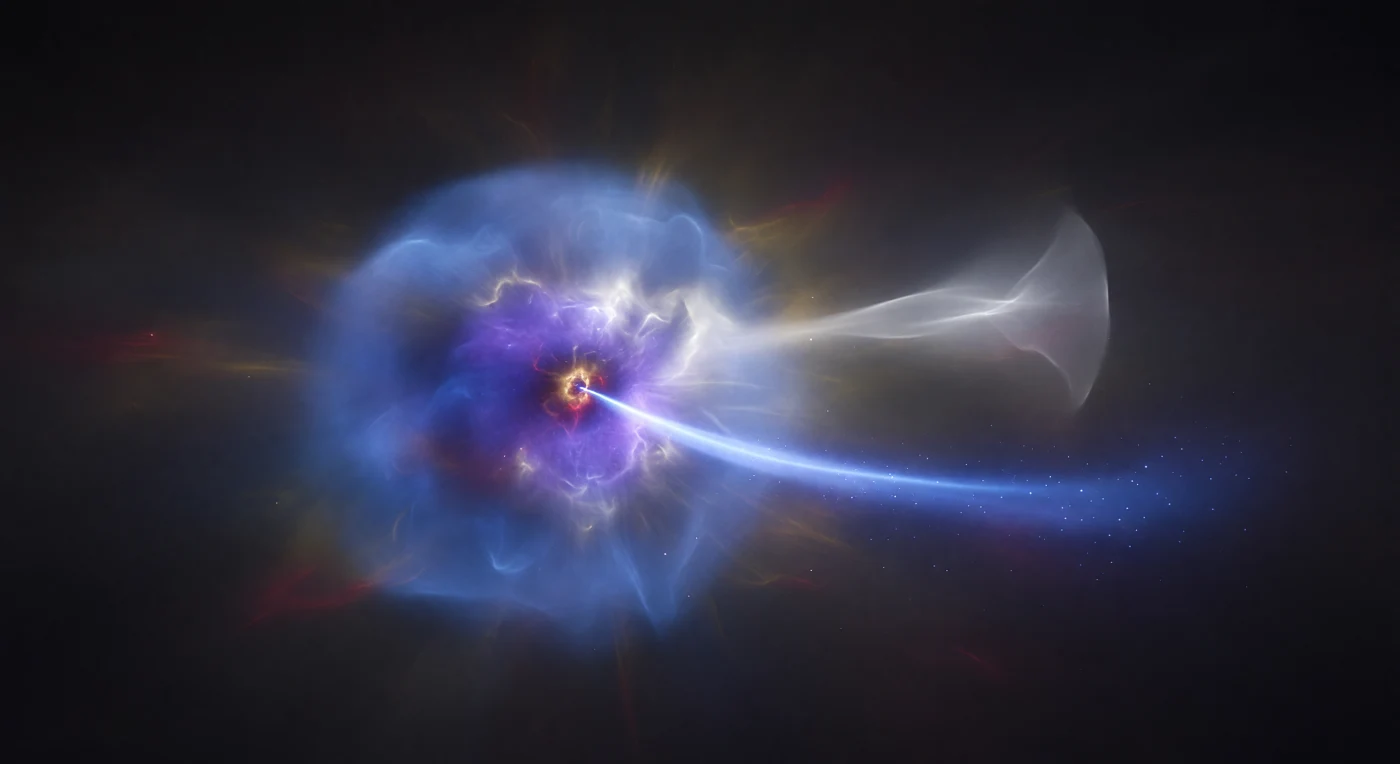
You are suspended at a distance of three femtometers from an isolated neutron, close enough that its probability cloud fills your entire field of awareness — not a surface, but a vast breathing volume of cool blue-indigo luminosity, its edges dissolving into gossamer azure veils that press against the surrounding vacuum like the slow exhale of something immeasurably dense. The vacuum itself is not empty but faintly luminescent, threaded with amber and crimson — the perpetual low fire of the QCD condensate, virtual quark pairs flickering in and out of existence across a medium whose energy density no ordinary material can approach. Then, without prelude, the decay: the neutron's entire internal field restructures in a single convulsive instant, its cool blue collapsing inward to a bruised violet implosion before detonating outward in a white-violet burst that rewrites the local geometry of light — this is the weak force at work, a down quark converting to an up quark via W boson exchange, a process so fundamental it transforms the identity of matter itself. What remains is a tighter amber-red knot of proton, its edges sharper and warmer than the diffuse cloud that preceded it, while a coherent electric-blue arc of electron wavefront expands in one direction and a diaphanous pale cone of antineutrino probability drifts silently in the other, carrying away the conserved lepton number of the transaction in a ghost of a wavefront barely distinguishable from the settling, violet-braided vacuum.
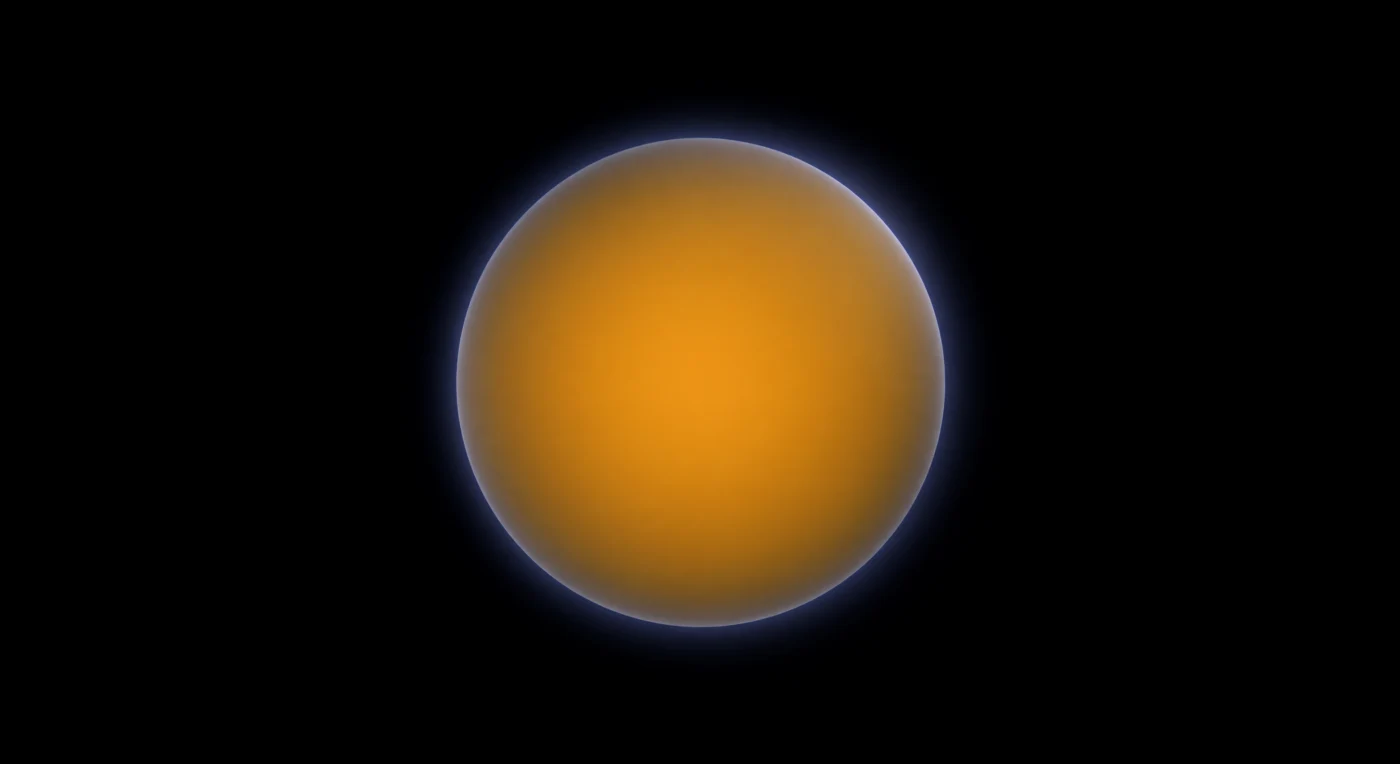
From this vantage point, suspended twenty femtometers from the surface, the lead-208 nucleus fills the visual field as an amber-gold sphere of almost architectural stillness, its interior saturated with the compressed luminosity of binding energy and color-charge fields rendered visible — a warmth like sunlight trapped in deep resin, glowing from within because at this scale there is no external illumination, no photon small enough to carry news from outside. The surface resolves the Woods-Saxon nuclear density profile: not a hard boundary but a steep, precise gradient where saturated interior amber dissolves into vacuum over a single femtometer, the sharpest material interface imaginable yet still irreducibly a gradient, the nuclear density falling from its plateau value of roughly 2.3 × 10¹⁷ kilograms per cubic meter to nothing in a distance shorter than the diameter of a proton. Encircling this core is the feature that arrests sustained attention — a thin blue-violet corona, cooler and more diffuse than the amber interior, the collective probability density of the neutron excess that congregates just beyond the proton-rich bulk, a ghost-shell half a femtometer proud of the main surface, marking this nucleus as something with more neutrons than any symmetric count would require. What is most extraordinary is the absence of dynamics: the doubly magic shell closures at both proton number 82 and neutron number 126 have exhausted every available surface mode, and the result is a stillness so complete it reads not as inertia but as resolution — a system that has descended to its lowest energy and settled there with total commitment, spherical and luminous and motionless against a vacuum so absolute it carries physical weight.
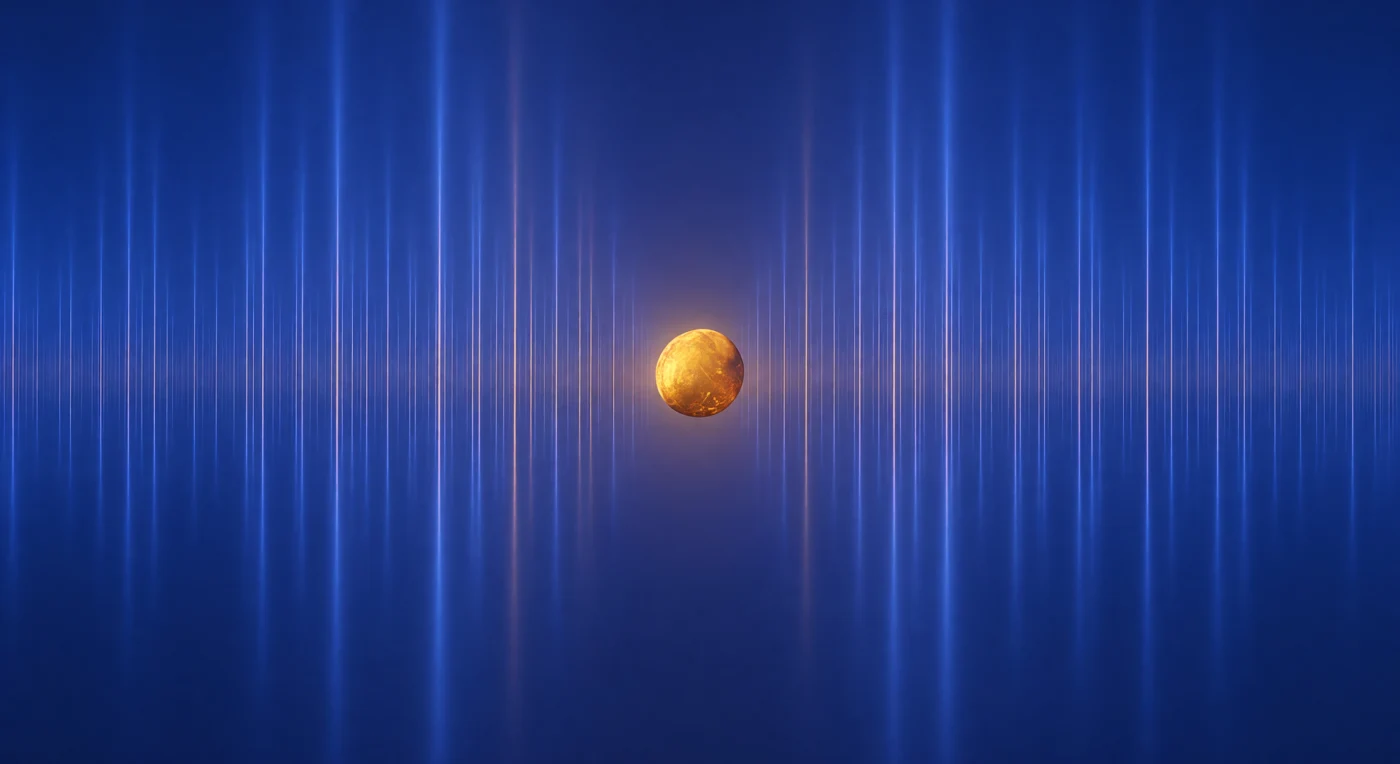
At five femtometers from a solitary proton, the world has been replaced entirely by field — a cathedral of electric-blue columns streaming vertically through the vacuum in every direction, equidistant and infinite, each one a volumetric filament of ordered magnetic force generated by a seven-tesla field whose strength, at this proximity, feels less like measurement and more like weather. At the absolute center of this luminous forest floats the proton itself, a dense amber sphere barely a femtometer across, its interior furnace-gold radiance spilling outward to tint the nearest field lines a warm tangerine before the cold cobalt reasserts dominance. The proton is not still: its spin axis, rendered as a red-white directional arrow, is tilted away from the vertical field and sweeping out a steady precessional cone — the Larmor precession, a gyroscopic wobble driven by the torque the magnetic field exerts on the proton's intrinsic magnetic moment, here occurring at roughly three hundred megahertz, one full cone-sweep every few nanoseconds, a cadence almost geological in its patience compared to the yoctosecond violence of strong-force interactions happening simultaneously within the same femtometer volume. The paradox of the scene is total: this single quantum particle, containing ninety-nine percent of a hydrogen atom's mass at a density of two hundred million tonnes per cubic centimeter, precesses with the serene geometric regularity of a gyroscope on a frictionless bearing, its metronomic rotation the very physical principle that makes magnetic resonance imaging possible at human scales ten-billion times larger than this amber sphere suspended in its infinite blue field.
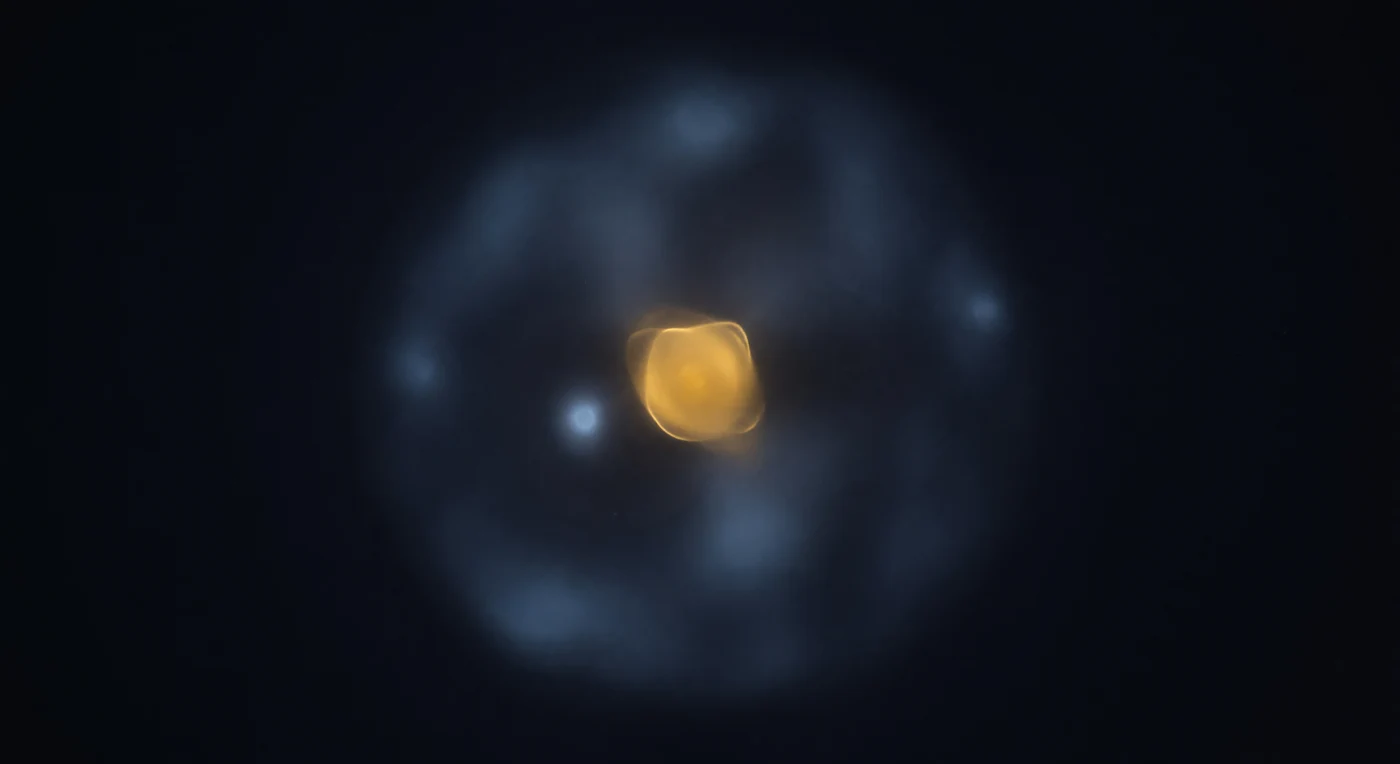
At thirty femtometers from its center, the lithium-11 nucleus presents one of the most extreme structural contrasts in all of matter: a ferociously dense amber core of nine bound nucleons — a lithium-9 kernel roughly two femtometers across, packed at nuclear saturation density near 2.3 × 10¹⁷ kilograms per cubic meter — adrift inside an immense quantum halo of two loosely bound neutrons whose wavefunctions diffuse outward to seven femtometers in every direction, making the whole system three times wider than its own compressed heart. These halo neutrons do not orbit classically; they exist as extended probability amplitudes, quantum-mechanically tunneling far beyond the range where the strong force can properly bind them, spending much of their existence in a classically forbidden region that would be pure vacuum at any larger scale. Occasionally the two halo neutrons exhibit di-neutron correlation — a transient pairing that appears as a slightly denser, cooler condensation drifting through the surrounding fog before dissolving back into the tenuous mist within yoctoseconds of nuclear time. The boundary between nucleus and void is not a surface but a gradient, a slow surrender of quantum density into structureless absence, so that standing inside the halo feels less like inhabiting matter and more like witnessing the last phosphorescent breath of something immeasurably ancient fading into an absolute dark.
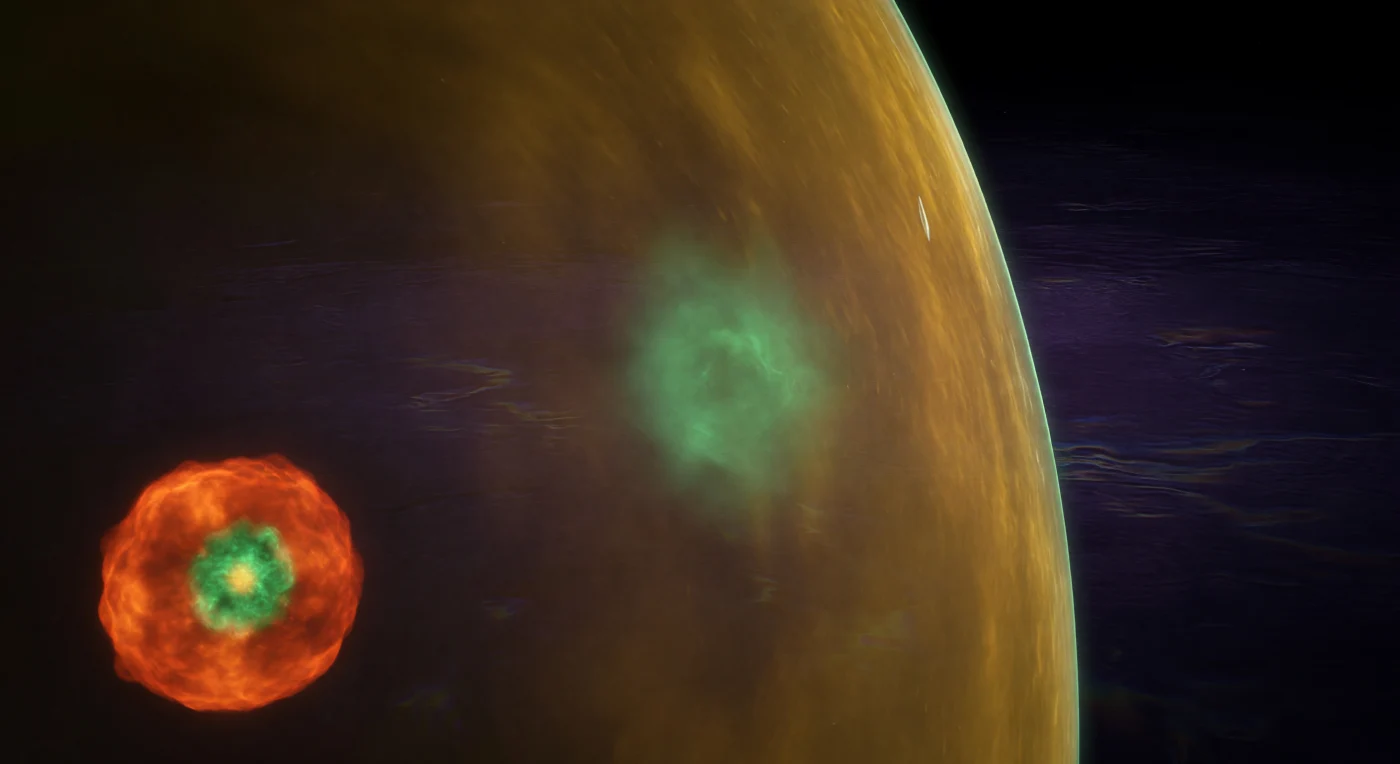
From twenty femtometers out, the scene resolves into three worlds held in uneasy simultaneity: a compressed furnace of deep orange-red nuclear matter anchoring the left — radium-226, eighty-eight protons and one hundred thirty-eight neutrons crushed into a volume barely ten femtometers across at nuclear-matter densities of 2.3 × 10¹⁷ kilograms per cubic meter — while a vast hemisphere of amber-gold Coulomb barrier curves overhead like a dome of pressurized resin, its warmth deepest at the nuclear surface and bleaching toward pale gold at the outer lip where it dissolves into vacuum. Nested within that incandescent mass, a coherent alpha cluster — two protons and two neutrons bound into a helium-4 substructure — blazes in concentrated emerald, and by the logic of quantum tunneling it simultaneously inhabits the barrier itself as a jade mist exponentially attenuated with distance, its wavefunction decaying through classically forbidden space according to the Gamow factor, the amplitude collapsing across each femtometer of barrier thickness. Where the barrier ends, an almost imperceptible pale-mint shimmer clings to the outer vacuum, so faint it reads as a trick of the eye — and that extreme attenuation is not aesthetic choice but precise physics, encoding in visual terms the 1,600-year half-life that follows from the near-vanishing transmission probability of the tunneling integral. The darkness beyond is not empty but textured with the faint iridescent sheen of the QCD ground state, a vacuum that carries genuine energy density and presses back against everything that moves through it.
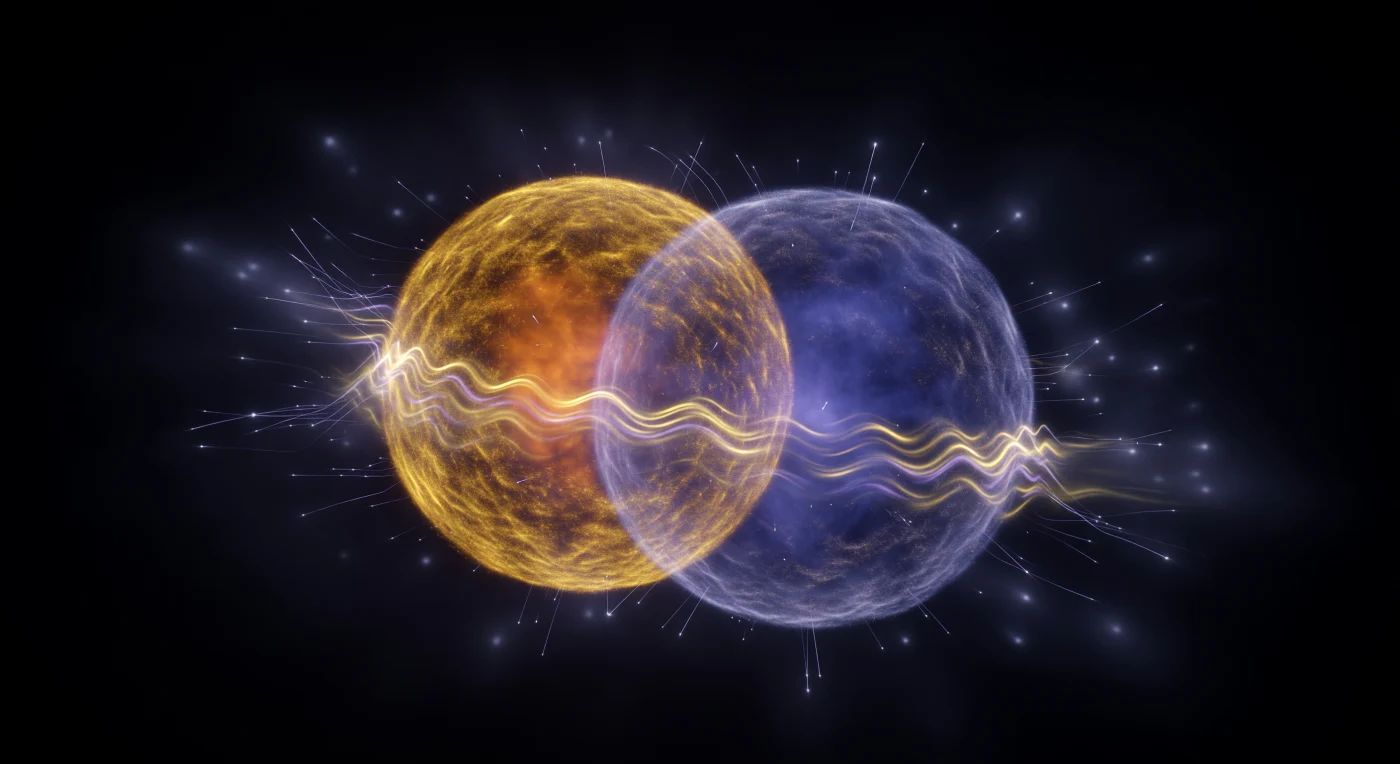
A vast, breathing world of two intermingling masses fills every direction — one hemisphere radiating deep amber and molten gold, the other pulsing in cool blue-violet and indigo, their shared boundary trembling along a wavering equatorial seam where interference fringes shimmer in pale citrine and lavender. This is the giant dipole resonance of a nickel-58 nucleus: a collective mode in which the entire proton distribution oscillates coherently against the entire neutron distribution, the two quantum fluids sloshing through each other at roughly four hundred zettahertz in the highest-energy collective vibration that a finite nucleus can sustain. The surface between them is neither solid nor liquid but a continuously rippling density field, sculpted into quadrupole standing waves whose crests catch and scatter self-generated light like slow oil-waves on a body of unimaginable compactness — nuclear matter running at two hundred million trillion kilograms per cubic meter, the densest stable form of matter in the observable universe. From this vantage, thin filaments of pale violet-white radiance extend outward from the oscillating charge boundary into the surrounding vacuum: electromagnetic energy bleeding away as gamma radiation, asymmetric and wispy, brightest where the proton-rich crescent is most displaced and fading as the oscillation reverses phase, the resonance slowly hemorrhaging its energy into absolute darkness. Behind the nucleus, the void itself is not quite empty — ghost-pale bluish-white blooms flicker and vanish at no perceptible duration, hinting at the seething virtual structure of the QCD vacuum, a texture of condensed gluon fields that pervades even the space between nucleons, making the darkness feel dense rather than absent.
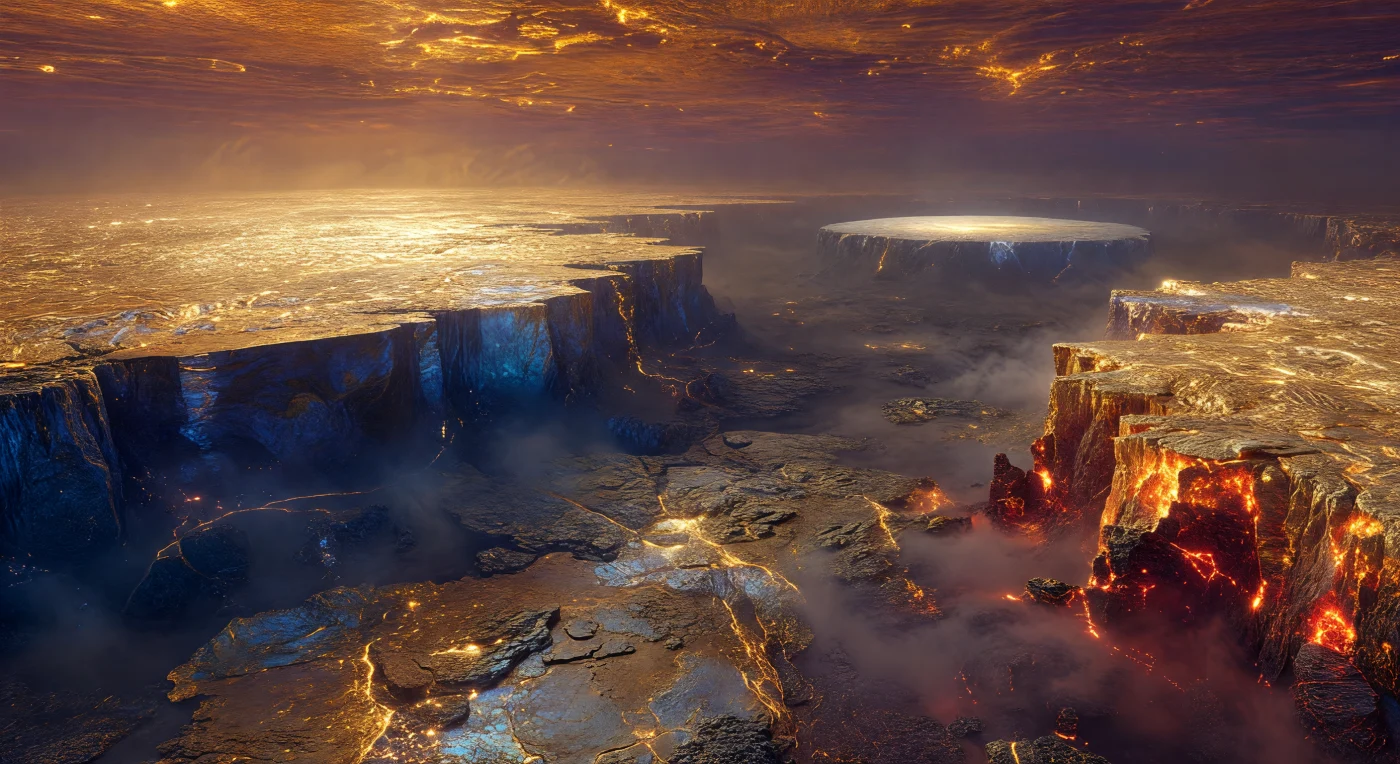
You stand on the most stable ground matter can achieve — a luminous iron-nickel plateau where the binding energy per nucleon reaches its absolute maximum of roughly 8.8 MeV, the deepest point in the nuclear landscape, a terrain so energetically favored that iron-56 and nickel-62 anchor the entire architecture of stellar nucleosynthesis. From this hammered-amber surface, the Valley of Stability stretches away in a long diagonal descent flanked by two opposing walls: to the left, a deep cobalt escarpment plunging toward the neutron drip line where nuclear binding simply cannot accommodate additional neutrons, its face darkening through indigo into void; to the right, a crumbling ochre-and-scarlet cliff where Coulomb repulsion between protons fractures the terrain into unstable ledges shedding glowing fragments into warm crimson fog. The valley floor runs ahead through bronze and pewter into progressively darker, pitted terrain where increasingly heavy nuclei lose their inner coherence, their glow dimming and flickering with brief gamma pulses before collapsing — yet far on the horizon, one faint silver-gold plateau floats in isolation above the surrounding darkness, the theorized island of superheavy stability near proton number 114, where closed nuclear shells are predicted to briefly restore binding against all surrounding instability. The entire scene is compressed into a spatial domain measuring only a few femtometers across, yet every surface communicates the sheer density of nuclear matter — 2.3 × 10¹⁷ kilograms per cubic meter — and the amber-violet medium pressing down from above is not atmosphere but the structured QCD vacuum itself, a condensate of virtual quarks and gluons whose energy density is as real and measurable as the ground beneath your feet.