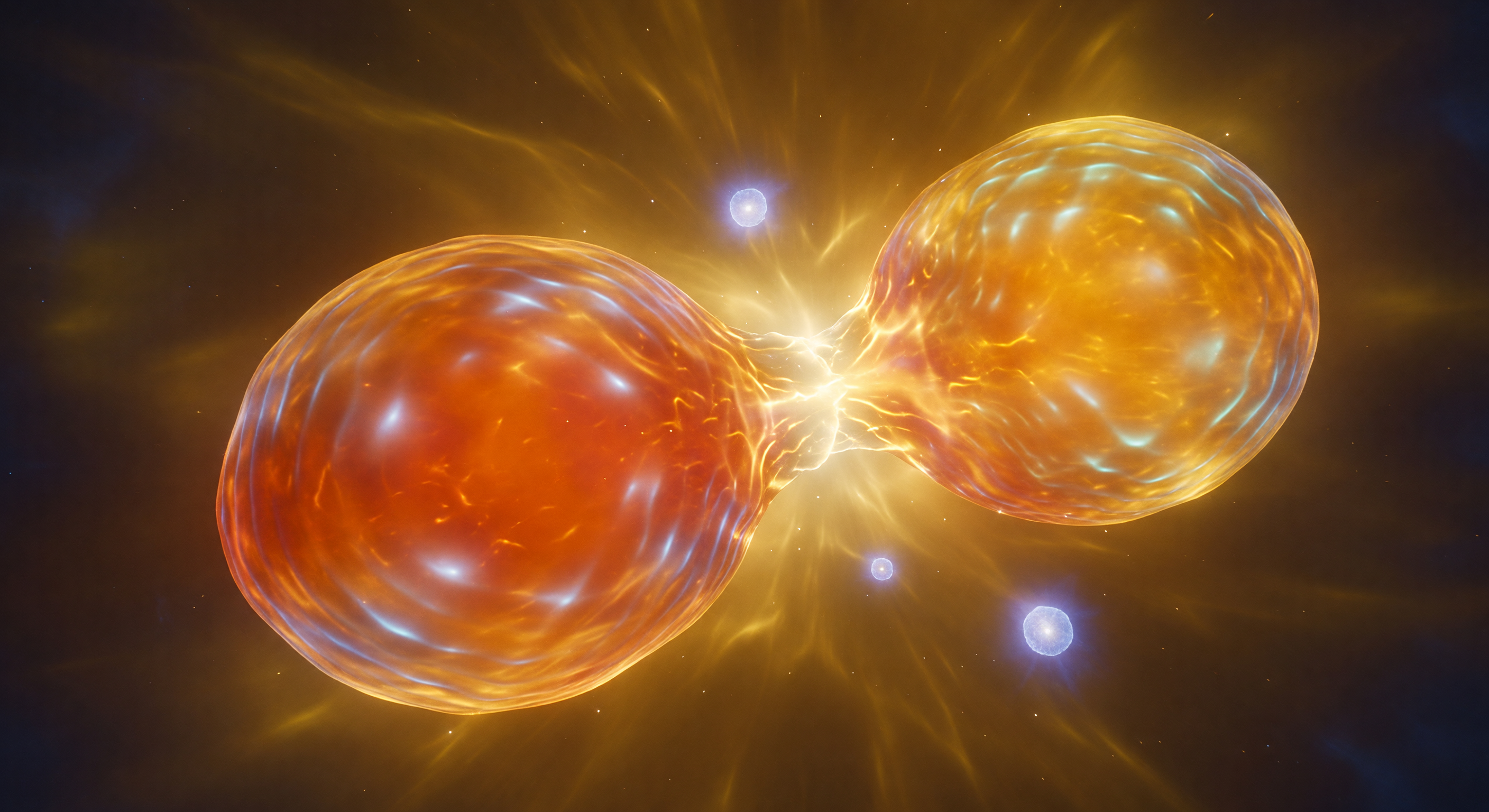
Before you, a colossus of nuclear matter dominates every direction — a uranium-235 nucleus caught in the final convulsion of fission, its bulk stretched into two enormous lobes of incandescent amber-orange connected by a neck of nuclear fluid so constricted it has become nearly transparent, a membrane of quark-gluon matter thinned to its absolute limit before the laws of QCD can hold it no longer. The scission flash erupts at that waist with the violence of two hundred million electron-volts of Coulomb repulsion releasing in a single yoctosecond pulse — a white-gold detonation that is less an outward explosion than a fundamental severing, the point where the strong force's reach simply runs out and electromagnetism takes catastrophic command. The two asymmetric fragments — a deep orange-red behemoth and a smaller, more frantically oscillating yellow-orange body — are already accelerating apart on their mutual electric hatred, their surfaces rolling with quadrupole oscillations as they shed the excess energy of their own deformation in cold blue-white gamma ripples, the nuclear matter within them still sloshing like a fluid that has never decided whether it is liquid or quantum field. Drifting outward in random directions, two or three compact spheres of brilliant blue-white light — free neutrons, carrying no charge and therefore no obligation to anything — move through a vacuum that is not empty but faintly luminous, threaded with gluon condensate energy, the seething QCD ground state that fills every cubic femtometer of this primordial, mass-saturated space.
Other languages
- Français: Éclair de Fission Uranium
- Español: Destello de Fisión Uranio
- Português: Flash de Fissão do Urânio
- Deutsch: Uran Spaltungsblitz
- العربية: وميض انشطار اليورانيوم
- हिन्दी: यूरेनियम विखंडन प्रकाश
- 日本語: ウラン核分裂の閃光
- 한국어: 우라늄 핵분열 섬광
- Italiano: Lampo di Fissione Uranio
- Nederlands: Uranium Splijtingsflits