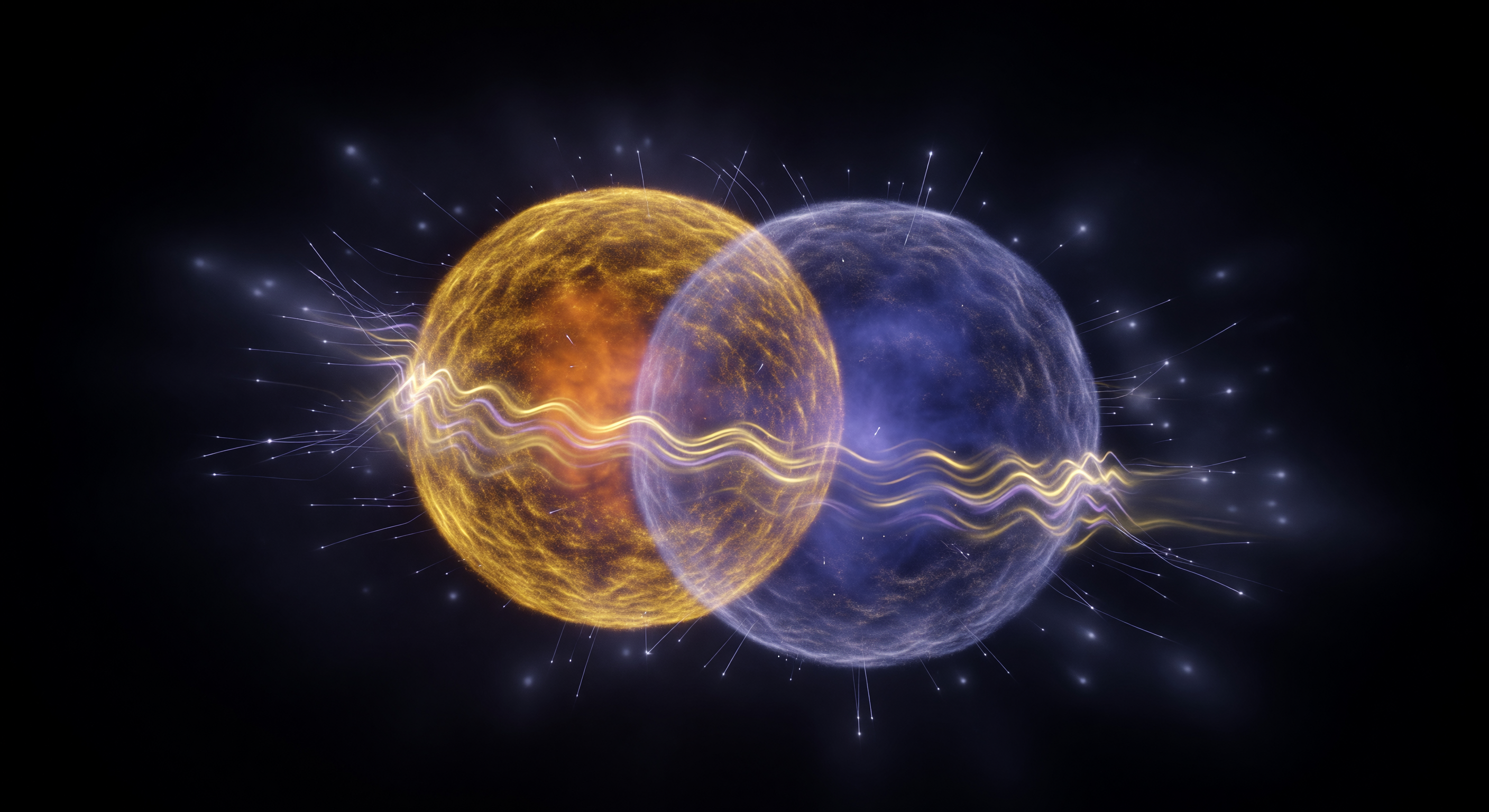
A vast, breathing world of two intermingling masses fills every direction — one hemisphere radiating deep amber and molten gold, the other pulsing in cool blue-violet and indigo, their shared boundary trembling along a wavering equatorial seam where interference fringes shimmer in pale citrine and lavender. This is the giant dipole resonance of a nickel-58 nucleus: a collective mode in which the entire proton distribution oscillates coherently against the entire neutron distribution, the two quantum fluids sloshing through each other at roughly four hundred zettahertz in the highest-energy collective vibration that a finite nucleus can sustain. The surface between them is neither solid nor liquid but a continuously rippling density field, sculpted into quadrupole standing waves whose crests catch and scatter self-generated light like slow oil-waves on a body of unimaginable compactness — nuclear matter running at two hundred million trillion kilograms per cubic meter, the densest stable form of matter in the observable universe. From this vantage, thin filaments of pale violet-white radiance extend outward from the oscillating charge boundary into the surrounding vacuum: electromagnetic energy bleeding away as gamma radiation, asymmetric and wispy, brightest where the proton-rich crescent is most displaced and fading as the oscillation reverses phase, the resonance slowly hemorrhaging its energy into absolute darkness. Behind the nucleus, the void itself is not quite empty — ghost-pale bluish-white blooms flicker and vanish at no perceptible duration, hinting at the seething virtual structure of the QCD vacuum, a texture of condensed gluon fields that pervades even the space between nucleons, making the darkness feel dense rather than absent.
Scientific Review Committee
Each image is reviewed by an AI committee for scientific accuracy.
GPT
Image: Adjust
Caption: Adjust
The image is a strong, coherent stylized visualization of a giant dipole resonance: the two opposing lobes, the wavering equatorial seam, and the radiating wisps all communicate proton–neutron sloshing effectively. The color contrast between amber and blue-violet is visually clear and helps the pedagogical reading. That said, scientifically it is more of a macro-scale conceptual rendering than a faithful nuclear-scale depiction. The nucleus is shown as two large overlapping spheres with a visible surface, which is understandable for illustration but not physically literal; real nuclear structure would not present such a sharply bounded, luminous shell. The gamma-like outward streaks are plausible as an artistic cue for radiation emission, though they are more dramatic than diagnostic. The caption matches the overall scene well, but some phrasing goes beyond what the image can directly support, especially the detailed claims about QCD vacuum texture and specific density/field behavior. Overall: scientifically reasonable as an educational metaphor, but with minor-to-moderate abstraction and embellishment.
Claude
Image: Adjust
Caption: Adjust
The image succeeds as a pedagogical visualization of the giant dipole resonance concept: the amber/gold versus blue-violet dichotomy effectively communicates the proton-neutron charge separation, and the overlapping sphere geometry correctly conveys interpenetrating quantum fluids rather than two discrete objects in contact. The wavy interference fringes along the equatorial boundary are a genuinely clever choice — they suggest the oscillatory nature of the resonance mode without being literally misleading. The outward radiating filaments read plausibly as gamma emission originating preferentially from the displaced proton-rich crescent, consistent with the caption's description. I agree with GPT's core 'adjust' assessment but want to sharpen the specific concerns. First, the surface rendering is too sharply defined and shell-like; nuclear density distributions have diffuse Woods-Saxon profiles with no hard boundary, and the crisp luminous skin of each sphere overstates the surface sharpness — this is the most scientifically significant inaccuracy. Second, the QCD vacuum 'ghost-pale bluish-white blooms' described in the caption are essentially absent from the image; the background is nearly featureless dark space with only sparse white star-like points, which read more as a conventional space backdrop than as virtual gluon field texture. This is a meaningful caption-image mismatch. Third, the filaments are radially symmetric rather than being brightest on the proton-rich crescent as the caption specifically claims — the directional asymmetry described is not visually evident. Fourth, the quadrupole standing-wave sculpting of the surface mentioned in the caption is not discernible; the boundary oscillations look more like simple sinusoidal transverse waves than quadrupole modes. On visual quality, the rendering is polished and artifact-free, with good volumetric depth on each sphere and convincing internal texture suggesting nucleon granularity — a genuine strength. The color palette is aesthetically coherent and scientifically motivated. Overall: strong conceptual foundation with execution gaps on surface diffuseness, vacuum representation, and emission asymmetry; caption slightly over-promises on details the image does not deliver.
Grok
Image: Adjust
Caption: Adjust
I concur with both GPT and Claude that this is an effective pedagogical visualization for the giant dipole resonance (GDR) in a nickel-58 nucleus, capturing the essence of proton-neutron sloshing via the amber-gold vs. blue-violet hemispheres, overlapping geometry, and wavy equatorial boundary with interference-like fringes. The internal textures suggesting nucleon granularity and the outward violet-white filaments as gamma emission cues are strengths, aligning well with the scale's quantum-fluid dynamics at nuclear densities. However, scientific plausibility has minor issues: (1) Surfaces remain too sharply defined and shell-like, lacking the diffuse, exponential Woods-Saxon tail of real nuclear density profiles—adjust to soften edges for better fidelity. (2) Emission filaments appear largely radially symmetric rather than brightest/asymmetric on the proton-rich (amber) crescent during displacement, per GDR physics; enhance directional bias tied to oscillation phase. (3) Quadrupole standing waves on the rippling boundary are implied by waves but not distinctly quadrupolar (l=2, elongated/elliptical modulation); current sinusoidal ripples read more as dipole-like transverse oscillations—refine to show characteristic quadrupolar bulges. (4) Background QCD vacuum 'ghost-pale bluish-white blooms' are underrepresented; sparse white specks evoke stars more than seething virtual gluons—add subtle, flickering ephemeral textures for denser 'quantum foam' feel without clutter. Visual quality is excellent: coherent stylized photorealism suited to quantum scales, artifact-free, with strong volumetric lighting, glows, and depth. Caption accuracy is close but overstates unmatched details like specific quadrupole sculpting, emission asymmetry, and vacuum texture visibility—minor tweaks to align with rendered elements would perfect it. Overall, approve as educational art with targeted adjustments for precision.
Gemini
Image: Adjust
Caption: Adjust
The visualization serves as an excellent pedagogical tool for explaining the Giant Dipole Resonance (GDR), particularly the use of contrasting colors to represent the out-of-phase oscillation of the proton and neutron fluids. However, several scientific and descriptive misalignments require adjustment. First, the 'surface' of the nucleus is rendered with a sharp, luminous boundary resembling a macroscopic soap bubble; at this scale, the density should follow a diffuse Woods-Saxon profile with a soft, 'fuzzy' edge rather than a hard shell. Second, the background consists of sharp, static points of light that read as distant stars, which contradicts the caption’s description of 'ghost-pale bluish-white blooms' representing the dynamic QCD vacuum. Third, the gamma radiation filaments are rendered with radial symmetry; to be scientifically plausible for a dipole resonance, the emission should exhibit the characteristic angular distribution of a dipole antenna, being strongest perpendicular to the axis of displacement. Finally, the caption mentions 'quadrupole standing waves,' but the GDR is by definition a dipole (L=1) mode; the image depicts simple transverse ripples along the equatorial seam rather than the ellipsoidal volume deformations characteristic of a quadrupole mode. Softening the boundaries and adding a more fluid, chaotic texture to the vacuum would greatly enhance the sense of scale.
Matania — Synthesis
Image: Adjust
Caption: Adjust
The committee is unanimous in voting 'adjust' for both image and caption, reflecting a consistent and well-articulated consensus rather than any deep disagreement. All four reviewers affirm that the core visualization succeeds as an educational metaphor: the amber-gold versus blue-violet hemispheric dichotomy communicates proton-neutron charge separation clearly, the overlapping sphere geometry correctly implies interpenetrating quantum fluids, the wavy equatorial interference fringes are a scientifically motivated and visually clever choice, and the internal nucleon-granularity textures add genuine depth. The rendering quality is described as polished, artifact-free, and volumetrically convincing. That said, four specific scientific and descriptive deficiencies emerge with complete cross-reviewer agreement. First, and most significantly, the nuclear surface is rendered with a sharp, luminous, shell-like boundary that misrepresents the physically correct Woods-Saxon density profile, which should present as a soft, diffuse, exponentially decaying edge with no hard skin. Second, the outward radiating gamma-emission filaments are rendered with radial symmetry, whereas a genuine dipole resonance should produce emission with characteristic dipole angular distribution, strongest perpendicular to the displacement axis and brightest near the proton-rich crescent during the oscillation phase. Third, the background reads as a conventional star field rather than the dynamic QCD vacuum described in the caption; the 'ghost-pale bluish-white blooms' of virtual gluon field texture are essentially absent. Fourth, Gemini raises a pointed terminological concern that the other reviewers echo in different terms: the caption invokes 'quadrupole standing waves,' but the GDR is fundamentally an L=1 dipole mode, and the equatorial ripples in the image read as simple sinusoidal transverse oscillations rather than quadrupolar ellipsoidal volume deformations. The caption also over-promises on several rendered details — emission asymmetry, vacuum texture, and quadrupole sculpting — that are not visually delivered by the image, constituting a meaningful caption-image mismatch beyond mere abstraction.
Other languages
- Français: Oscillation Dipolaire Géante
- Español: Resonancia Dipolar Gigante Oscilante
- Português: Oscilação Dipolar Gigante Nuclear
- Deutsch: Riesendipol Resonanz Schwingung
- العربية: تذبذب الرنين ثنائي القطب العملاق
- हिन्दी: विशाल द्विध्रुव अनुनाद दोलन
- 日本語: 巨大双極子共鳴の揺動
- 한국어: 거대 쌍극자 공명 진동
- Italiano: Oscillazione Risonanza Dipolare Gigante
- Nederlands: Reuze Dipool Resonantie Slosh