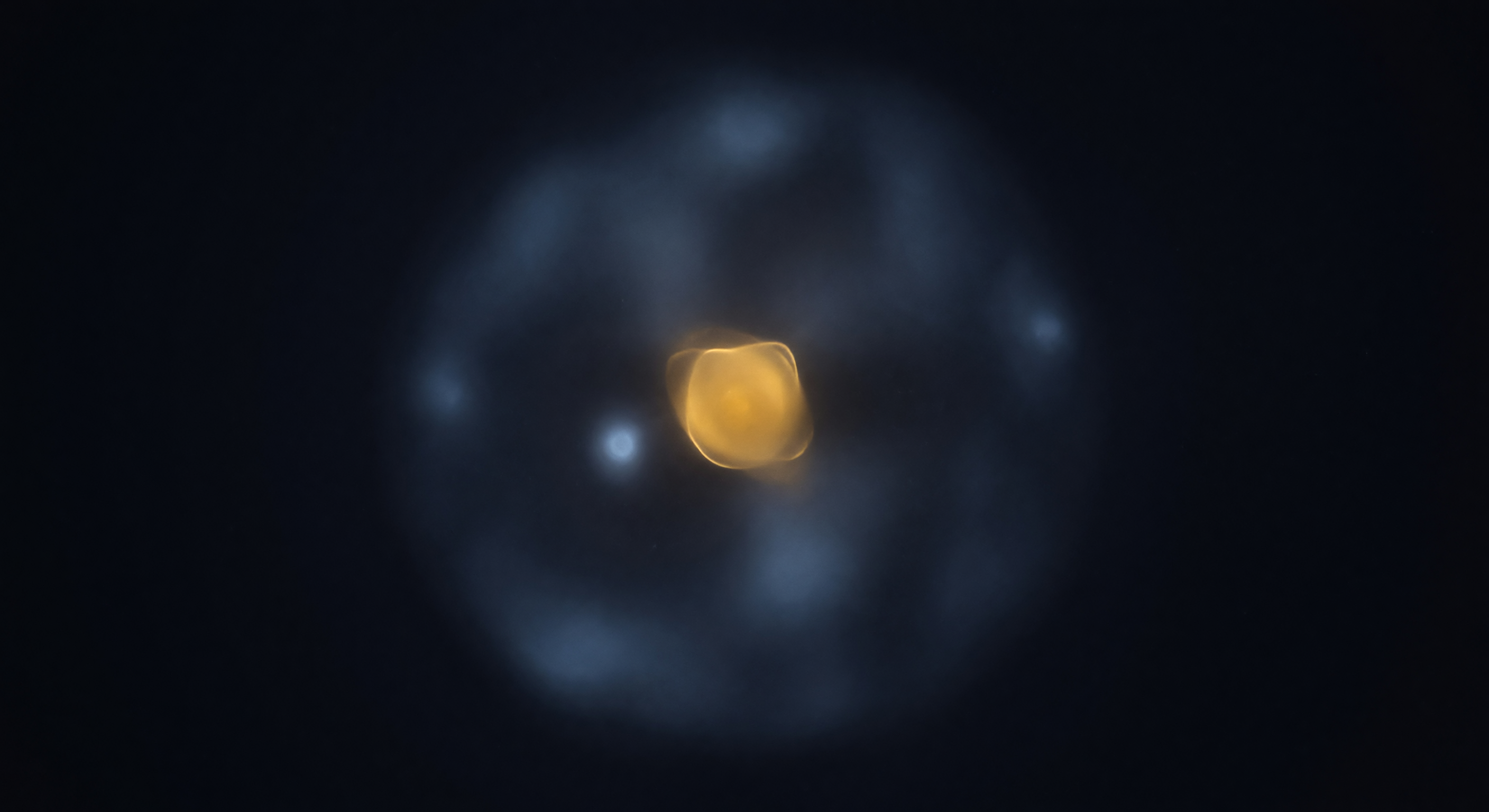
At thirty femtometers from its center, the lithium-11 nucleus presents one of the most extreme structural contrasts in all of matter: a ferociously dense amber core of nine bound nucleons — a lithium-9 kernel roughly two femtometers across, packed at nuclear saturation density near 2.3 × 10¹⁷ kilograms per cubic meter — adrift inside an immense quantum halo of two loosely bound neutrons whose wavefunctions diffuse outward to seven femtometers in every direction, making the whole system three times wider than its own compressed heart. These halo neutrons do not orbit classically; they exist as extended probability amplitudes, quantum-mechanically tunneling far beyond the range where the strong force can properly bind them, spending much of their existence in a classically forbidden region that would be pure vacuum at any larger scale. Occasionally the two halo neutrons exhibit di-neutron correlation — a transient pairing that appears as a slightly denser, cooler condensation drifting through the surrounding fog before dissolving back into the tenuous mist within yoctoseconds of nuclear time. The boundary between nucleus and void is not a surface but a gradient, a slow surrender of quantum density into structureless absence, so that standing inside the halo feels less like inhabiting matter and more like witnessing the last phosphorescent breath of something immeasurably ancient fading into an absolute dark.
Other languages
- Français: Nébuleuse du Noyau Halo Lithium-11
- Español: Nebulosa del Núcleo Halo Litio-11
- Português: Nebulosa do Núcleo Halo Lítio-11
- Deutsch: Lithium-11 Halokern Nebel
- العربية: سديم نواة هالة الليثيوم-11
- हिन्दी: लिथियम-11 हेलो नाभिक नीहारिका
- 日本語: リチウム11ハロー核星雲
- 한국어: 리튬-11 헤일로 핵 성운
- Italiano: Nebulosa del Nucleo Alone Litio-11
- Nederlands: Lithium-11 Halo Kern Nevel