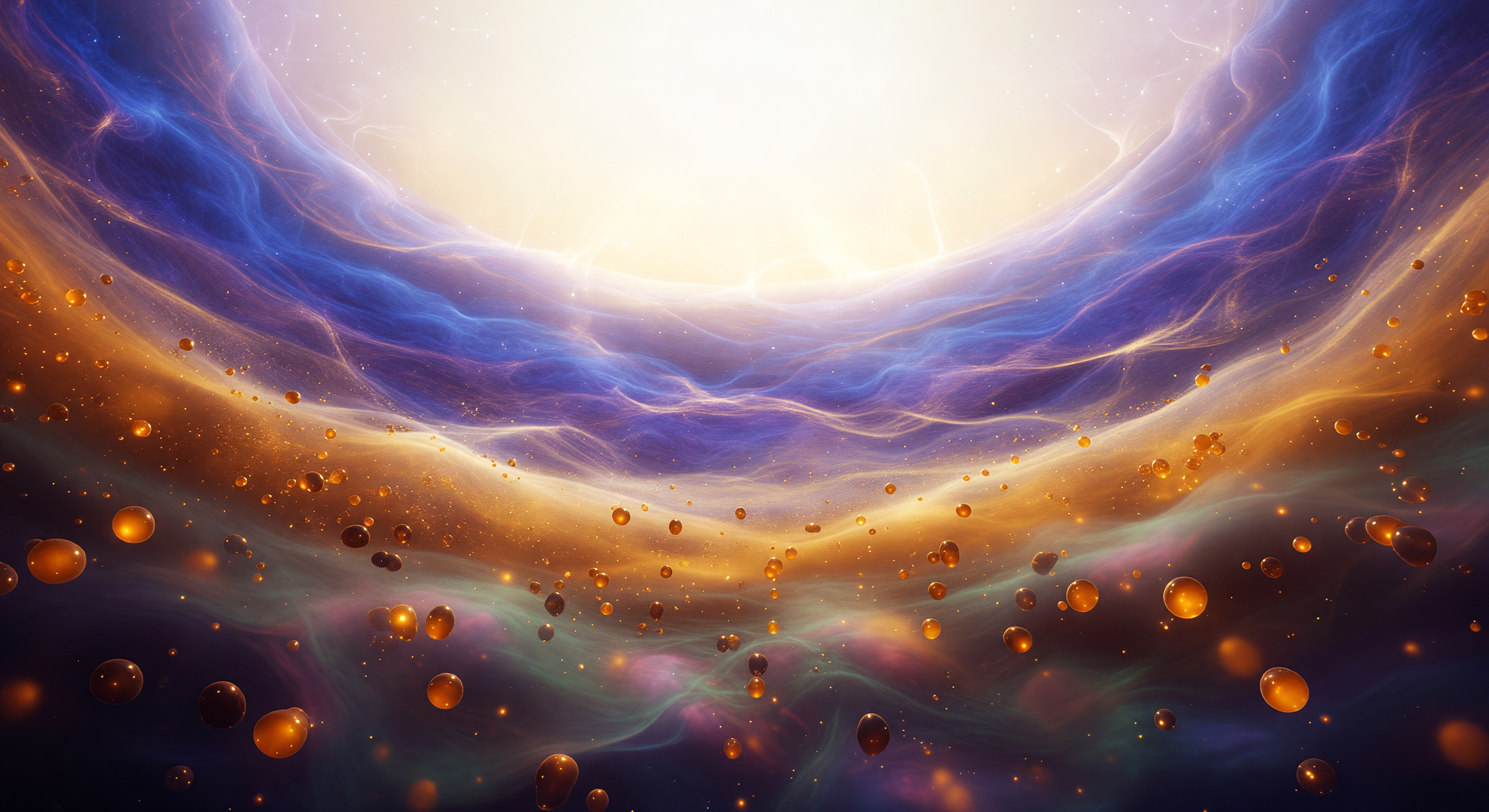
You stand at the inner surface of a boundary that should not exist — the curved, self-luminous threshold where a quark-gluon plasma, hotter than any state the present universe sustains, surrenders its formlessness and condenses into the first coherent nucleons and pions ever to exist. The plasma interior blazes overhead in white-gold obliteration, cooling through electric violet across distances measured in fractions of a femtometer, a temperature gradient so steep it encompasses the entire history of matter's emergence within a spatial span smaller than a single proton diameter. At the curved amber shell of the hadronization boundary, nascent nucleons crystallize out of the luminous heat-haze with an almost botanical patience — asymmetric, still trembling with thermal memory, their lit faces glowing caramelized orange where the plasma blazes against them and fading into near-shadow on their cooler sides. Between them, the inter-nucleon medium is never truly void: the QCD vacuum seethes with a faint iridescent condensate of virtual quark-antiquark pairs and gluon fields, a structured jade-and-rose mist that pulses at a grain scale finer than the nucleons themselves, a visible reminder that at this depth of reality, empty space carries negative energy density and the distinction between matter and vacuum is a question of temperature alone. This is the most extreme phase transition the universe performs — not a freezing but a becoming, formlessness learning, in the span of yoctoseconds, to have mass.
Other languages
- Français: Frontière Cristallisante Plasma Quarks
- Español: Frontera Cristalizante de Plasma
- Português: Fronteira Cristalizante do Plasma
- Deutsch: Kristallisierende Quark-Gluon-Grenze
- العربية: حدود بلازما الكواركات المتبلورة
- हिन्दी: क्वार्क-ग्लूऑन प्लाज्मा क्रिस्टलीय सीमा
- 日本語: クォークグルーオン境界結晶化
- 한국어: 쿼크-글루온 플라스마 결정 경계
- Italiano: Confine Cristallizzante Plasma Quark
- Nederlands: Kristalliserende Quark-Gluon Grens