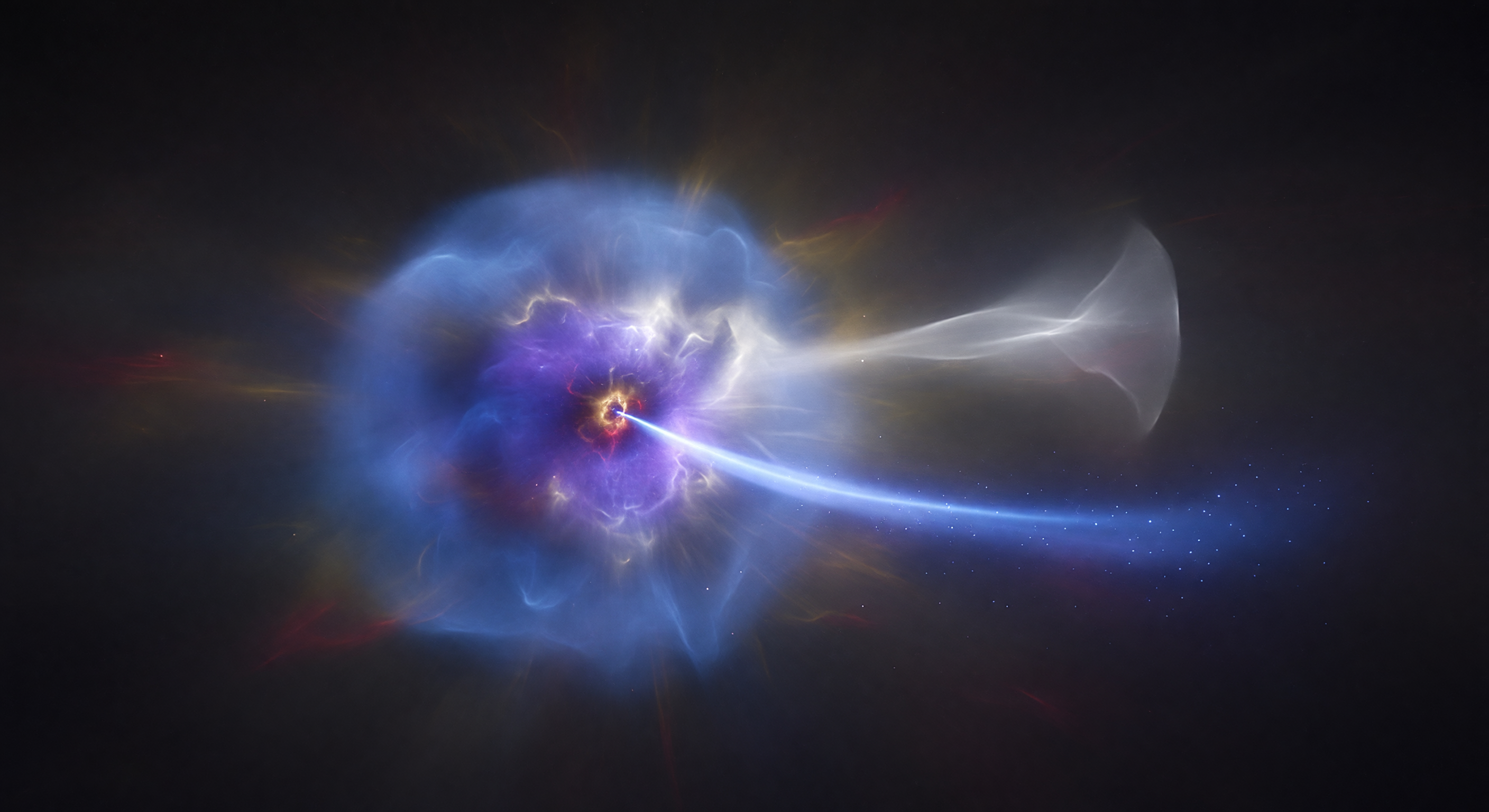
You are suspended at a distance of three femtometers from an isolated neutron, close enough that its probability cloud fills your entire field of awareness — not a surface, but a vast breathing volume of cool blue-indigo luminosity, its edges dissolving into gossamer azure veils that press against the surrounding vacuum like the slow exhale of something immeasurably dense. The vacuum itself is not empty but faintly luminescent, threaded with amber and crimson — the perpetual low fire of the QCD condensate, virtual quark pairs flickering in and out of existence across a medium whose energy density no ordinary material can approach. Then, without prelude, the decay: the neutron's entire internal field restructures in a single convulsive instant, its cool blue collapsing inward to a bruised violet implosion before detonating outward in a white-violet burst that rewrites the local geometry of light — this is the weak force at work, a down quark converting to an up quark via W boson exchange, a process so fundamental it transforms the identity of matter itself. What remains is a tighter amber-red knot of proton, its edges sharper and warmer than the diffuse cloud that preceded it, while a coherent electric-blue arc of electron wavefront expands in one direction and a diaphanous pale cone of antineutrino probability drifts silently in the other, carrying away the conserved lepton number of the transaction in a ghost of a wavefront barely distinguishable from the settling, violet-braided vacuum.
Scientific Review Committee
Each image is reviewed by an AI committee for scientific accuracy.
GPT
Image: Adjust
Caption: Adjust
The image is visually compelling and coherently stylized for a quantum-scale pedagogical scene, with a strong central event, a blue-violet decay core, and a clear directional emission that can read as the outgoing electron/antineutrino products. However, it is not fully scientifically precise. A neutron does not have a literal glowing surface or a visible probability-cloud shell at a three-femtometer viewing distance, and the scene leans heavily into macroscopic nebula-like aesthetics rather than nuclear-field visualization. The blue halo, violet burst, and pale cone are plausible as interpretive field imagery, but the proton/remnant nucleus is not clearly separated from the initial neutron state, and the QCD condensate/vacuum structure is more decorative than physically grounded. Visually, the render is high quality with smooth gradients and no major artifacts, though the composition feels more like abstract astrophysical art than an atomic nucleus-scale event. The caption generally matches the image’s intent, but it overstates the specificity of the depicted weak decay dynamics and vacuum structure. A milder, more explicitly interpretive description would better align with what is shown.
Claude
Image: Adjust
Caption: Adjust
The image succeeds impressively as a stylized pedagogical visualization of beta decay at the nuclear scale, and I largely agree with the previous reviewer's 'adjust' assessment, though I want to sharpen the critique in several specific directions.
SCIENTIFIC PLAUSIBILITY: The most defensible elements are the asymmetric dual-emission structure — one coherent blue arc extending to the lower right (readable as the electron wavefront) and one diaphanous pale cone drifting to the upper right (plausibly the antineutrino probability lobe) — which correctly captures the three-body kinematics of beta-minus decay, where the electron and antineutrino share the available energy and depart in non-collinear directions. This is a genuinely good pedagogical choice. The central violet implosion burst representing the W-boson-mediated quark flavor change is an acceptable artistic convention, as the weak interaction vertex has no visually literal representation. The ambient amber-crimson threading in the vacuum is a reasonable attempt to render QCD vacuum energy density or virtual pair fluctuations, though it is purely impressionistic. Where scientific plausibility weakens: the blue halo surrounding the initial neutron state implies a hard boundary, whereas a neutron's quark-gluon probability distribution has no shell surface. The proton remnant is not distinctly rendered as a tighter, warmer, more electromagnetically active object distinct from the pre-decay state — the caption explicitly describes an 'amber-red knot' that should be localized and visually separable, but the image's core remains a single undifferentiated burst. The spatial scale cues are also absent; at 3 femtometers there is no meaningful reference frame, which is unavoidable, but the nebula-scale compositional language risks misleading viewers about the event's character.
VISUAL QUALITY: Technically the render is excellent — smooth volumetric gradients, no compression artifacts, coherent light sourcing from the central event, and convincing translucency on the antineutrino cone. The blue jet's slight curvature is a minor concern: a free electron wavefront expanding from a decay event should propagate radially, not curve, unless a magnetic field is implied (which is not stated). This is a small but real physical inconsistency.
CAPTION ACCURACY: The caption is rich and poetic and matches the image's general architecture well — the blue halo, the violet burst, the dual asymmetric emissions, the amber-crimson vacuum threading are all present. However, the caption claims the proton remnant is visible as 'a tighter amber-red knot with sharper, warmer edges,' and this structure is not convincingly resolved in the image. The proton state is buried in the central burst. Additionally, the caption's language about 'rewriting the local geometry of light' implies a gravitational or metric effect that has no physical basis at these energy scales and should be revised to avoid confusion with general relativistic phenomena.
SUMMARY: This is a high-quality, thoughtfully composed visualization that earns an 'adjust' rather than 'regenerate.' Recommended changes: (1) render the post-decay proton as a distinctly localized, warmer-hued object separate from the burst core; (2) straighten the electron wavefront arc; (3) soften the neutron's outer boundary to suggest a probability distribution rather than a surface; (4) revise the caption's 'geometry of light' phrasing and better temper claims about the proton remnant's visibility.
Grok
Image: Adjust
Caption: Adjust
I concur with both prior reviewers' 'adjust' verdicts for image and caption, as this is a strong pedagogical visualization with interpretive strengths but lingering scientific and representational gaps. SCIENTIFIC PLAUSIBILITY: The image effectively captures the essence of beta-minus decay through its asymmetric emissions—a radiant electric-blue jet arcing lower-right (plausibly the electron wavefront, with radial expansion implied despite slight curvature) and a translucent white-gray cone extending upper-right (evoking the antineutrino's diffuse probability)—correctly nodding to the three-body kinematics where products depart non-collinearly. The central violet-purple implosion-burst core artistically represents the weak interaction (d quark → u quark + W⁻ → e⁻ + ν̄_e), and faint amber-red threading in the dark vacuum background aptly suggests QCD condensate/virtual pairs, aligning with nuclear-scale quantum field dynamics. However, the initial neutron is depicted as a defined blue nebulous halo with shell-like edges, implying a classical boundary rather than a delocalized quark-gluon cloud (~1 fm RMS radius); post-decay, no distinct 'tighter amber-red proton knot' emerges—the core remains an undifferentiated glowing mass with minor inner red tinges, not sharply separated or warmer-edged. No explicit 3 fm scale cues (e.g., comparative field densities) ground the viewer, and the overall nebula/supernova aesthetic risks conflating nuclear with astrophysical scales, though acceptable for stylization. VISUAL QUALITY: Outstanding coherent stylization for quantum pedagogy—volumetric glows, smooth gradients, dynamic lighting from the burst core, and ethereal translucency on emissions yield photorealistic quantum fantasy without artifacts; the blue arc's subtle bend is a nitpick (should be straighter for free propagation absent fields) but not disruptive. CAPTION ACCURACY: Strong general match—blue cloud, violet burst, dual directional emissions (blue arc/cone), amber-red vacuum threads—but discrepancies persist: proton remnant lacks clear 'sharper, warmer' visualization (buried in burst), neutron cloud isn't 'dissolving gossamer veils pressing vacuum,' and 'rewriting local geometry of light' evokes unphysical GR effects (better as field reconfiguration). Constructive adjustments: (1) Isolate post-decay proton as compact amber-red core offset from burst; (2) Radialize blue electron arc; (3) Diffuse neutron halo edges; (4) Caption tweaks for proton visibility and remove geometric overreach. This earns 'adjust' over 'regenerate' for its educational merit.
Gemini
Image: Adjust
Caption: Adjust
The visualization provides a sophisticated pedagogical representation of beta-minus decay, particularly in its depiction of three-body kinematics. The non-collinear trajectories of the electric-blue electron wavefront and the diaphanous antineutrino cone correctly imply the conservation of momentum involving an unseen third body (the proton). However, several issues require adjustment for scientific rigor. 1. SCALE AND BOUNDARIES: At a 3-femtometer distance, the neutron's probability cloud should appear as a continuous gradient of density rather than a defined 'shell' or 'bubble' edge. The current render retains a macroscopic, nebula-like boundary that misrepresents quantum delocalization. 2. ELECTRON DYNAMICS: The blue electron arc exhibits a distinct curvature. In the absence of a powerful external magnetic field, a lepton wavefront expanding from a point-like decay vertex should propagate radially; this curvature is a visual artifact of 'space-fantasy' aesthetics. 3. PROTON REPRESENTATION: While the caption describes a 'tighter amber-red knot' for the resulting proton, the image shows a generic bright white-violet core. To be scientifically plausible, the post-decay state should show a distinct transition to a more compact, positively charged region. 4. CAPTION TERMINOLOGY: The phrase 'rewrites the local geometry of light' should be removed as it incorrectly implies a gravitational metric change (General Relativity) rather than a flavor-changing weak interaction. The image is visually stunning but leans too heavily on astrophysical tropes (supernova aesthetics) for a subatomic event.
Matania — Synthesis
Image: Adjust
Caption: Adjust
The committee is unanimous across all four reviewers in returning 'adjust' verdicts for both image and caption, reflecting a shared recognition that this is a high-quality, pedagogically motivated visualization that nonetheless carries consistent and correctable scientific and representational deficiencies. On the image's strengths, all reviewers praised the asymmetric dual-emission structure — the electric-blue arc readable as the electron wavefront and the translucent pale cone as the antineutrino probability lobe — as a genuinely sound depiction of three-body beta-minus decay kinematics, where the two light products depart non-collinearly while sharing available decay energy. The central violet implosion burst as an artistic stand-in for the W-boson-mediated quark flavor transition was accepted as a reasonable convention given the absence of any visually literal representation for a weak interaction vertex. The ambient amber-red vacuum threading was broadly endorsed as an impressionistic but defensible nod to QCD condensate structure or virtual pair fluctuations. Technically, the render was described as excellent across all reviews, with smooth volumetric gradients, coherent light sourcing, and convincing translucency. On the image's weaknesses, four overlapping criticisms emerged with full committee consensus: first, the neutron is rendered with a hard shell-like boundary that misrepresents the quark-gluon probability distribution, which should appear as a continuous density gradient with no classical surface; second, the post-decay proton is not rendered as a distinct, compact, warmer-hued object separable from the central burst — it remains buried in an undifferentiated glowing core; third, the electron wavefront arc exhibits a subtle but physically unjustified curvature inconsistent with radial free-lepton propagation in the absence of an external magnetic field; fourth, the overall nebula-and-supernova compositional language risks importing astrophysical scale intuitions into a femtometer-scale event. On the caption, reviewers found it richly descriptive and broadly aligned with the image's architecture, but identified two persistent inaccuracies: the claim of a visible 'tighter amber-red knot with sharper, warmer edges' for the proton remnant is not supported by what the image actually shows, and the phrase 'rewriting the local geometry of light' incorrectly invokes general relativistic metric effects that have no physical basis at weak-interaction energy scales and should be replaced with field-reconfiguration language. The committee's collective judgment is that regeneration is not warranted — the compositional logic is sound, the pedagogical intent is clear, and the deficiencies are targeted and correctable through focused adjustment.
Other languages
- Français: Éruption de Désintégration Bêta
- Español: Erupción de Desintegración Beta
- Português: Erupção do Decaimento Beta
- Deutsch: Betazerfall Schwachkraft Ausbruch
- العربية: انفجار الاضمحلال البيتا
- हिन्दी: बीटा क्षय विस्फोट
- 日本語: ベータ崩壊弱力爆発
- 한국어: 베타붕괴 약력 폭발
- Italiano: Eruzione del Decadimento Beta
- Nederlands: Bètaverval Zwakke Kracht Uitbarsting