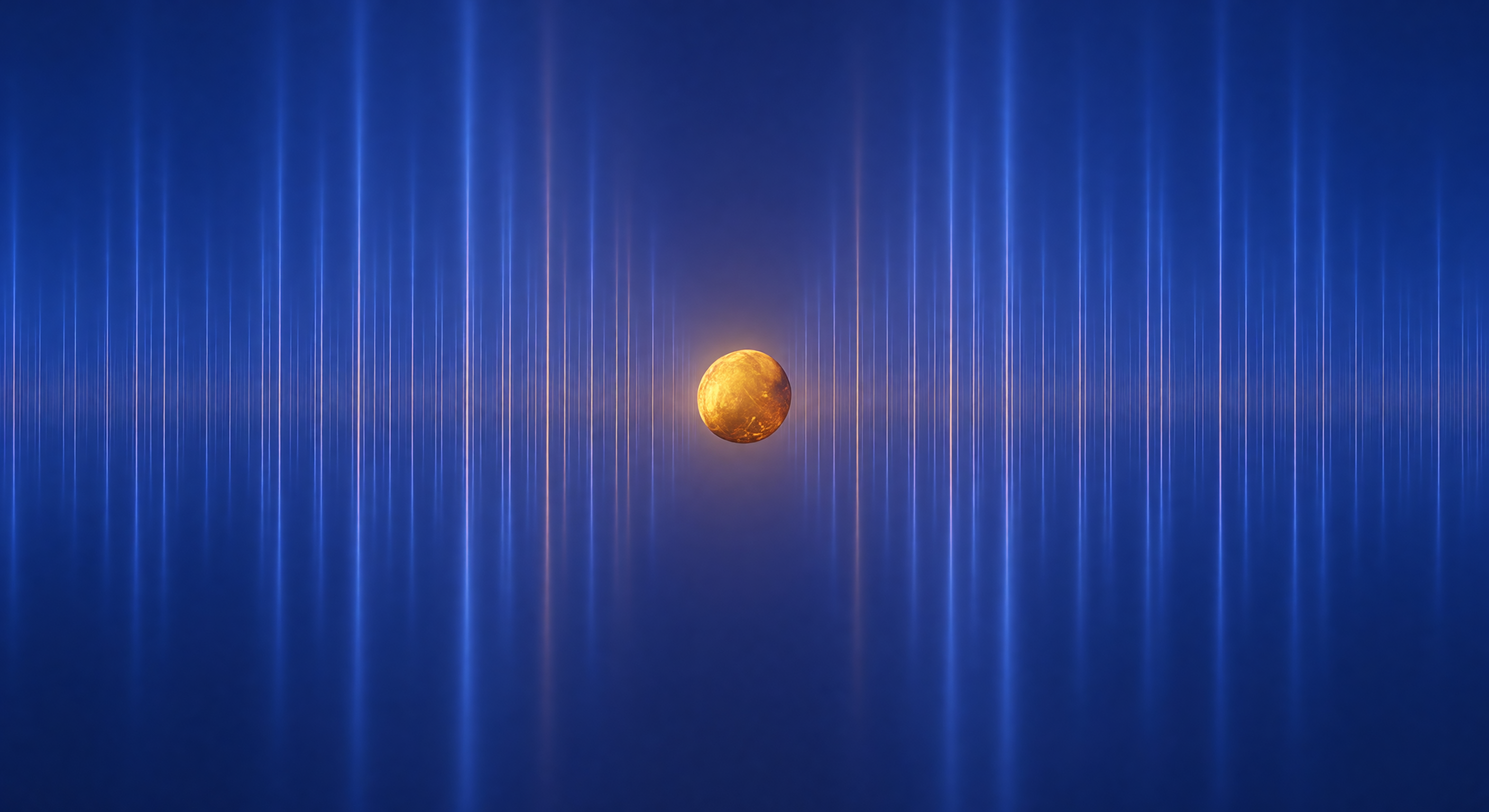
At five femtometers from a solitary proton, the world has been replaced entirely by field — a cathedral of electric-blue columns streaming vertically through the vacuum in every direction, equidistant and infinite, each one a volumetric filament of ordered magnetic force generated by a seven-tesla field whose strength, at this proximity, feels less like measurement and more like weather. At the absolute center of this luminous forest floats the proton itself, a dense amber sphere barely a femtometer across, its interior furnace-gold radiance spilling outward to tint the nearest field lines a warm tangerine before the cold cobalt reasserts dominance. The proton is not still: its spin axis, rendered as a red-white directional arrow, is tilted away from the vertical field and sweeping out a steady precessional cone — the Larmor precession, a gyroscopic wobble driven by the torque the magnetic field exerts on the proton's intrinsic magnetic moment, here occurring at roughly three hundred megahertz, one full cone-sweep every few nanoseconds, a cadence almost geological in its patience compared to the yoctosecond violence of strong-force interactions happening simultaneously within the same femtometer volume. The paradox of the scene is total: this single quantum particle, containing ninety-nine percent of a hydrogen atom's mass at a density of two hundred million tonnes per cubic centimeter, precesses with the serene geometric regularity of a gyroscope on a frictionless bearing, its metronomic rotation the very physical principle that makes magnetic resonance imaging possible at human scales ten-billion times larger than this amber sphere suspended in its infinite blue field.
Other languages
- Français: Précession de Larmor du Proton
- Español: Precesión de Larmor del Protón
- Português: Precessão de Larmor do Próton
- Deutsch: Larmor-Präzession des Protons
- العربية: تقدم لارمور لدوران البروتون
- हिन्दी: प्रोटॉन स्पिन लार्मर प्रीसेशन
- 日本語: 陽子スピンのラーモア歳差運動
- 한국어: 양성자 스핀 라모어 세차운동
- Italiano: Precessione di Larmor del Protone
- Nederlands: Proton Spin Larmor Precessie