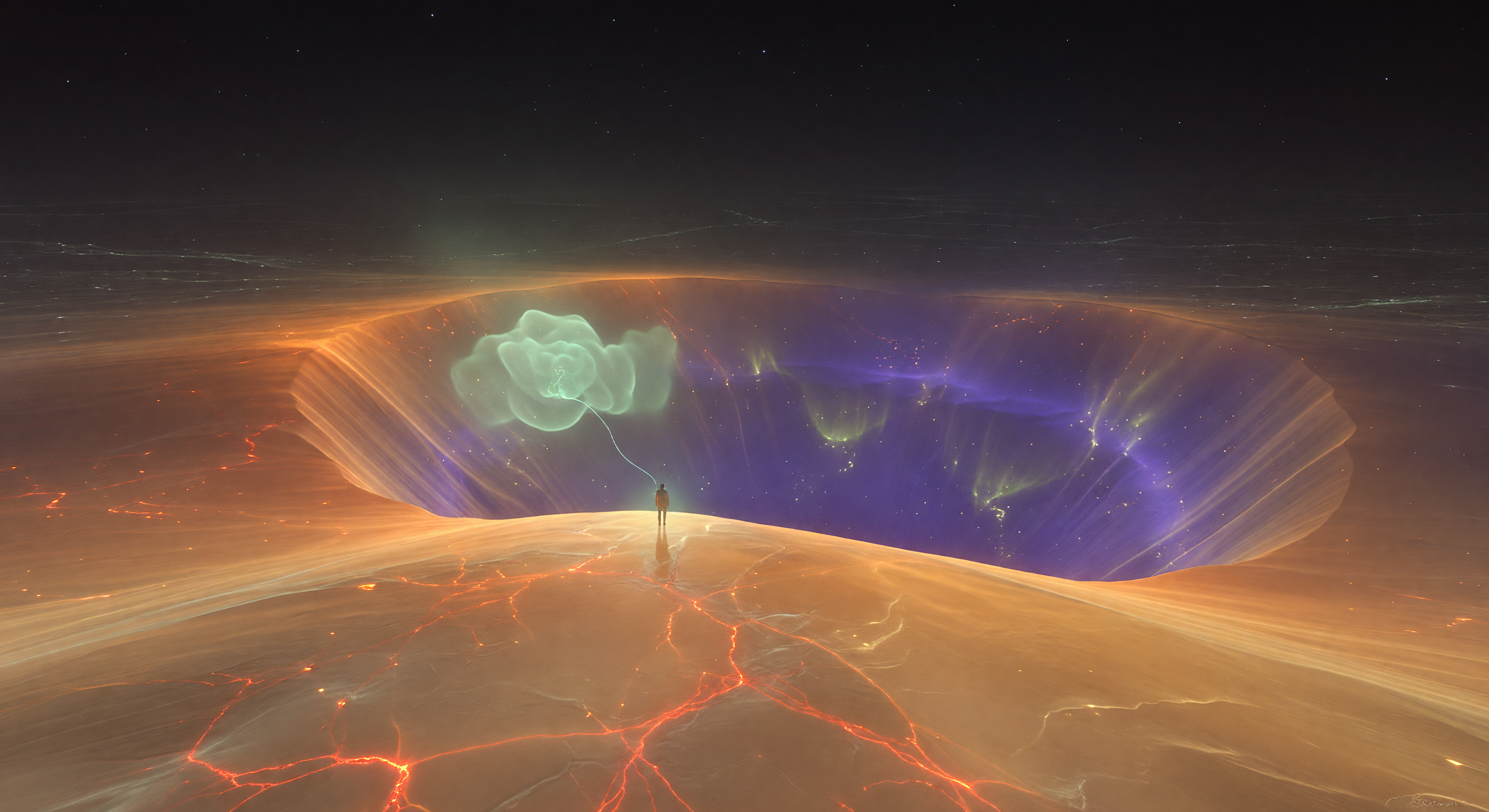
You stand at the crest of a ridge that is not made of stone but of frozen repulsion — the Coulomb potential of a uranium-238 nucleus made visible, glowing amber-orange with the residue of electromagnetic force between 92 protons compressed into a sphere barely seven femtometers across. Behind you the ground plunges away in a near-vertical caldera, its inner walls radiating cold violet and indigo light that emanates not from any surface but from the nuclear medium itself, a material at densities of 2.3 × 10¹⁷ kilograms per cubic meter where nucleons move at roughly a third the speed of light and the fundamental clock tick of the world runs at ten-septillionths of a second. Ahead, the ridge descends through warm saffron into pale amber and then into the chromatic near-black of the quantum vacuum, which is not emptiness but a seething condensate of virtual quarks and gluon fields held just below the threshold of permanence — the faint granular shimmer at the far horizon is the vacuum fluctuating, not resting. Below you on the inner wall, a semi-transparent cluster of pale jade light drifts against the amber barrier, its edges dissolving into the surrounding medium without ever forming a true surface, because it is not a particle in any classical sense but an alpha cluster whose wavefunction — two protons, two neutrons bound in a helium-4 configuration — extends a cool jade tendril directly through the solid-seeming Coulomb barrier, occupying the same space as the warm orange rock in a quantum superposition that, given enough time measured in anything from microseconds to billions of years, will resolve into escape: tunneling, the process by which uranium slowly becomes lead, one ghost-green tendril at a time.
Other languages
- Français: Crête de Coulomb au Crépuscule
- Español: Cresta de Coulomb al Atardecer
- Português: Cume de Coulomb ao Entardecer
- Deutsch: Coulomb-Barriere im Abendrot
- العربية: حافة حاجز كولوم عند الغسق
- हिन्दी: कूलम्ब अवरोध शिखर सांझ में
- 日本語: 黄昏のクーロン障壁の峰
- 한국어: 황혼의 쿨롱 장벽 능선
- Italiano: Cresta di Coulomb al Tramonto
- Nederlands: Coulombbarrière bij Schemering