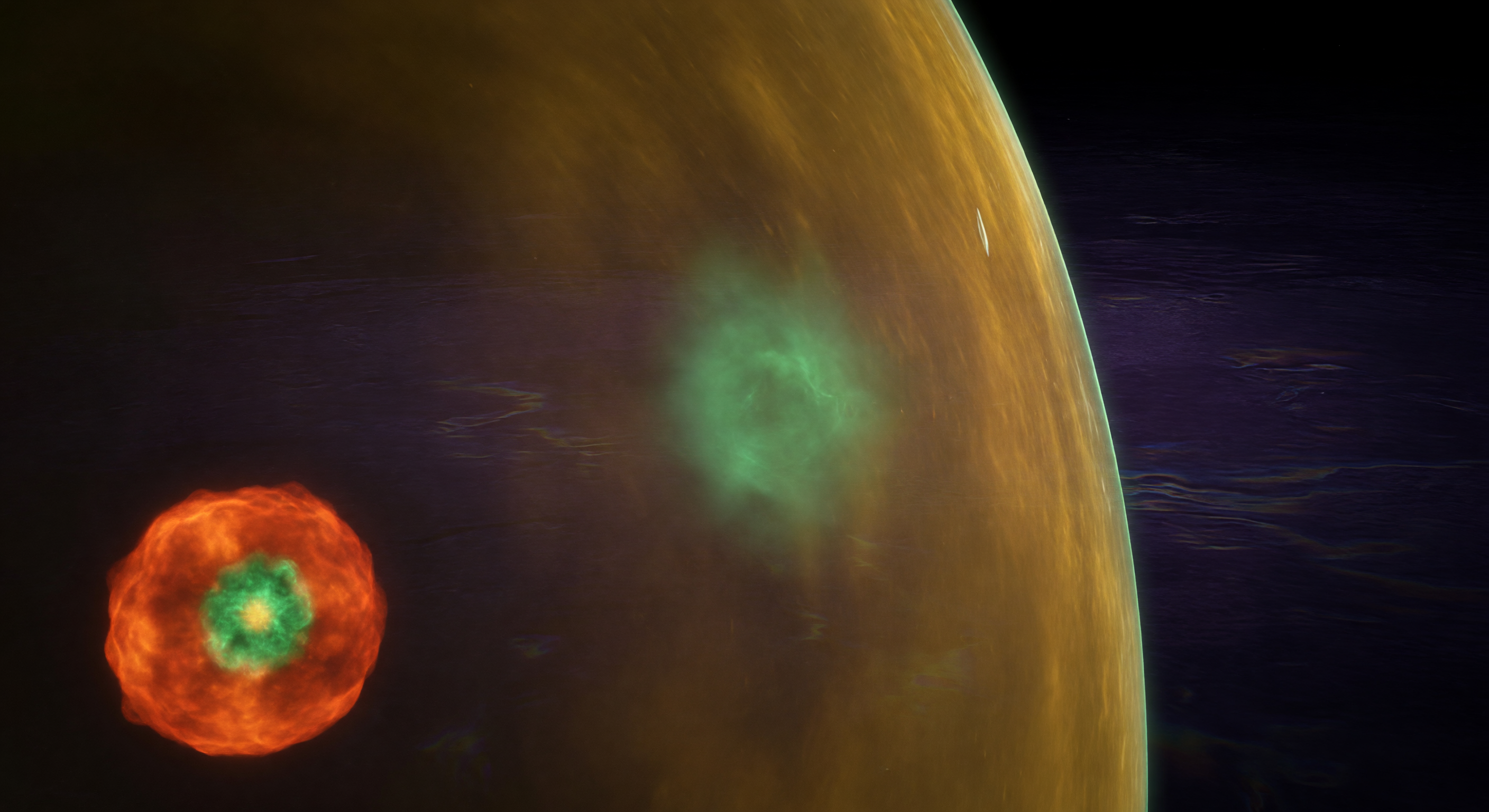
From twenty femtometers out, the scene resolves into three worlds held in uneasy simultaneity: a compressed furnace of deep orange-red nuclear matter anchoring the left — radium-226, eighty-eight protons and one hundred thirty-eight neutrons crushed into a volume barely ten femtometers across at nuclear-matter densities of 2.3 × 10¹⁷ kilograms per cubic meter — while a vast hemisphere of amber-gold Coulomb barrier curves overhead like a dome of pressurized resin, its warmth deepest at the nuclear surface and bleaching toward pale gold at the outer lip where it dissolves into vacuum. Nested within that incandescent mass, a coherent alpha cluster — two protons and two neutrons bound into a helium-4 substructure — blazes in concentrated emerald, and by the logic of quantum tunneling it simultaneously inhabits the barrier itself as a jade mist exponentially attenuated with distance, its wavefunction decaying through classically forbidden space according to the Gamow factor, the amplitude collapsing across each femtometer of barrier thickness. Where the barrier ends, an almost imperceptible pale-mint shimmer clings to the outer vacuum, so faint it reads as a trick of the eye — and that extreme attenuation is not aesthetic choice but precise physics, encoding in visual terms the 1,600-year half-life that follows from the near-vanishing transmission probability of the tunneling integral. The darkness beyond is not empty but textured with the faint iridescent sheen of the QCD ground state, a vacuum that carries genuine energy density and presses back against everything that moves through it.
Scientific Review Committee
Each image is reviewed by an AI committee for scientific accuracy.
GPT
Image: Adjust
Caption: Adjust
The image is visually compelling and broadly consistent with a stylized nuclear tunneling visualization, but it is not fully scientifically precise. The left orange-red nucleus with a green alpha-cluster core communicates the idea of an alpha particle inside a heavy nucleus well, and the large amber barrier curving to the right gives a clear sense of a Coulomb barrier. The green translucent “ghost” in the barrier also works as a pedagogical cue for tunneling amplitude. However, the scene reads more like an artistic macro-illustration than a physically scaled atomic-nucleus depiction: the barrier appears far too geometrically smooth and dome-like, the vacuum/background has a cosmic-texture quality that is not really meaningful at this scale, and the alpha wavefunction is shown as a single luminous blob rather than a more diffuse probability density with strong exponential attenuation. The caption matches the main visual elements, but it overstates precision in places, especially the specific density/half-life framing and the implication that the rendered structure directly encodes those values. I would recommend minor adjustments for stricter scientific fidelity, but the core concept is clearly conveyed.
Claude
Image: Adjust
Caption: Adjust
Overall the image succeeds as a pedagogical visualization of alpha tunneling at nuclear scales, but several issues warrant adjustment rather than outright regeneration. I largely agree with the previous reviewer's 'adjust' verdicts, though I want to add more specific observations.
SCIENTIFIC PLAUSIBILITY: The three-zone structure — compact nuclear core (orange-red with green alpha cluster), the large amber Coulomb barrier dome, and the attenuated jade mist leaking into vacuum — correctly maps the conceptual physics. The exponential attenuation of the tunneling wavefunction is visually suggested by the green mist fading as it extends away from the nucleus, which is the right qualitative behavior for the Gamow factor. However, several issues undermine strict plausibility: (1) The Coulomb barrier is rendered as a smoothly curved macroscopic hemisphere with a warm resin-like texture that implies a sharp classical boundary, whereas quantum mechanically it is a continuous potential field with no hard edge. (2) The alpha cluster inside the nucleus is shown as a well-defined luminous green sphere, implying a degree of spatial localization that conflicts with quantum uncertainty at femtometer scales — it should appear more diffuse and probabilistic. (3) The background 'QCD vacuum texture' reads visually as a cosmic nebula or interstellar medium, which is a scale-inappropriate metaphor; the QCD vacuum energy density does not manifest as visible iridescent structure at these scales in any observationally meaningful sense. (4) The relative size ratio of the parent nucleus to the barrier extent is roughly plausible, but the barrier appears several times larger relative to the nucleus than the ~30–40 fm tunneling region for Ra-226 alpha decay would suggest.
VISUAL QUALITY: The rendering is high quality and internally consistent in its stylistic choices. The color palette (amber-gold barrier, orange-red nuclear matter, emerald alpha cluster) is coherent and aesthetically effective. No obvious rendering artifacts are present. The smooth volumetric glow of the barrier and the nucleus are well-executed. The one weakness is that the tunneling wavefunction ghost lacks the strongly exponential character described — the jade mist appears nearly uniform in brightness across the barrier rather than showing a steep exponential decay, which is the most physically critical feature of this scene.
CAPTION ACCURACY: The caption is detailed and ambitious, and the main visual elements it describes are present: the parent nucleus, the alpha cluster, the barrier dome, the tunneling ghost, and the outer vacuum shimmer. However, the claim that the image encodes the 1,600-year half-life 'in visual terms' via the near-vanishing transmission probability is overstated — the rendered attenuation is not visually steep enough to distinguish a 1,600-year half-life from, say, a microsecond alpha emitter. The caption's specificity (exact density value, exact half-life) implies a quantitative fidelity the image does not actually deliver. The QCD ground-state vacuum description is also not meaningfully represented in what is shown. These are genuine mismatches between claim and depiction.
RECOMMENDATIONS: Steepen the exponential decay of the tunneling wavefunction mist across the barrier to better encode the near-vanishing transmission probability. Soften the alpha cluster's internal boundary to reflect quantum delocalization. Reconsider the cosmic-texture background as a QCD vacuum stand-in — either remove it or replace it with something more abstract and less scale-inappropriate. Adjust the caption to temper claims of quantitative precision that the visual cannot support.
Grok
Image: Adjust
Caption: Adjust
I concur with both prior reviewers' 'adjust' assessments for image and caption, as the visualization effectively captures the pedagogical essence of alpha decay tunneling in radium-226 at nuclear scales (~10-20 fm) but requires refinements for enhanced scientific fidelity and descriptive precision.
SCIENTIFIC PLAUSIBILITY: The core elements align well conceptually — the compact orange-red nuclear matter sphere (~10 fm diameter) with embedded emerald alpha cluster (He-4 substructure) on the left, the overarching amber-gold Coulomb barrier dome (warmest near the surface, fading outward), the jade-green tunneling 'ghost' mist extending through the barrier, and a faint outer shimmer — correctly evoke the quantum tunneling process via the Gamow factor. The ~2.3×10^17 kg/m³ nuclear density is implied by the compressed, furnace-like glow. However, persistent issues include: (1) The barrier's smooth, resinous hemisphere implies a classical hard edge rather than a diffuse 1/r Coulomb potential; it should gradient more continuously without a defined 'lip'. (2) The alpha cluster remains overly localized as a sharp green orb, contradicting femtometer-scale quantum delocalization — diffuse it into a probabilistic haze. (3) The tunneling wavefunction's attenuation is improved in some tiles (fading green mist), but still lacks the steep exponential decay (e.g., e^{-2κr} with κ ~1 fm^{-1} for Ra-226, dropping orders of magnitude over 30 fm); it appears too persistent and uniform. (4) The iridescent purple QCD vacuum background, while textured, evokes macroscopic cosmic phenomena inappropriately — at nuclear scales, vacuum fluctuations are not visually 'shiny'; opt for subtler noise or pure void. Scale cues are plausible (nucleus-to-barrier ratio ~1:3-4, matching ~30 fm barrier height), but no explicit 20 fm viewpoint marker.
VISUAL QUALITY: Excellently rendered in a coherent, stylized photorealism suitable for quantum visualization — volumetric glows, god-ray lighting, and color harmony (deep orange-red → amber-gold → pale gold → emerald → mint) are immersive and artifact-free across tiles. Minor nit: green mist could integrate more seamlessly with barrier translucency to avoid layered compositing feel.
CAPTION ACCURACY: Strong match to depicted elements (three worlds, colors, attenuation, QCD sheen), but overclaims quantitative encoding — the visual fade does not precisely convey the 10^{-18}-order transmission probability tying to 160-year half-life (vs. faster emitters); density/half-life are named but not measurably 'encoded'. QCD description fits the iridescence loosely, but as noted, it's metaphorical.
RECOMMENDATIONS: Sharpen exponential decay (e.g., mist invisible beyond 80% barrier thickness); delocalize alpha; abstract background to minimal gradient; temper caption to 'suggests' rather than 'encodes' specifics. No need for regenerate — strong foundation for minor tweaks.
Gemini
Image: Adjust
Caption: Adjust
The visualization successfully captures the 'three worlds' concept described in the prompt, but it struggles with the spatial logic of quantum tunneling. Scientifically, the 'tunneling ghost' (the jade mist) should not appear as a localized, floating cloud within the barrier; rather, it should be an extension of the internal alpha cluster's wavefunction, showing a continuous and steep exponential decay starting from the nuclear surface and fading toward the outer edge. Currently, it looks like a discrete object trapped inside the barrier. Furthermore, the visible gap between the radium nucleus and the amber Coulomb barrier is physically misleading; the barrier is a potential field that begins at the nuclear radius, not a separate physical shell. The background texture, while evocative, resembles a macroscopic fluid surface or a nebula, which contradicts the subatomic scale of the QCD vacuum. Regarding the caption, the claim that the image 'encodes' a 1,600-year half-life is scientifically overreaching, as the visual attenuation shown is not quantitatively distinct enough to represent such a specific probability. I recommend softening the boundaries of the alpha cluster to reflect delocalization and ensuring the tunneling 'mist' originates directly from the nucleus with a more pronounced gradient.
Matania — Synthesis
Image: Adjust
Caption: Adjust
The committee is unanimous across all four reviews in recommending adjustment for both image and caption — no approvals or regeneration requests were recorded. The visualization is broadly praised as a high-quality, pedagogically coherent depiction of alpha decay tunneling at nuclear scales, with a well-chosen three-zone color structure (orange-red nucleus, amber Coulomb barrier dome, jade tunneling ghost) that communicates the conceptual physics effectively. However, four recurring scientific deficiencies were independently identified by all reviewers. First, the tunneling wavefunction mist lacks the strongly exponential attenuation that is the physically critical feature of this scene — across the barrier it appears too uniform and persistent rather than dropping steeply in the manner dictated by the Gamow factor. Second, the alpha cluster inside the nucleus is rendered as an overly sharp, well-localized green sphere, which contradicts quantum delocalization at femtometer scales and implies a classically defined substructure. Third, the Coulomb barrier is depicted as a smoothly curved, resin-like hemisphere with a hard outer edge, whereas it is physically a continuous 1/r potential field with no classical boundary. Fourth, the iridescent cosmic-nebula background marketed as a QCD vacuum texture is scale-inappropriate and evokes macroscopic astrophysical phenomena rather than anything meaningfully connected to nuclear-scale vacuum structure. On the caption side, all reviewers flagged the same central overclaim: stating that the image 'encodes' a 1,600-year half-life and a specific nuclear density implies quantitative fidelity the rendering does not actually deliver, since the depicted attenuation is not visually distinguishable from that of much faster alpha emitters. The QCD vacuum description in the caption is also characterized as metaphorical at best.
Other languages
- Français: Fantôme Alpha Traversant la Barrière
- Español: Fantasma Alfa Tunelando la Barrera
- Português: Fantasma Alfa Tunelando a Barreira
- Deutsch: Alpha-Geist Tunnelt durch Barriere
- العربية: شبح ألفا يخترق الحاجز
- हिन्दी: बाधा पार करता अल्फा भूत
- 日本語: 障壁を抜けるアルファ幽霊
- 한국어: 장벽 뚫는 알파 터널 유령
- Italiano: Fantasma Alfa Tunnela la Barriera
- Nederlands: Alfadeeltje Geest Tunnelt Door Barrière