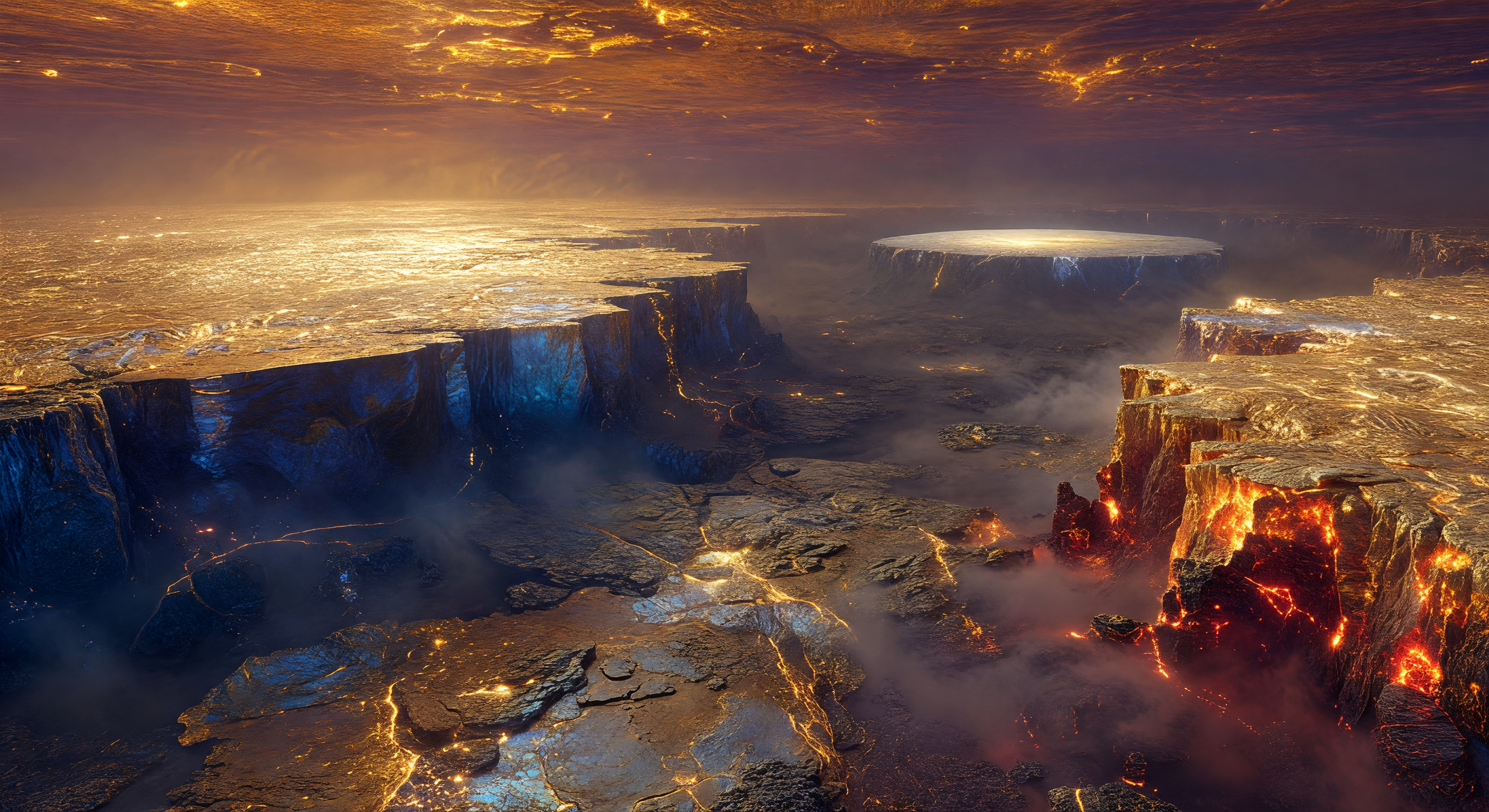
You stand on the most stable ground matter can achieve — a luminous iron-nickel plateau where the binding energy per nucleon reaches its absolute maximum of roughly 8.8 MeV, the deepest point in the nuclear landscape, a terrain so energetically favored that iron-56 and nickel-62 anchor the entire architecture of stellar nucleosynthesis. From this hammered-amber surface, the Valley of Stability stretches away in a long diagonal descent flanked by two opposing walls: to the left, a deep cobalt escarpment plunging toward the neutron drip line where nuclear binding simply cannot accommodate additional neutrons, its face darkening through indigo into void; to the right, a crumbling ochre-and-scarlet cliff where Coulomb repulsion between protons fractures the terrain into unstable ledges shedding glowing fragments into warm crimson fog. The valley floor runs ahead through bronze and pewter into progressively darker, pitted terrain where increasingly heavy nuclei lose their inner coherence, their glow dimming and flickering with brief gamma pulses before collapsing — yet far on the horizon, one faint silver-gold plateau floats in isolation above the surrounding darkness, the theorized island of superheavy stability near proton number 114, where closed nuclear shells are predicted to briefly restore binding against all surrounding instability. The entire scene is compressed into a spatial domain measuring only a few femtometers across, yet every surface communicates the sheer density of nuclear matter — 2.3 × 10¹⁷ kilograms per cubic meter — and the amber-violet medium pressing down from above is not atmosphere but the structured QCD vacuum itself, a condensate of virtual quarks and gluons whose energy density is as real and measurable as the ground beneath your feet.
Other languages
- Français: Vallée de Stabilité Nucléaire
- Español: Valle de Estabilidad Nuclear
- Português: Vale da Estabilidade Nuclear
- Deutsch: Tal der Kernstabilität
- العربية: وادي الاستقرار النووي
- हिन्दी: स्थिरता की परमाणु घाटी
- 日本語: 核安定の谷
- 한국어: 안정성의 핵 계곡
- Italiano: Valle di Stabilità Nucleare
- Nederlands: Dal van Kernstabiliteit