Scientific confidence: Medium
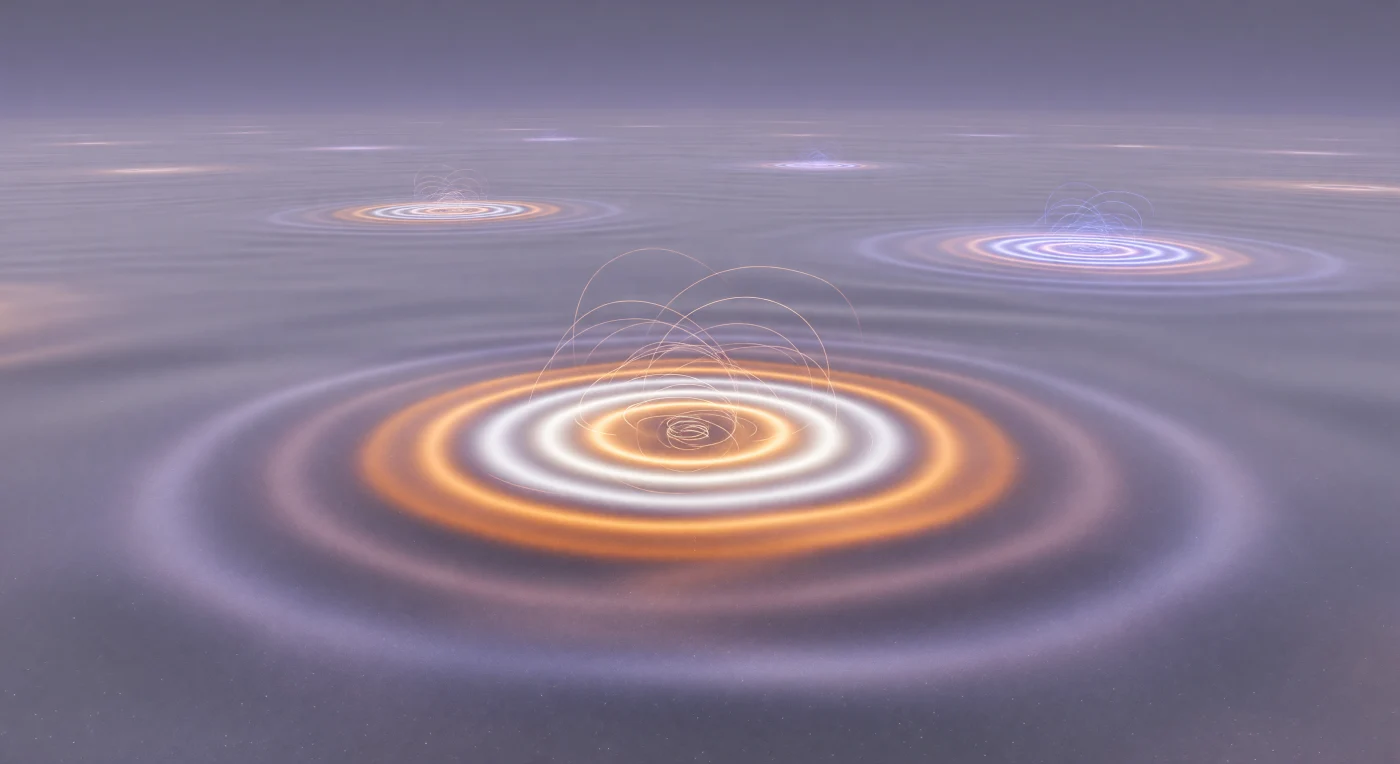
You are suspended within a sea that is not empty — a slowly breathing violet-gray luminescence fills every direction without horizon or floor, the ambient glow of the gluon condensate that constitutes the true ground state of the vacuum, granular and iridescent, pulsing with the faint ripples of virtual pair condensation and field fluctuation. Directly ahead, an instanton storm crests into full violence: a compact spherical eruption of amber and white radial shells, each concentric layer alternating field topology in diminishing intervals inward, the entire structure cycling through slow majestic pulses that send interference fringes of pale lavender and deep indigo radiating outward through the surrounding medium like pressure waves through a luminous ocean. From its mid-shell boundary, extraordinarily fine rose-gold spirals curl inward along logarithmic curves — chiral symmetry streamers, marking the zones where the vacuum's broken symmetry bends quark handedness toward the topological core of a structure that exists for roughly 10⁻²⁴ seconds and yet reshapes the chirality of any quark it engulfs. Across the vast chromodynamic expanse, two anti-instantons drift in cool blue-violet, their inverse topology sending broad interference bands through the condensate between them and the central storm, the whole scene locked in the pressurized silence of a universe whose deepest violence is indistinguishable from its most perfect structure.
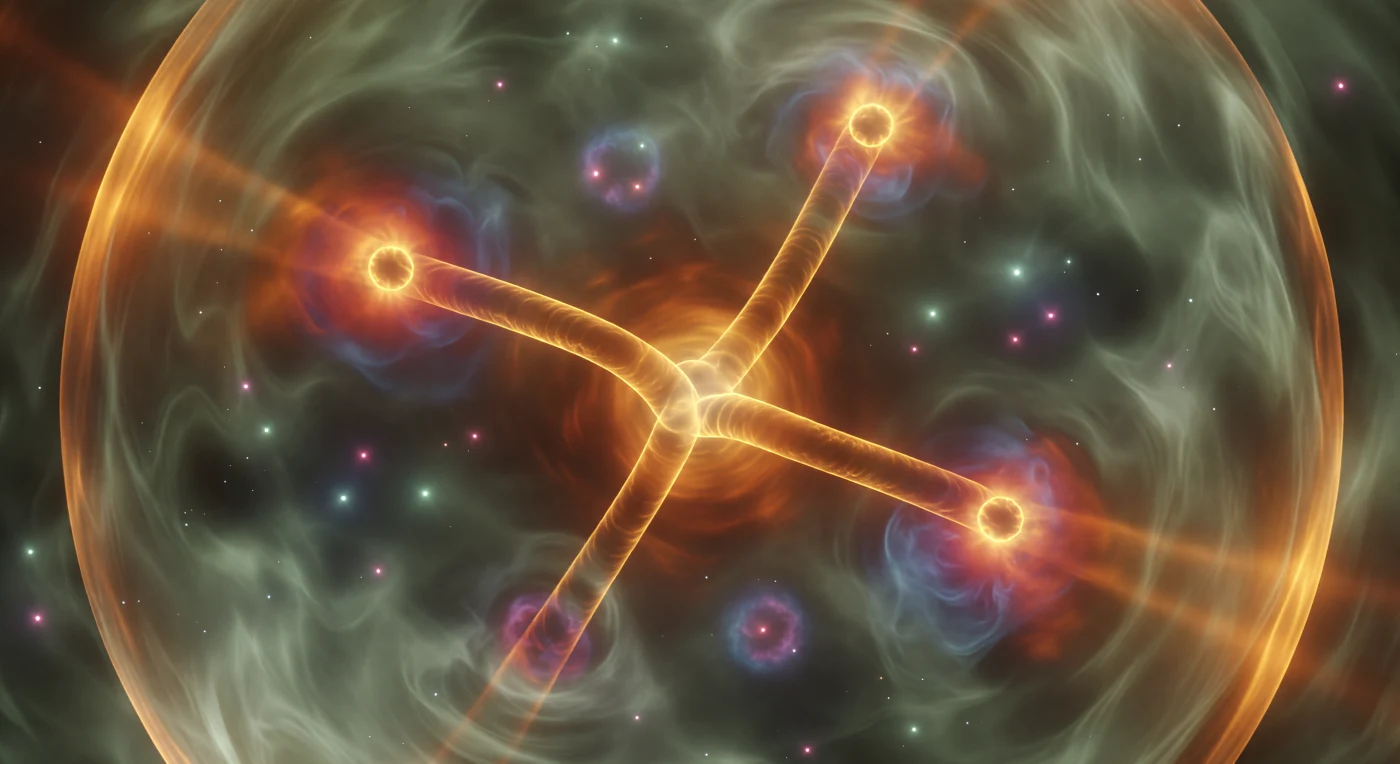
Suspended within a cavity no wider than a single proton, the observer floats at the heart of one of nature's most inescapable enclosures, where three valence quarks — bound up-up-down in this baryon — streak luminous trails through the churning volume, their relativistic motion smearing warm gold into Doppler-shifted halos of orange and violet as they trace their ceaseless, never-escaping paths. Between them, thick flux tubes of compressed chromodynamic field energy form a Y-shaped braid of amber plasma, converging at a central baryon junction that blazes with the radiance of a forge seen from inside, the string tension within each cord approaching 14 tonnes of force — a confinement so absolute that any attempt to pull a quark free would simply nucleate an entirely new quark-antiquark pair from the vacuum itself. The surrounding medium is not empty space but a living gluon condensate — pearlescent green-gray fog seething with the paired aurora-flashes of sea quarks condensing and annihilating in intervals shorter than 10⁻²⁴ seconds, while occasional instanton pulses roll through the volume like violet storm-bruises, brief topological upheavals in the quantum vacuum that dissolve back into the ambient haze before a single strong-force crossing time has elapsed. The cavity wall is not a surface but a pressure — the flux tubes brighten and curve inward as they approach the boundary, the entire hadronic world self-sealed, its interior energy density rivaling that of the early universe compressed into a sphere a hundred million times smaller than an atom.
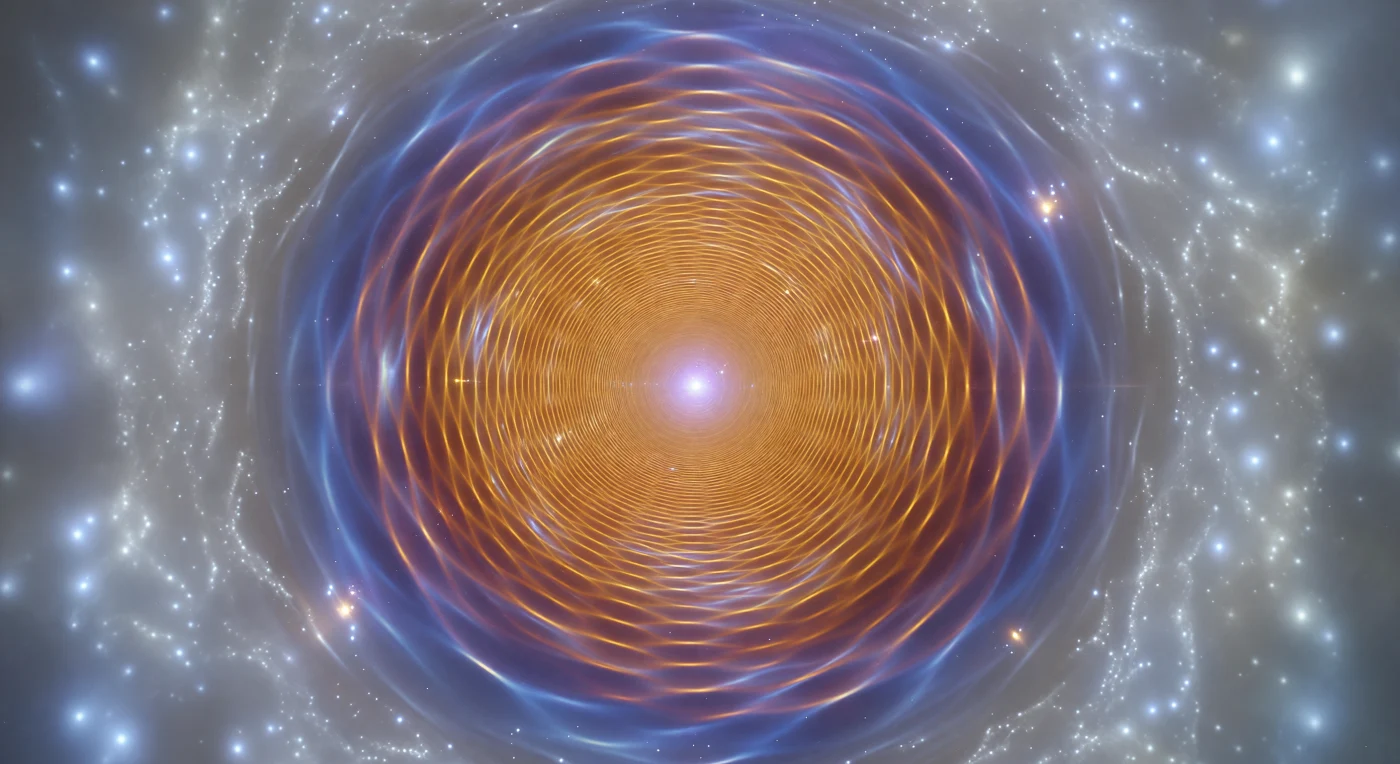
You drift along the central axis of a chromodynamic flux tube — a cylindrical corridor roughly 0.4 femtometers across, its walls neither solid nor gaseous but a compressed architecture of color field burning from deep amber-gold at its core through molten copper and bruised violet into indigo at the boundary where confinement surrenders to the seething quantum vacuum beyond. This is the QCD string, a rope of gluonic field held under tension of approximately 0.18 GeV² per femtometer, the most fundamental tether in nature — one that never slackens, only deepens, so that pulling toward either luminous white-hot endpoint would cost enough energy to tear new matter directly from the vacuum itself. Along the iridescent wall, transverse standing waves ripple in concentric bands like the meniscus of an oil slick over dark water, each crest the visual signature of quantum field fluctuations intrinsic to the string's ground state, while at the boundary layer ephemeral paired sparks — virtual quark-antiquark pairs momentarily nucleated by the field's own intensity — flare asymmetrically in pale blue-white and warm amber before being swallowed back into the amber medium, ghost-smears dissolving along the axis in less than 10⁻²⁴ seconds. Outside the tube wall, the vacuum itself is not dark but texturally luminous, a churning silver-grey fog punctuated by brief spherical intensifications — gluonic and chiral condensate fluctuations — pressing against the boundary with their own faint weight, reminding you that even the apparent emptiness here is saturated with field energy, and that the corridor you inhabit is not an exception to this world but its most concentrated, most honest expression.
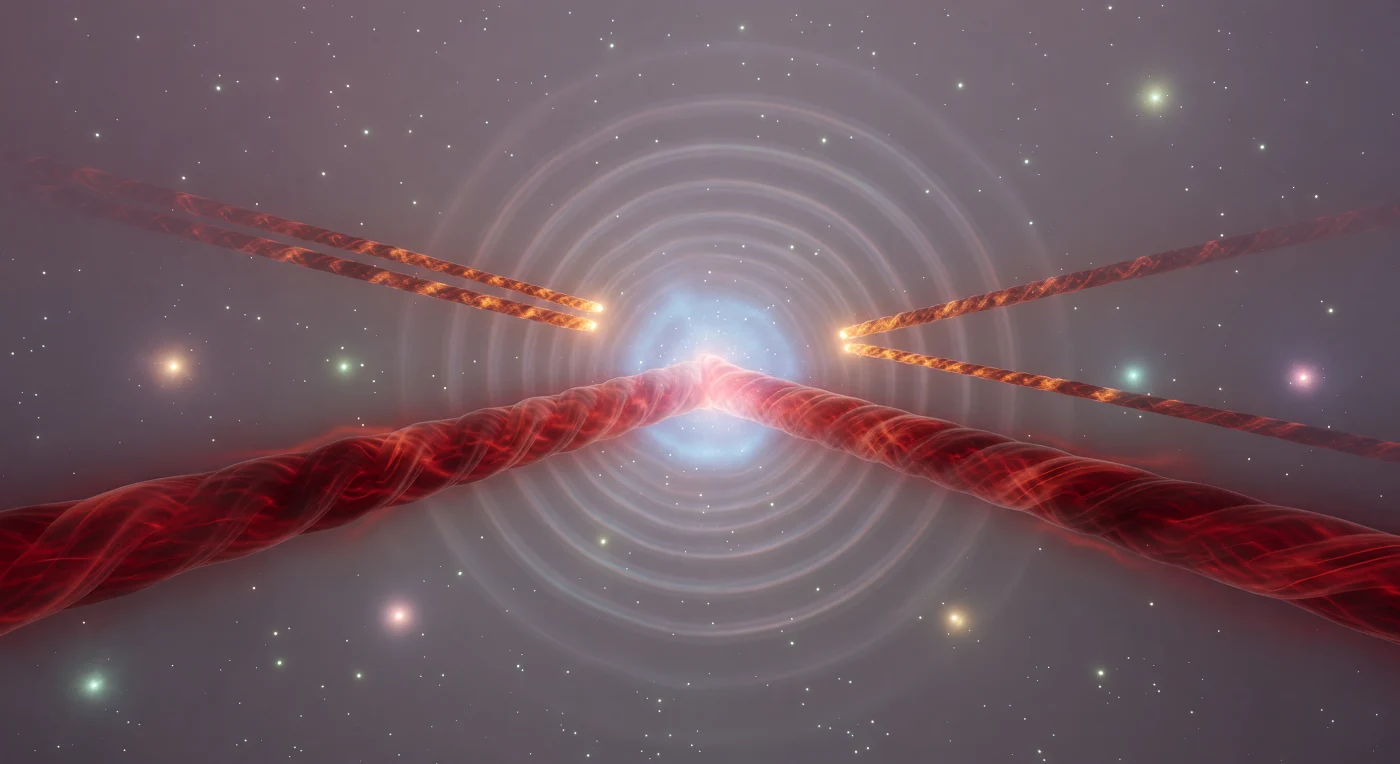
You are hovering inside the chromodynamic substrate of space itself, at the precise instant a flux tube — a rope of compressed color field carrying roughly one GeV of stored energy per femtometer of length — tears open at its midpoint in a spherical nucleation flash, the vacuum surrendering to the unbearable tension by conjuring two new quark-antiquark pairs directly from nothing. This is string breaking, the fundamental mechanism by which QCD confinement enforces its absolute law: rather than allowing color charge to separate freely, the field pours its accumulated energy into fresh matter, sealing each severed end with a new quark and re-establishing confinement on a shorter rope, an act of creation that takes place in roughly 10⁻²³ seconds and cannot, in any thermodynamic sense, be undone. The parent flux tube was not a classical object but a self-organized filament of non-perturbative gluon field, maintained at near-constant diameter by the balance between chromodynamic pressure and the confining vacuum condensate surrounding it, and the concentric iridescent wavefronts now propagating outward are not sound or light but disturbances in that condensate — ripples in broken chiral symmetry, displacing the virtual-pair sea that fills what would otherwise be empty space. The daughter ropes recoil in opposite directions, each anchored by its new quark endpoint into a configuration already racing toward hadronization, while the ambient violet-gray medium continues its ceaseless background flicker of virtual condensation and dissolution, indifferent to the geological rupture that has just reorganized the local topology of color charge.
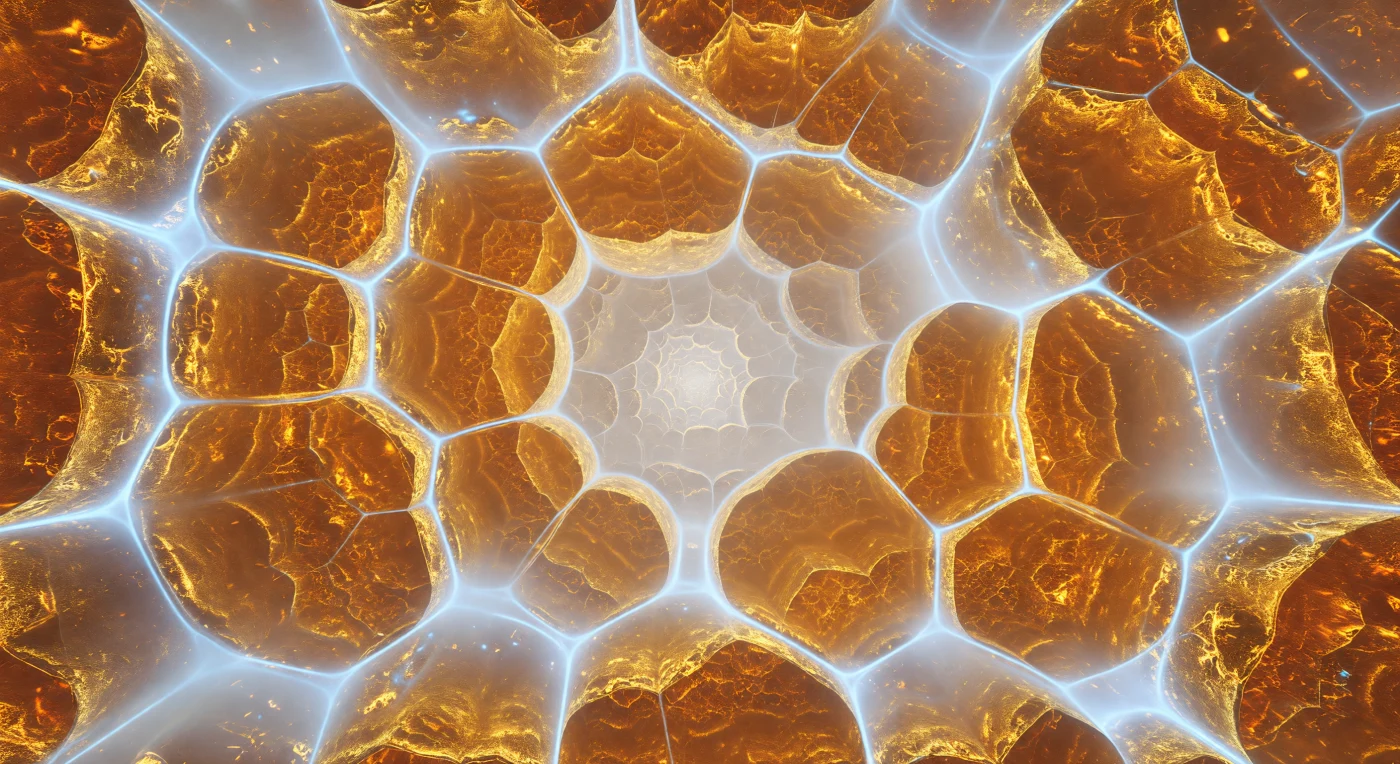
You find yourself inside a structure with no outside — every direction consumed by a dense, self-repeating architecture of amber-gold field domains packed so tightly that no gap survives between them, their boundaries igniting in razor-thin membranes of blue-white chromatic discontinuity wherever one color-field territory presses against the next. These are gluon saturation cells, each roughly a tenth of a femtometer across, so numerous and so densely overlapping in this ultra-relativistically boosted frame that the usual hierarchy of a few dominant color charges has dissolved entirely into a democratic foam — a regime physicists call gluon saturation, where the occupation number of low-momentum gluons reaches its quantum maximum and the system can absorb no further color field without nonlinear self-screening. Between every wall seam, a pale blue-white haze drifts in slow volumetric currents: the saturated sea of virtual quark-antiquark pairs, so densely materialized in this Lorentz-compressed interior that they no longer read as discrete events but as a continuous luminous medium, a chromodynamic dielectric filling every crack the amber foam leaves behind. Depth is felt not through open distance but through stacked translucency — each domain wall faintly semi-transparent, allowing the glow of the cell behind it and the cell behind that to accumulate in layered amber registers deepening toward a buried white-hot core that is always one more layer further in, unreachable, because the fractal tiling has no center and no edge, only more of itself at every scale you attempt to resolve.
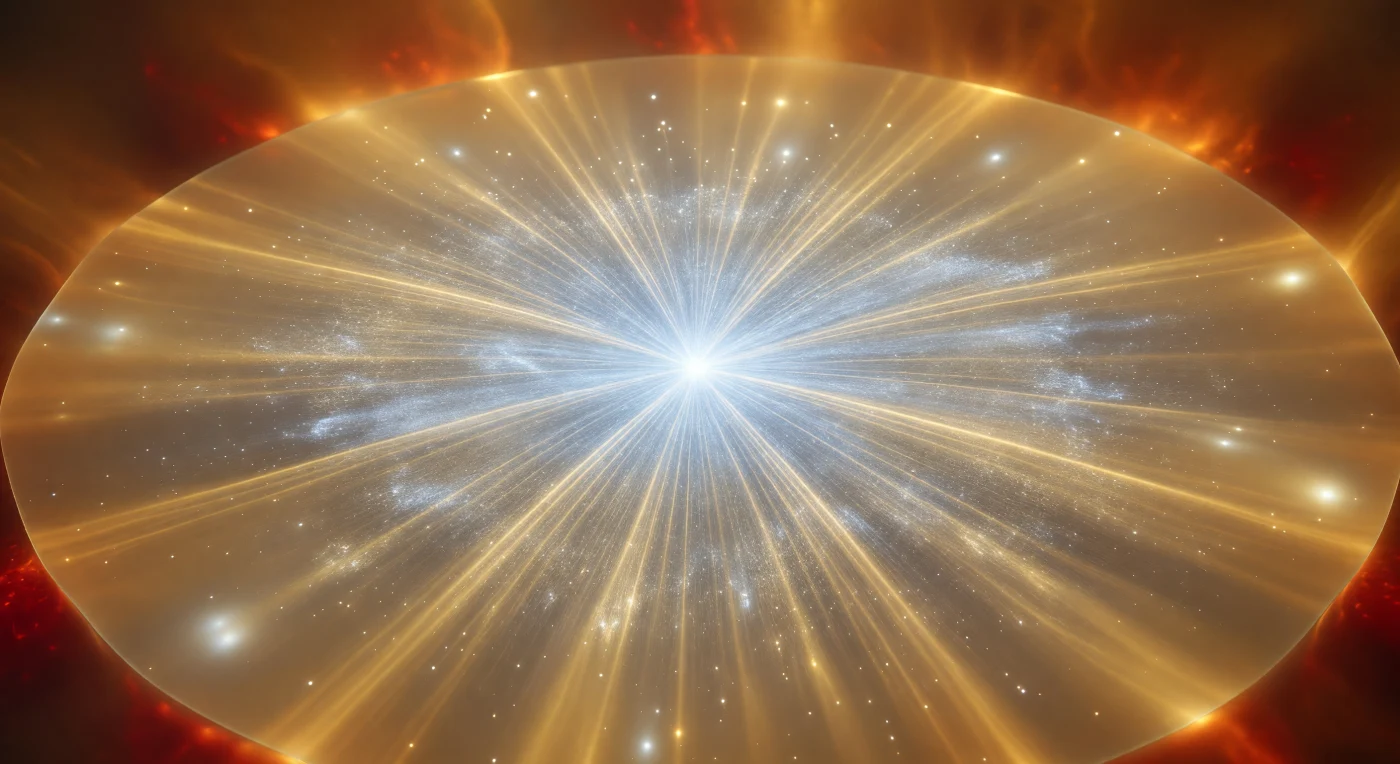
You are standing inside the eye of a force that contains itself by growing stronger the further you stray from it — a universe governed by a law precisely opposite to every intuition earned at human scales. What surrounds you is not empty space but the chromodynamic vacuum made traversable: at this extreme proximity to a valence quark, asymptotic freedom has thinned the medium to something approaching crystalline translucence, the coupling constant α_s having dropped toward near-perturbative weakness, so that the seething virtual-pair condensate of the outer volume recedes here into a fine luminous granularity — quantum stochastic texture, the residue of fluctuations too brief and too small to fully materialize, each one catching and releasing field energy at staggered rhythms like frost-crystal lit from within. At the center, the quark itself resolves not as a surface or a body but as a radial singularity of white-blue incandescence, its color charge projecting outward in long golden filaments of Coulomb-symmetric force — gluon field gradients rendered as volumetric fiber, following the SU(3) gauge geometry with an architectural precision that feels almost calm, almost inevitable. Yet the calm is conditional and bounded: as perception travels outward toward the full femtometer scale, the crystalline clarity thickens into amber haze and finally into the molten copper glow of confinement itself — flux-tube walls where the string tension κ ≈ 0.18 GeV²/fm reasserts, where the linear potential V(r) ≈ κr climbs without mercy, and where the only escape would cost enough energy to tear new matter from the vacuum and begin the whole entrapment again.
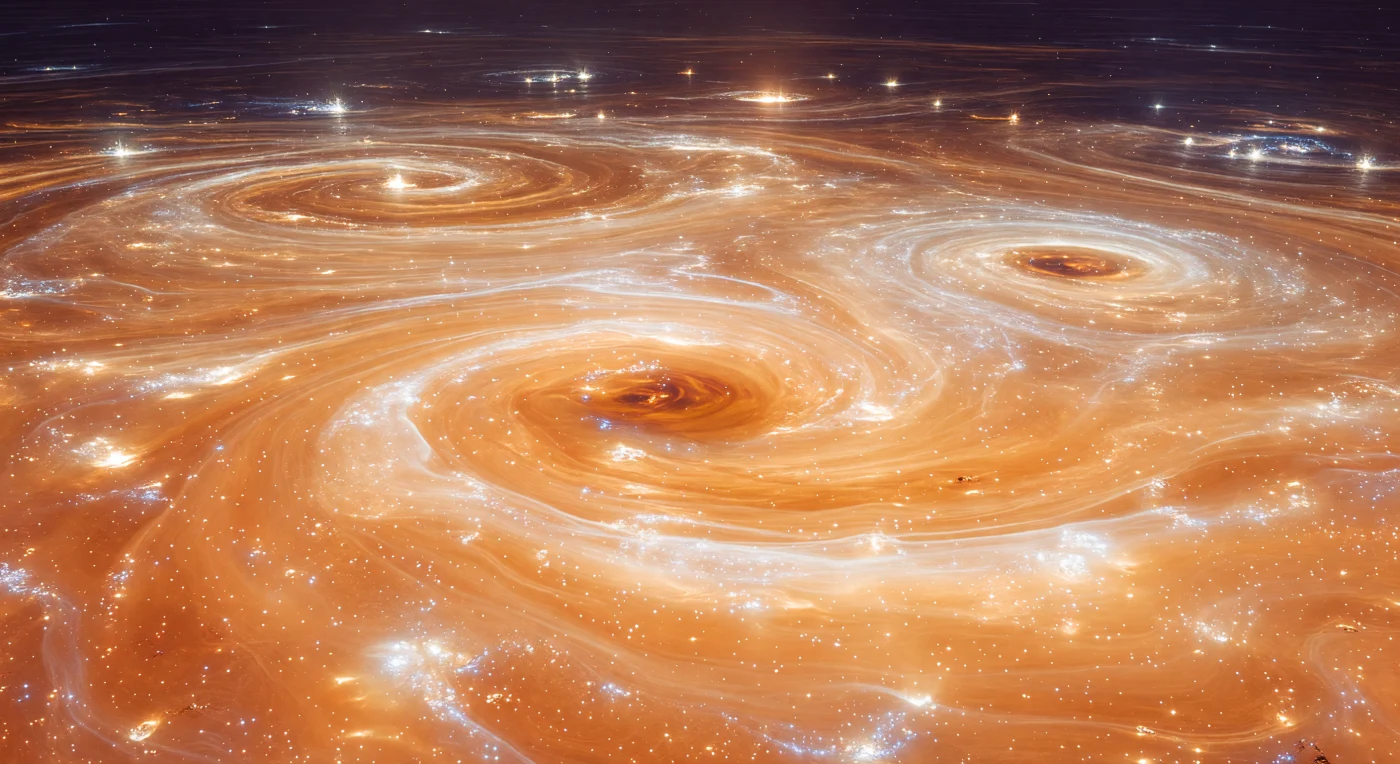
The viewer stands submerged within a boundless, self-luminous ocean of deconfined matter — not a plasma in any familiar sense but a saturated continuum of color charge dissolved entirely into heat and motion, where temperatures exceeding three trillion Kelvin have erased every distinction between particle and field into a single blinding, orange-white broth. This is quark-gluon plasma: a state of QCD matter that last existed naturally in the first microseconds after the Big Bang, now recreated fleetingly in heavy-ion collisions, in which quarks and gluons roam freely across femtometer distances rather than being bound within the chromodynamic wells of protons and neutrons. Enormous viscous vortices rotate around the observer like continental weather systems compressed to scales where light takes ten yoctoseconds to cross them, their inner cores pooling to deeper amber where energy density peaks, their outer arms brightening toward white phosphorescence as the fluid stretches and thins — the collective elliptic flow geometry of a cooling droplet of primordial matter made visible in luminous streaming filaments. Toward what might be called the horizon, the plasma surface grows violently agitated as the phase transition asserts itself: the thermal ocean cools just enough to crystallize its energy into discrete hadronic sparks that nucleate at the boundary with brief coronas of condensing field energy, then break free outward into a translucent violet-black vacuum whose own faint iridescent grain betrays the non-perturbative chromodynamic ground state beneath the silence. The light here casts no shadows because it radiates from within every attometer of the surrounding substance itself, and the granular, seething texture of the medium — virtual pairs condensing and annihilating faster than any resolved perception — speaks to a vacuum that is never truly empty but always already alive with the fluctuating architecture of the strong force.
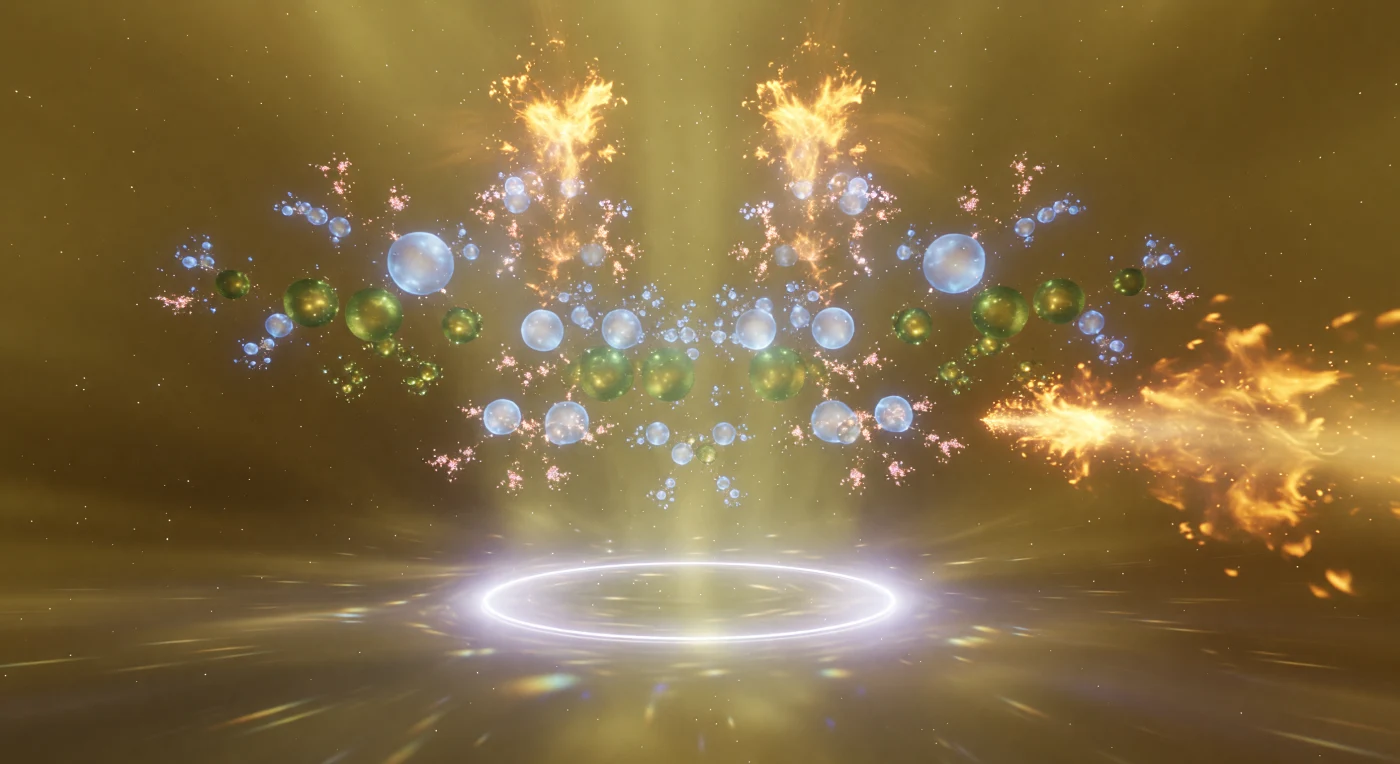
At the moment of hard scattering, the observer stands at the chromodynamic origin and watches a Lorentz-compressed disk of white-silver radiance vanish forward at nearly the speed of light, its passage leaving the surrounding vacuum trembling in an amber-gold haze of unspent color-field energy stretched to the breaking point. This is jet fragmentation: a struck quark carries away enormous momentum, and as the QCD string connecting it to the remnant stretches beyond roughly one femtometer, the tension — approximately 0.18 GeV per femtometer — becomes sufficient to nucleate new quark-antiquark pairs directly from the vacuum, snapping the string and producing a cascade of real hadrons in a self-similar branching tree. Each generation of string-break materializes as a bloom of orange-yellow luminescence that splits again into cooler tiers, with pale-blue pion motes coalescing at the lightest thresholds and heavier green-gold kaon nodes condensing more slowly among them, the entire collimated structure fanning forward within a narrow cone whose geometry is defined by the original quark's momentum. To one side, a broader amber sub-jet flares wide and coarse where a hard gluon was radiated before hadronisation began, redistributing field energy into a secondary branch that makes the whole luminous tree asymmetric — a visible record of a single quantum interaction whose entire duration, from the first string-stretch to the last particle materializing from the foam, lasted mere femtoseconds of strong-force time.
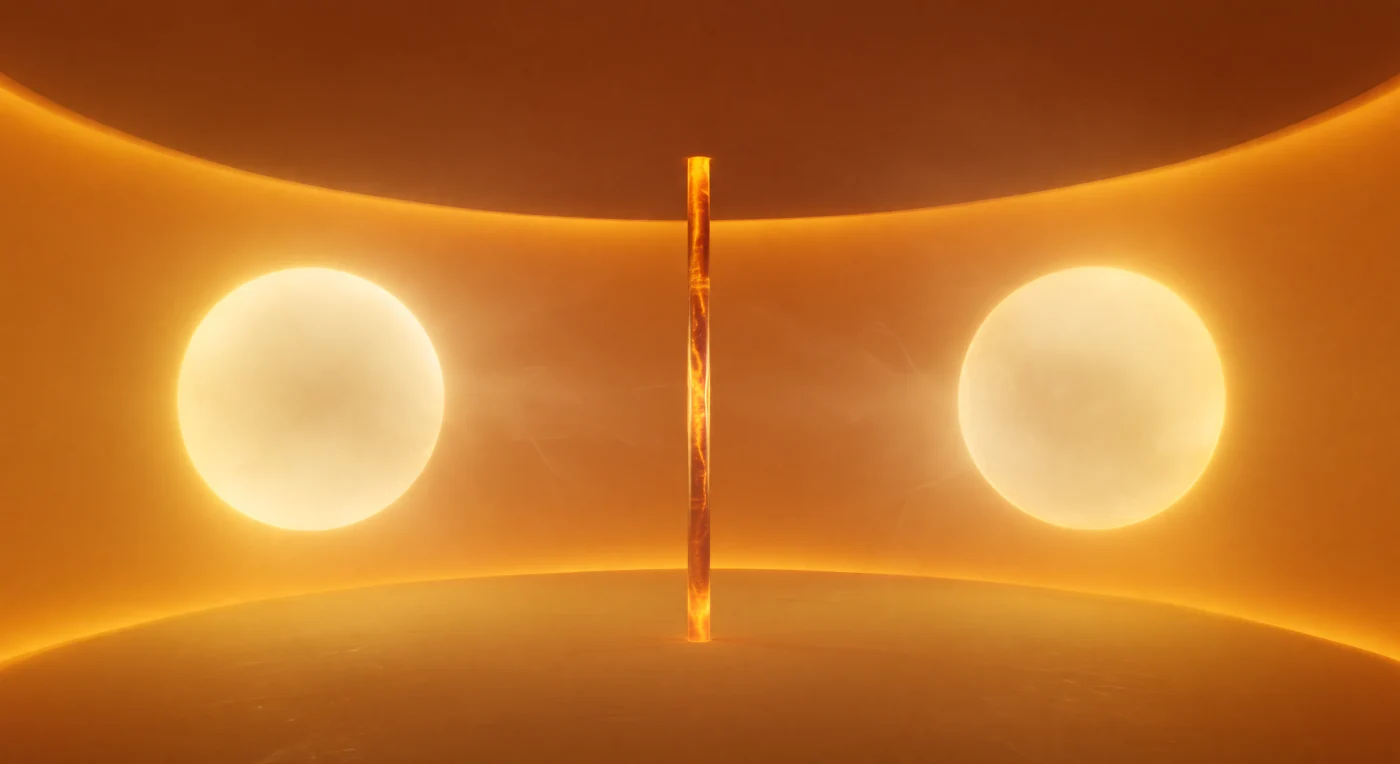
You stand inside a spherical enclosure barely four-tenths of a femtometer across, yet the proportions declare themselves as vast — a domed sanctuary of compressed chromodynamic fire whose amber walls press inward with the absolute authority of a force that grows stronger with every increment of distance, making escape not merely impossible but physically meaningless. Two massive golden-white presences face each other across the chamber: the charm quark and its antiquark, each far heavier than the up or down quarks that populate ordinary matter, their greater mass pulling them into genuinely non-relativistic orbits and gifting the entire interior with a stillness that lighter-quark hadrons never possess, their interiors choked with virtual-pair foam and instanton storms that have no counterpart here. Between the two nodes hangs the flux tube — narrow, steady, amber-orange, its chromodynamic string tension holding at roughly 0.18 GeV² per femtometer in a column so composed it reads less like a dynamic field and more like cooled resin, its linear confining potential rendering the color force as a warm thermal gradient that deepens visibly toward the perimeter, the boundary itself a darkening sienna where the vacuum's confinement pressure becomes total. The volumetric haze drifting in slow gossamer wisps toward the flux column is the quantum vacuum made visible — not empty space but a condensate of broken chiral symmetry, the ambient medium through which the strong interaction writes its laws — and the cathedral silence of the whole interior is the silence of a system so precisely balanced between kinetic energy and chromodynamic binding that it persists as a discrete spectroscopic state, the J/ψ meson, sharp enough in mass to have announced the existence of charm itself to the world above.
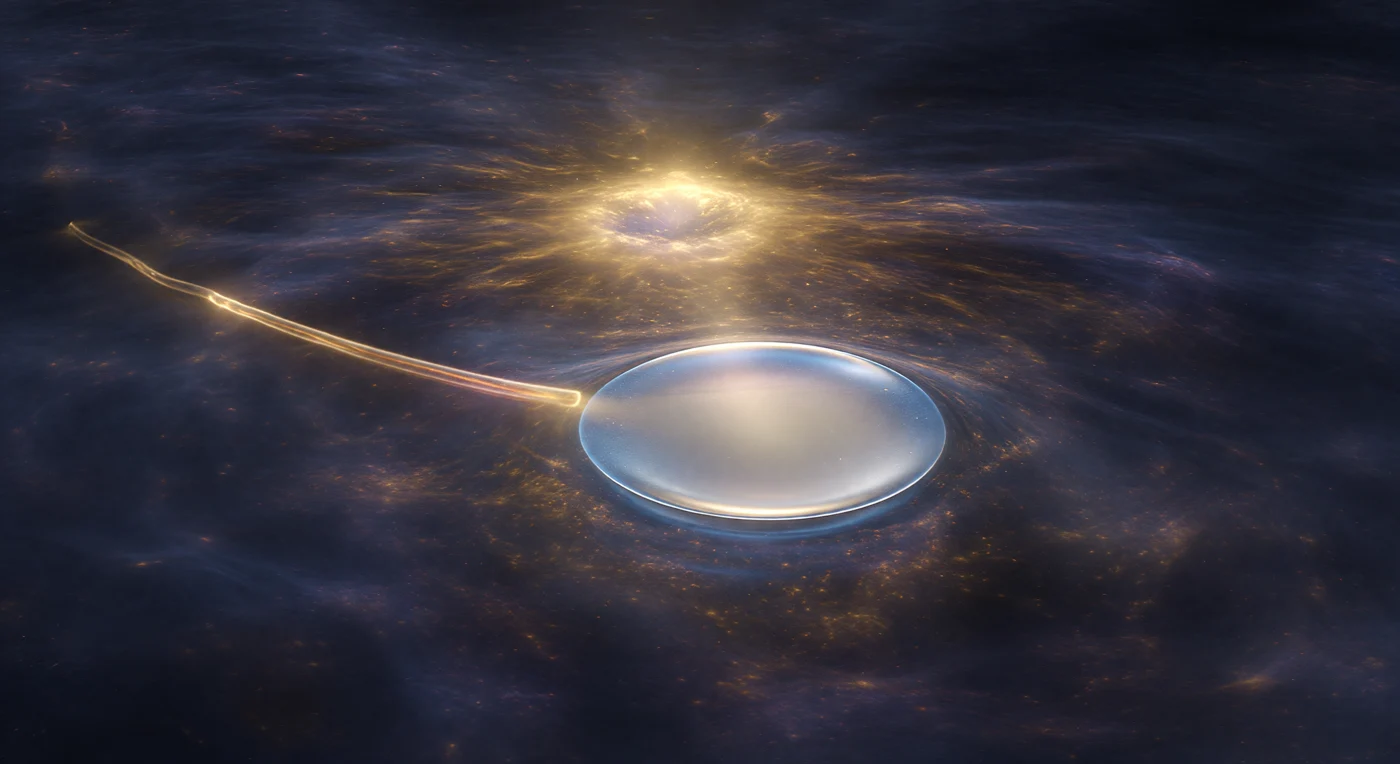
At a distance of perhaps two femtometers, the viewer confronts a wound in the fabric of the quantum vacuum itself: a point of near-singular white-gold radiance so intensely compressed that the surrounding chromodynamic medium — a churning indigo-charcoal ground state threaded with amber gluonic condensate and brief ember-bright flickers of virtual pair condensation — curves visibly inward around it, sheared into a radial lens of field stress before any flux tube can fully organize. Then the detonation: a geometrically perfect sphere of silver-blue electroweak luminescence expands outward from that core, its glassy, cold-metallic leading edge texturally alien against the granular warmth of the QCD medium, the boundary between the two field-worlds razor-sharp — one smooth and iridescent, the other turbulent and storm-lit, the contrast encoding the fundamental distinction between the electroweak and strong forces. The top quark, the heaviest known fermion at roughly 173 GeV/c², is so massive that its lifetime — on the order of 10⁻²⁵ seconds — is shorter than the timescale required for color confinement to operate, meaning it decays as a bare quark before a hadron can form around it, making this silver-blue W-boson emission not an interruption of hadronic physics but a pre-emption of it. Behind the detonation point, the recoiling bottom quark trails a nascent flux tube into the vacuum: a delicate filament of molten-gold chromodynamic field, barely forming, its string tension already compressing the surrounding medium along its flanks, the far end already shimmering with the earliest nucleation of the pairs that will eventually snap it into new matter.
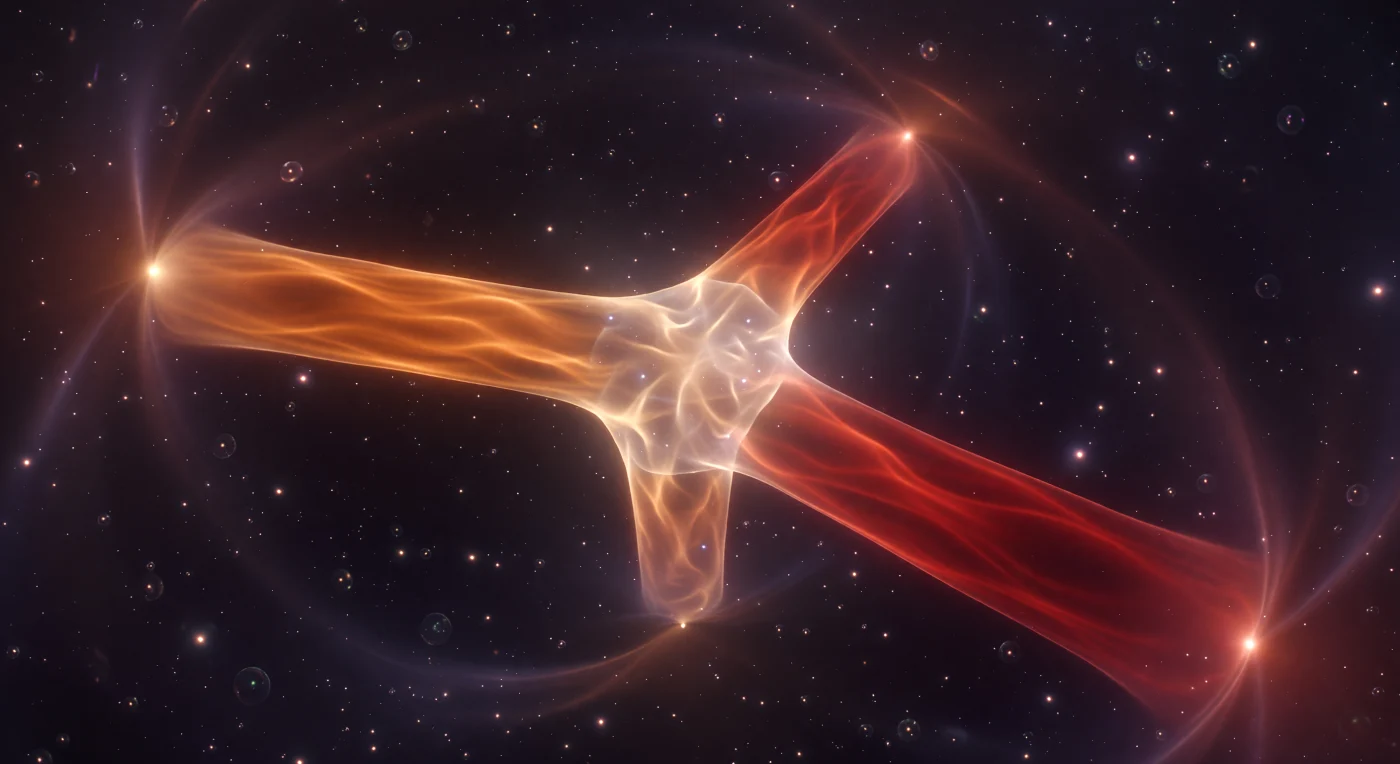
Standing at the junction of three diverging flux tubes deep within a baryon, you look outward along corridors of pure chromodynamic field energy — two blazing warm orange toward the up quarks, one shifting into cooler crimson toward the down — while behind you the junction itself pulses as a white-gold interference knot, its threefold lobes blooming and collapsing in the restless rhythm of color charge equilibrium. These are gluon flux tubes made visible: not metaphors but the literal chromodynamic strings that enforce confinement, carrying a string tension of roughly 0.18 GeV² per femtometer, binding the quarks together with a force that only grows as distance increases, making escape thermodynamically impossible without nucleating new matter from the vacuum itself. Around you the surrounding medium is far from empty — brief translucent spheres bloom and vanish in the dark, each one an instanton, a topological storm in the vacuum condensate that reshuffles chiral structure before dissolving back into the granular haze of the chiral condensate, the background field that permeates the entire hadronic interior. The corridors sway with the thermal motion of the quarks at their far ends, sweeping their amber and crimson light across a faint, soap-bubble boundary wall — the confinement surface, the limit of the hadron — which catches each passing beam in a ghost of pale amber before retreating again into the instanton-flecked dark. Every direction leads inward, every force pulls toward structure, and the only light anywhere in this sealed world is the light that confinement itself has made.
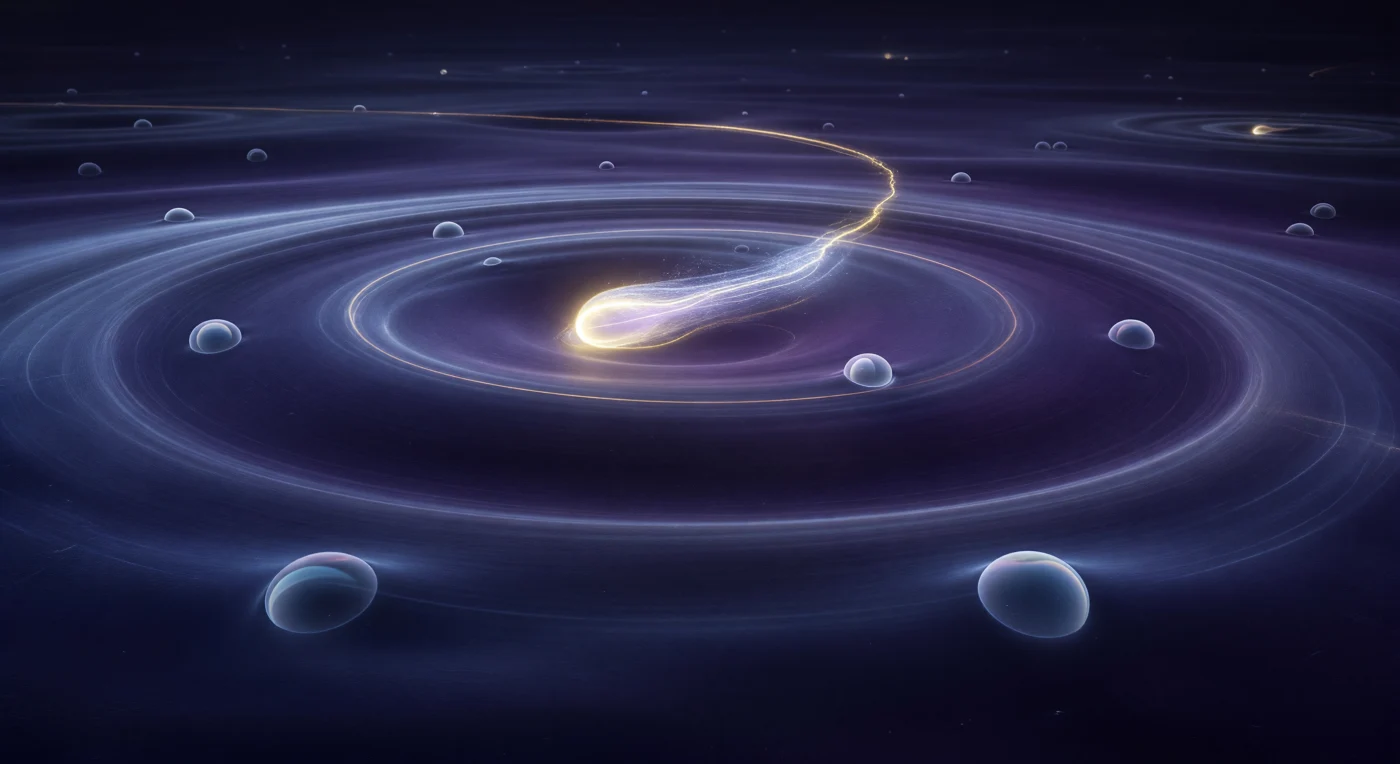
The observer floats suspended inside a substance that is neither space nor matter but something older than both — the chiral condensate, a non-perturbative vacuum condensate of quark-antiquark pairs whose spontaneous formation breaks the chiral symmetry of QCD and in doing so donates roughly 300 MeV of constituent mass to every quark that moves through it, transforming nearly massless current quarks into the heavy, sluggish objects that build protons and neutrons. All around, the medium presses inward with a dark indigo-violet density that carries no classical analogue: it is structured nothingness, an order parameter ⟨ψ̄ψ⟩ ≠ 0 filling all hadronic space at a scale of femtometers, its inner luminescence the diffuse signature of latent QCD energy with nowhere to dissipate. Ahead, a quark blazes a white-gold trail as its field aura visibly fattens with absorbed mass, the surrounding condensate warping subtly inward in response to its color charge, while gossamer blue-violet rings expand outward across the medium wherever a pion — the pseudo-Goldstone boson born precisely because chiral symmetry was broken — sends a low-energy disturbance rippling through the fabric. Scattered through the violet dark, pale spherical bubbles silently open and seal where thermal or quantum fluctuations momentarily restore chiral symmetry, their iridescent walls a fleeting reminder that this dense, ancient medium is not permanent law but a chosen ground state, the universe settling into the lowest available energy like breath condensing on cold glass — and that all visible mass begins here, in the stillness of a broken symmetry.
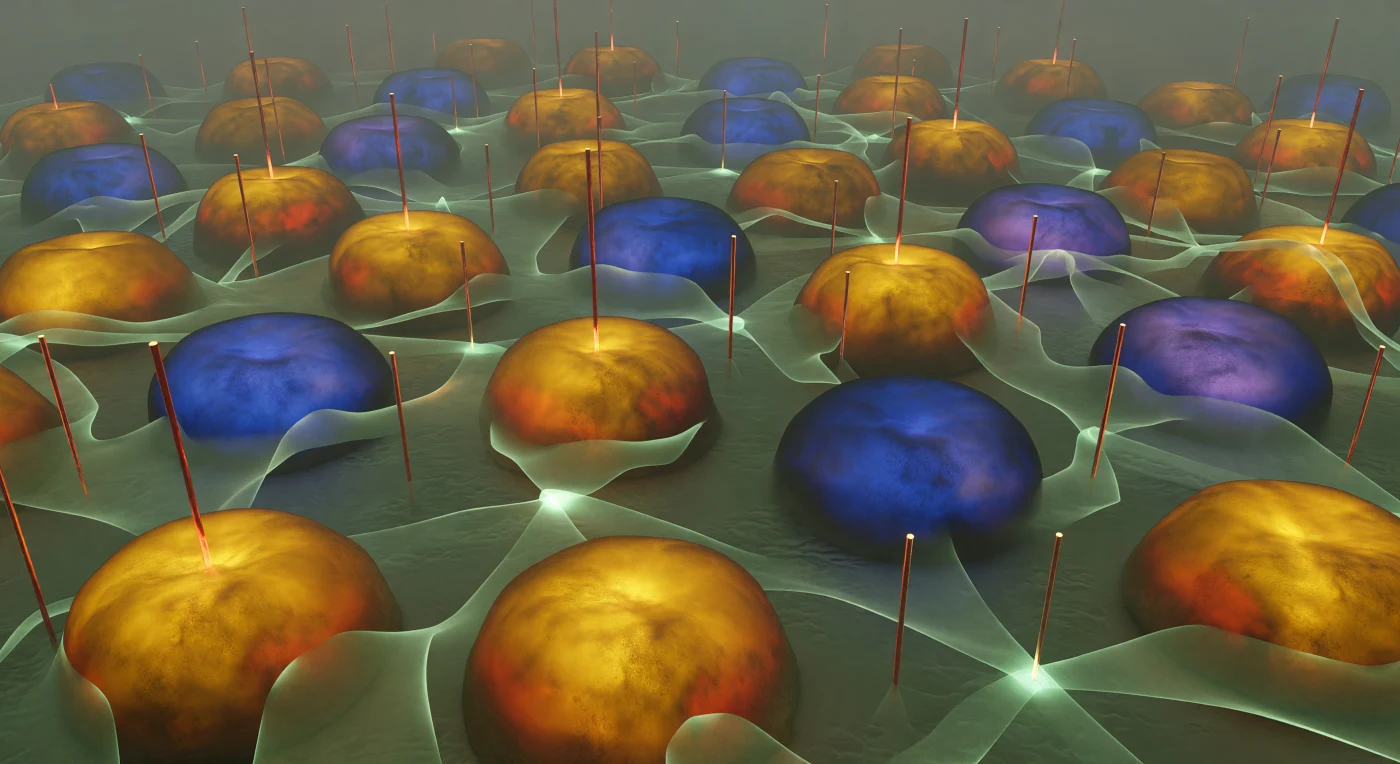
The viewer floats without footing inside what appears to be a dense, breathing reef of vacuum — not empty space but a teeming chromodynamic architecture in which warm amber-ochre masses and cool blue-violet counterparts alternate throughout the volume like sessile organisms maintaining territorial spacing, each one a topological instanton or anti-instanton: a localized, violent tunneling event in the gluon field that has shaped the structure of the vacuum itself. Threading between and through these blobs, thin pale-celadon membranes — center vortex sheets carrying quantized magnetic flux of the color field — drape and intersect like translucent kelp, their luminous rims marking the boundaries of chromodynamic disorder that underpin confinement, while vertical red-gold Polyakov filaments rise needle-straight through the entire assembly, encoding the thermodynamic response of color charge to the surrounding field. The muted gray-green haze that swallows the middle distance is not obscuring darkness but the gluon condensate itself, the non-perturbative ground state of QCD in which chiral symmetry is broken and quark masses are dynamically generated — a medium so energetically dense that the notion of empty space has no meaning here. Everything visible is, by any classical definition, vacuum: the seething, structured, topologically complex ground from which all hadronic matter is built.
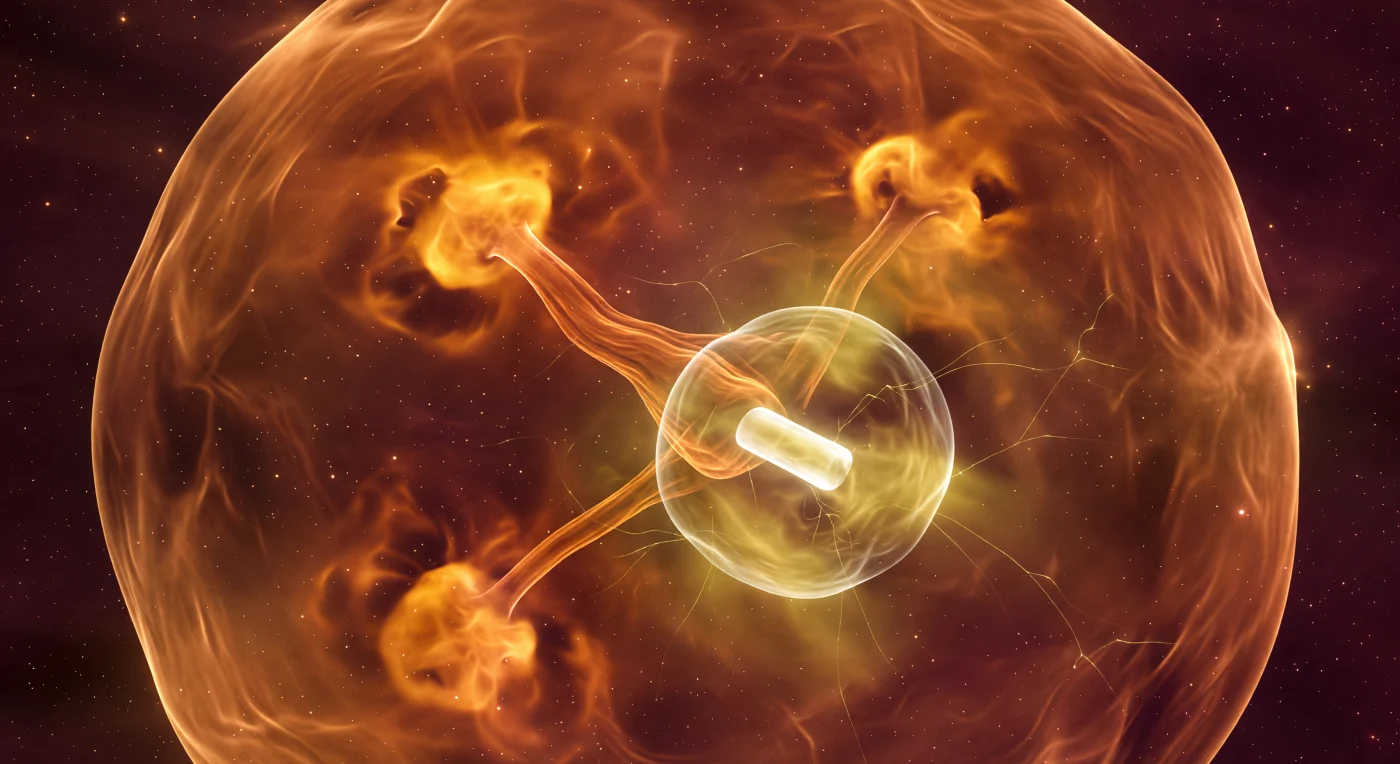
You are suspended inside a structure that should not exist — a fleeting, asymmetric cathedral of chromodynamic pressure whose amber walls curve overhead and tremble at their edges, flickering with the irregular pulse of a system already coming apart. The dominant enclosure is the proton bubble, its warm interior suffused with tangerine and burnt sienna haze through which three dense valence nodes burn like knots of concentrated fire, joined by a Y-shaped ridge of collimated flux — a physical rope of plasma-orange light whose braided surface ripples with longitudinal texture, the visible signature of the QCD string tension binding color charges at roughly a tenth of a millionth of a billionth of a meter. Pressed against the inner wall, interpenetrating it in a crescent of strained citrine luminescence, the charmonium inclusion floats like a cold jewel: its charm-anticharm pair locked together by a near-white flux tube so tightly bound it appears almost solid, its harder geometry a direct consequence of the charm quark's greater mass and correspondingly shorter confinement radius. Gossamer threads of multi-gluon exchange drift through the shared boundary, barely distinguishable from the ambient vacuum noise — that deep burgundy-violet ground-state that seethes with virtual pair condensations flickering at the limits of perception, each a quantum fluctuation completing its entire existence before the strong interaction has time to cross the structure once. The asymmetric outer boundary shivers and dims unevenly on one side, geometry lopsiding with each pulse, the whole extraordinary compound object dissolving even as you witness it.
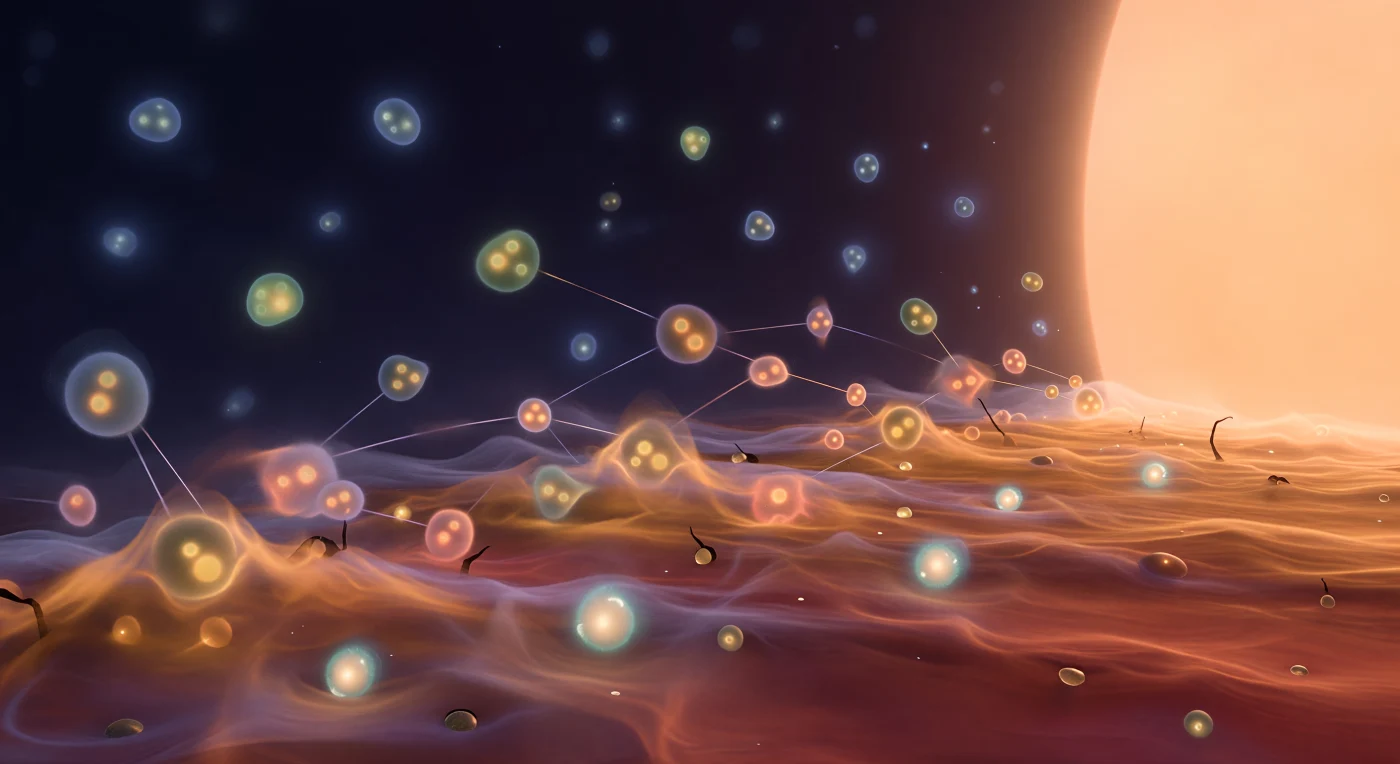
The observer stands precisely at the boundary where two irreconcilable phases of matter confront one another across a turbulent transition surf no wider than a single proton — on one side the confined hadronic realm, a cathedral-dark vacuum alive with isolated luminous motes of pions, kaons, and proton-mass baryons tethered to one another by hair-thin chromodynamic flux tubes that resist separation with an elastic force growing stronger the further they stretch, and on the other an advancing wall of quark-gluon plasma, a state of deconfined matter that existed only in the first microseconds after the Big Bang and briefly re-emerges in the cores of ultrarelativistic heavy-ion collisions when temperatures exceed 150 MeV and the strong coupling constant weakens enough to liberate color charge from its hadronic prison. Within the transition zone itself — a band governed not by any surface tension visible to macroscopic intuition but by the non-perturbative dynamics of QCD at the crossover temperature — hadronic objects partially dissolve as their outer color-field halos fray and their flux-tube connections fragment mid-span, each severed string end releasing a brief blossom of luminosity before new quark-antiquark pairs nucleate from the vacuum energy and either reform into fresh hadrons or are absorbed into the advancing plasma front. Instantonic storms punctuate this surf as transient spherical brightnesses — compact topological fluctuations of the gauge field that tunnel between distinct vacuum states, each lasting a fraction of 10⁻²⁴ seconds before collapsing back into the chromodynamic foam — while dark fingers of partially hadronizing matter briefly penetrate inward against the plasma face before sealing over with bronze warmth. The entire scene is lit by a profound asymmetry: behind, only the cold self-luminescence of individual hadronic motes and the faint iridescent haze of the confining vacuum condensate; ahead, the indiscriminate thermal radiance of fully deconfined matter pressing outward with the energy of a state where quarks and gluons move as freely as photons in a stellar corona.