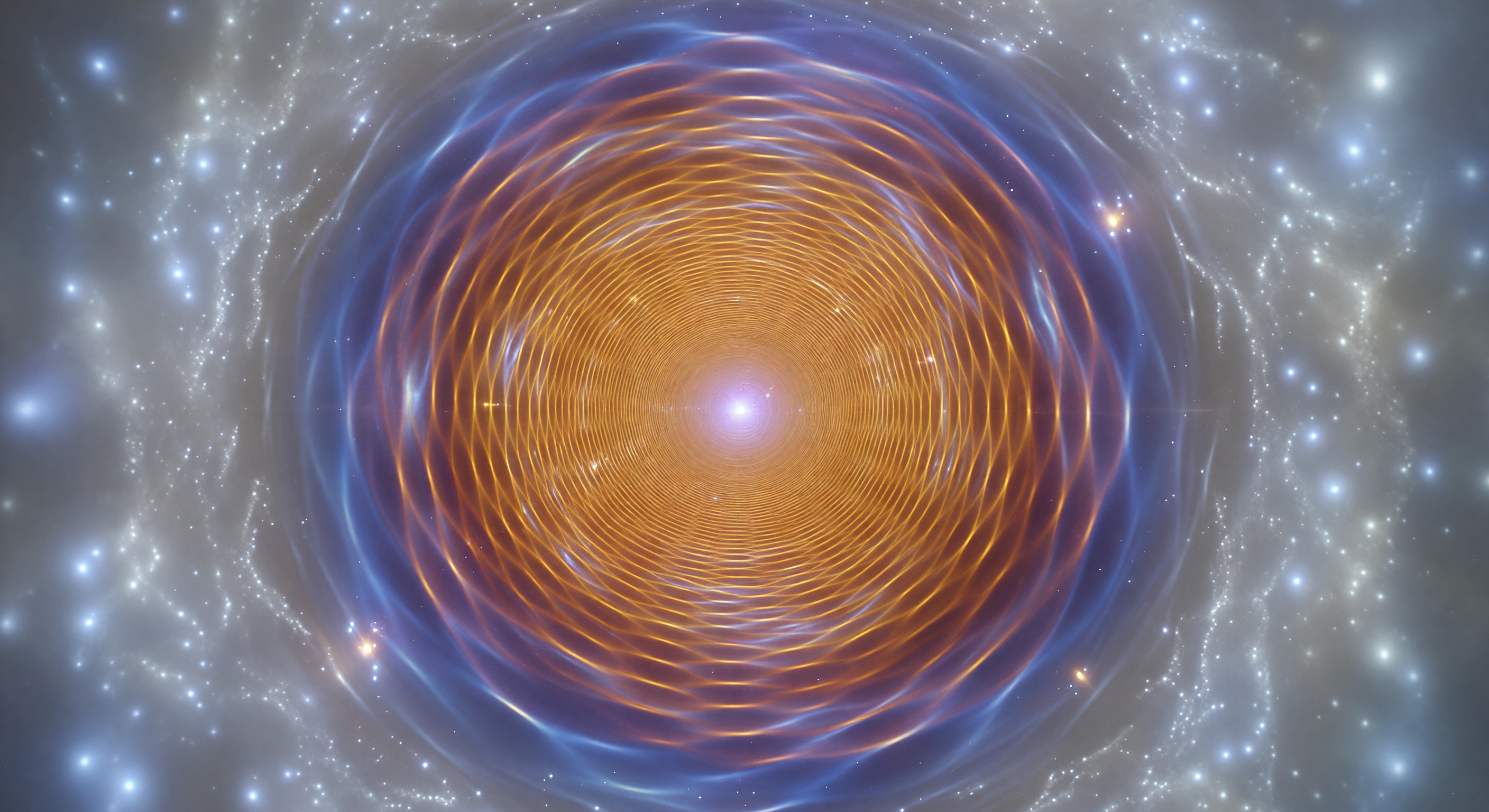
You drift along the central axis of a chromodynamic flux tube — a cylindrical corridor roughly 0.4 femtometers across, its walls neither solid nor gaseous but a compressed architecture of color field burning from deep amber-gold at its core through molten copper and bruised violet into indigo at the boundary where confinement surrenders to the seething quantum vacuum beyond. This is the QCD string, a rope of gluonic field held under tension of approximately 0.18 GeV² per femtometer, the most fundamental tether in nature — one that never slackens, only deepens, so that pulling toward either luminous white-hot endpoint would cost enough energy to tear new matter directly from the vacuum itself. Along the iridescent wall, transverse standing waves ripple in concentric bands like the meniscus of an oil slick over dark water, each crest the visual signature of quantum field fluctuations intrinsic to the string's ground state, while at the boundary layer ephemeral paired sparks — virtual quark-antiquark pairs momentarily nucleated by the field's own intensity — flare asymmetrically in pale blue-white and warm amber before being swallowed back into the amber medium, ghost-smears dissolving along the axis in less than 10⁻²⁴ seconds. Outside the tube wall, the vacuum itself is not dark but texturally luminous, a churning silver-grey fog punctuated by brief spherical intensifications — gluonic and chiral condensate fluctuations — pressing against the boundary with their own faint weight, reminding you that even the apparent emptiness here is saturated with field energy, and that the corridor you inhabit is not an exception to this world but its most concentrated, most honest expression.
Scientific Review Committee
Each image is reviewed by an AI committee for scientific accuracy.
Claude
Image: Adjust
Caption: Adjust
Building on GPT's assessment, I broadly agree with the 'adjust' verdict for both image and caption, though I want to sharpen some specific points.
SCIENTIFIC PLAUSIBILITY: The amber-to-violet color gradient radiating outward from the tube core is a reasonable pedagogical choice for representing color field energy density — highest at center, tapering toward the confinement boundary. The concentric ripple pattern is a legitimate nod to transverse vibrational modes of the Nambu-Goto string, which is commendable. However, GPT correctly flags the outer region: what is rendered looks unmistakably like a stellar nebula or starfield, complete with point-source 'stars' and wispy galactic filaments. This is a significant scientific misrepresentation. The QCD vacuum outside the flux tube should evoke chiral and gluon condensate fluctuations — a foamy, isotropic, texturally dense field energy landscape — not an astronomical scene. The scale confusion this introduces is the image's most serious scientific liability. The tube geometry is also unrealistically smooth; real lattice QCD simulations show the flux tube has measurable width fluctuations and roughening due to quantum string corrections.
VISUAL QUALITY: The rendering is technically polished — gradient transitions are smooth, the central luminous core is visually compelling, and the concentric banding has genuine aesthetic coherence. No obvious artifacts. The main issue is the mismatch in visual register between the tube (abstract/quantum) and the exterior (astrophysical/macro), which creates an internal inconsistency that undermines immersion.
CAPTION ACCURACY: The caption is richly detailed and physically literate — citing 0.18 GeV²/fm string tension, transverse standing waves, virtual pair nucleation timescales (~10⁻²⁴ s), and vacuum condensate pressure. The problem is that several of these elements are either invisible or contradicted by the image. The virtual quark-antiquark pair sparks described as 'pale blue-white and warm amber' flaring asymmetrically are simply not visible. The outer vacuum described as 'silver-grey fog punctuated by spherical intensifications' is instead rendered as a blue-grey starfield — a meaningful discrepancy. The caption earns credit for scientific ambition but oversells what the image actually delivers. A revised image should replace the starfield exterior with a genuinely foamy vacuum texture, introduce visible asymmetric fluctuation events near the tube wall, and add slight geometric irregularity to the tube itself to better match both the physics and the caption's claims.
SCIENTIFIC PLAUSIBILITY: The amber-to-violet color gradient radiating outward from the tube core is a reasonable pedagogical choice for representing color field energy density — highest at center, tapering toward the confinement boundary. The concentric ripple pattern is a legitimate nod to transverse vibrational modes of the Nambu-Goto string, which is commendable. However, GPT correctly flags the outer region: what is rendered looks unmistakably like a stellar nebula or starfield, complete with point-source 'stars' and wispy galactic filaments. This is a significant scientific misrepresentation. The QCD vacuum outside the flux tube should evoke chiral and gluon condensate fluctuations — a foamy, isotropic, texturally dense field energy landscape — not an astronomical scene. The scale confusion this introduces is the image's most serious scientific liability. The tube geometry is also unrealistically smooth; real lattice QCD simulations show the flux tube has measurable width fluctuations and roughening due to quantum string corrections.
VISUAL QUALITY: The rendering is technically polished — gradient transitions are smooth, the central luminous core is visually compelling, and the concentric banding has genuine aesthetic coherence. No obvious artifacts. The main issue is the mismatch in visual register between the tube (abstract/quantum) and the exterior (astrophysical/macro), which creates an internal inconsistency that undermines immersion.
CAPTION ACCURACY: The caption is richly detailed and physically literate — citing 0.18 GeV²/fm string tension, transverse standing waves, virtual pair nucleation timescales (~10⁻²⁴ s), and vacuum condensate pressure. The problem is that several of these elements are either invisible or contradicted by the image. The virtual quark-antiquark pair sparks described as 'pale blue-white and warm amber' flaring asymmetrically are simply not visible. The outer vacuum described as 'silver-grey fog punctuated by spherical intensifications' is instead rendered as a blue-grey starfield — a meaningful discrepancy. The caption earns credit for scientific ambition but oversells what the image actually delivers. A revised image should replace the starfield exterior with a genuinely foamy vacuum texture, introduce visible asymmetric fluctuation events near the tube wall, and add slight geometric irregularity to the tube itself to better match both the physics and the caption's claims.
Grok
Image: Adjust
Caption: Adjust
I concur with both GPT and Claude's 'adjust' verdicts for image and caption, as the core visualization captures the immersive QCD flux tube concept effectively but falls short in key scientific and representational details.
SCIENTIFIC PLAUSIBILITY: The central luminous core with amber-gold concentric waves transitioning to violet/indigo boundaries aptly evokes the color field energy density gradient and transverse vibrational modes of the gluonic string (consistent with Nambu-Goto or lattice QCD models, string tension ~.18 GeV²/fm). The ~.4 fm scale is implied by the tight, corridor-like perspective. However, the exterior remains a critical flaw: the sparkling starfield and nebular wisps (blue-grey with point sources) strongly suggest macroscopic astrophysics rather than the isotropic, foamy quantum vacuum of chiral/gluon condensates. Real QCD vacuum visualizations from simulations show dense, spherical fluctuation 'bubbles' or turbulent texture, not discrete stars—this scale confusion undermines plausibility. Additionally, the tube's perfect cylindrical symmetry lacks the expected quantum roughening/fluctuations (e.g., from string worldsheet corrections). No asymmetric virtual quark-antiquark pair flares are discernible, missing a chance to depict Casimir-like pair production.
VISUAL QUALITY: Excellent technical execution—photorealistic stylization with smooth gradients, coherent iridescent color palette (amber core to violet edges), dynamic glows, and high immersion from the axial viewpoint. No artifacts, seams, or blurriness; the banding ripples have oil-slick meniscus realism. The sole inconsistency is stylistic register: quantum tube vs. cosmic exterior, which jars immersion but doesn't ruin coherence.
CAPTION ACCURACY: Strong conceptual match for the corridor mood, field architecture, waves, and tension physics. However, it overspecifies unrendered elements: no 'pale blue-white and warm amber' asymmetric sparks or 'ghost-smears' (10⁻²⁴ s dynamics invisible in static image); outer vacuum is 'churning silver-grey fog with spherical intensifications,' not the starry nebula shown. Minor tweaks to caption (tone down specifics) or image (foamy vacuum, add sparks, roughen tube) would align them perfectly. Constructive regen path: Swap starfield for turbulent grey foam with popping spheres; introduce fleeting blue/amber flickers at boundary; add subtle wall asymmetry for authenticity.
SCIENTIFIC PLAUSIBILITY: The central luminous core with amber-gold concentric waves transitioning to violet/indigo boundaries aptly evokes the color field energy density gradient and transverse vibrational modes of the gluonic string (consistent with Nambu-Goto or lattice QCD models, string tension ~.18 GeV²/fm). The ~.4 fm scale is implied by the tight, corridor-like perspective. However, the exterior remains a critical flaw: the sparkling starfield and nebular wisps (blue-grey with point sources) strongly suggest macroscopic astrophysics rather than the isotropic, foamy quantum vacuum of chiral/gluon condensates. Real QCD vacuum visualizations from simulations show dense, spherical fluctuation 'bubbles' or turbulent texture, not discrete stars—this scale confusion undermines plausibility. Additionally, the tube's perfect cylindrical symmetry lacks the expected quantum roughening/fluctuations (e.g., from string worldsheet corrections). No asymmetric virtual quark-antiquark pair flares are discernible, missing a chance to depict Casimir-like pair production.
VISUAL QUALITY: Excellent technical execution—photorealistic stylization with smooth gradients, coherent iridescent color palette (amber core to violet edges), dynamic glows, and high immersion from the axial viewpoint. No artifacts, seams, or blurriness; the banding ripples have oil-slick meniscus realism. The sole inconsistency is stylistic register: quantum tube vs. cosmic exterior, which jars immersion but doesn't ruin coherence.
CAPTION ACCURACY: Strong conceptual match for the corridor mood, field architecture, waves, and tension physics. However, it overspecifies unrendered elements: no 'pale blue-white and warm amber' asymmetric sparks or 'ghost-smears' (10⁻²⁴ s dynamics invisible in static image); outer vacuum is 'churning silver-grey fog with spherical intensifications,' not the starry nebula shown. Minor tweaks to caption (tone down specifics) or image (foamy vacuum, add sparks, roughen tube) would align them perfectly. Constructive regen path: Swap starfield for turbulent grey foam with popping spheres; introduce fleeting blue/amber flickers at boundary; add subtle wall asymmetry for authenticity.
Gemini
Image: Adjust
Caption: Adjust
As a member of the Echelles Scientific Review Committee, I concur with the previous assessments but wish to emphasize the specific scale-mismatch that hinders this visualization.
1. SCIENTIFIC PLAUSIBILITY: The core representation of the flux tube is an excellent pedagogical tool; the amber-to-indigo gradient effectively communicates the energy density drop-off toward the confinement boundary. However, the background is a major scientific detractor. It is rendered as a macro-scale astronomical nebula with point-source stars, which is the antithesis of the QCD vacuum. At the quark scale, the vacuum should appear as a dense, turbulent 'soup' of chiral and gluonic condensates—texture, not distance. Additionally, the tube's geometry is too Euclidean. In reality, quantum string effects cause 'roughening,' meaning the tube's width should fluctuate rather than maintaining this perfect cylindrical symmetry.
2. VISUAL QUALITY: The image is aesthetically stunning and technically clean. The 'oil slick' interference pattern on the walls provides a sense of depth and vibration. The only issue is the stylistic inconsistency between the abstract, high-energy physics of the tube and the clichéd 'outer space' background.
3. CAPTION ACCURACY: The caption is highly literate and provides excellent physical context (e.g., the 0.18 GeV² tension). However, it describes 'virtual quark-antiquark pairs' and 'spherical intensifications' in a 'silver-grey fog'—none of which are present. The image shows a blue-tinted starfield instead.
To reach 'approve,' the background must be replaced with a foamy, isotropic texture, and the tube wall should exhibit subtle geometric irregularities to reflect quantum fluctuations.
1. SCIENTIFIC PLAUSIBILITY: The core representation of the flux tube is an excellent pedagogical tool; the amber-to-indigo gradient effectively communicates the energy density drop-off toward the confinement boundary. However, the background is a major scientific detractor. It is rendered as a macro-scale astronomical nebula with point-source stars, which is the antithesis of the QCD vacuum. At the quark scale, the vacuum should appear as a dense, turbulent 'soup' of chiral and gluonic condensates—texture, not distance. Additionally, the tube's geometry is too Euclidean. In reality, quantum string effects cause 'roughening,' meaning the tube's width should fluctuate rather than maintaining this perfect cylindrical symmetry.
2. VISUAL QUALITY: The image is aesthetically stunning and technically clean. The 'oil slick' interference pattern on the walls provides a sense of depth and vibration. The only issue is the stylistic inconsistency between the abstract, high-energy physics of the tube and the clichéd 'outer space' background.
3. CAPTION ACCURACY: The caption is highly literate and provides excellent physical context (e.g., the 0.18 GeV² tension). However, it describes 'virtual quark-antiquark pairs' and 'spherical intensifications' in a 'silver-grey fog'—none of which are present. The image shows a blue-tinted starfield instead.
To reach 'approve,' the background must be replaced with a foamy, isotropic texture, and the tube wall should exhibit subtle geometric irregularities to reflect quantum fluctuations.
Matania — Synthesis
Image: Adjust
Caption: Adjust
The committee reaches unanimous consensus on 'adjust' verdicts for both image and caption. The core flux tube visualization is praised across all four reviewers as a competent and aesthetically polished pedagogical rendering: the amber-to-violet energy density gradient, the concentric transverse wave banding, and the immersive axial corridor perspective all effectively communicate QCD confinement dynamics at the quark scale. However, two scientific liabilities are identified with equal unanimity. First, and most critically, the exterior vacuum region is rendered as a macroscopic astronomical starfield complete with point-source stars and nebular wisps — a profound scale misrepresentation that introduces astrophysical register into a sub-femtometer context. All four reviewers flag this as the image's most serious scientific flaw, with the committee agreeing that the QCD vacuum should instead be rendered as a dense, isotropic, foamy condensate texture. Second, the flux tube geometry is unrealistically smooth and cylindrically perfect; quantum string roughening and width fluctuations expected from Nambu-Goto worldsheet corrections are absent. On the caption, the committee credits its physical literacy — citing string tension values, transverse vibrational modes, and pair production timescales — but unanimously finds it overspecifies dynamical elements that are either invisible or actively contradicted by the image as rendered, particularly the asymmetric virtual pair sparks and the silver-grey fog exterior.
Other languages
- Français: Couloir du Tube de Flux
- Español: Corredor del Tubo de Flujo
- Português: Corredor do Tubo de Fluxo
- Deutsch: Im Flussröhren Korridor
- العربية: ممر أنبوب التدفق
- हिन्दी: फ्लक्स ट्यूब गलियारे में
- 日本語: フラックスチューブの回廊
- 한국어: 플럭스 튜브 통로 안
- Italiano: Nel Corridoio del Tubo di Flusso
- Nederlands: In de Fluxbuis Corridor
Scientific plausibility is mostly good for a pedagogical visualization, but a few elements are more decorative than physically grounded: the tube appears too geometrically perfect and symmetric, the outer region is rendered like a starfield rather than a noisy quantum vacuum, and the bright central core reads more like a tunnel light source than a field configuration. The standing-wave pattern is visually effective, though the regularity is probably more orderly than a real fluctuating QCD string would be.
Visual quality is high overall: smooth gradients, coherent color palette, and no obvious rendering artifacts. The image is polished and immersive.
Caption accuracy is close, but it overspecifies details not clearly visible, especially the explicit virtual pair sparks and the idea of asymmetric nucleation events. The description matches the general look and mood, but some of the finer dynamical claims are not directly evidenced in the image. Overall: good match conceptually, but both the image and caption would benefit from slightly less idealized symmetry and a more explicitly fluctuating vacuum texture.