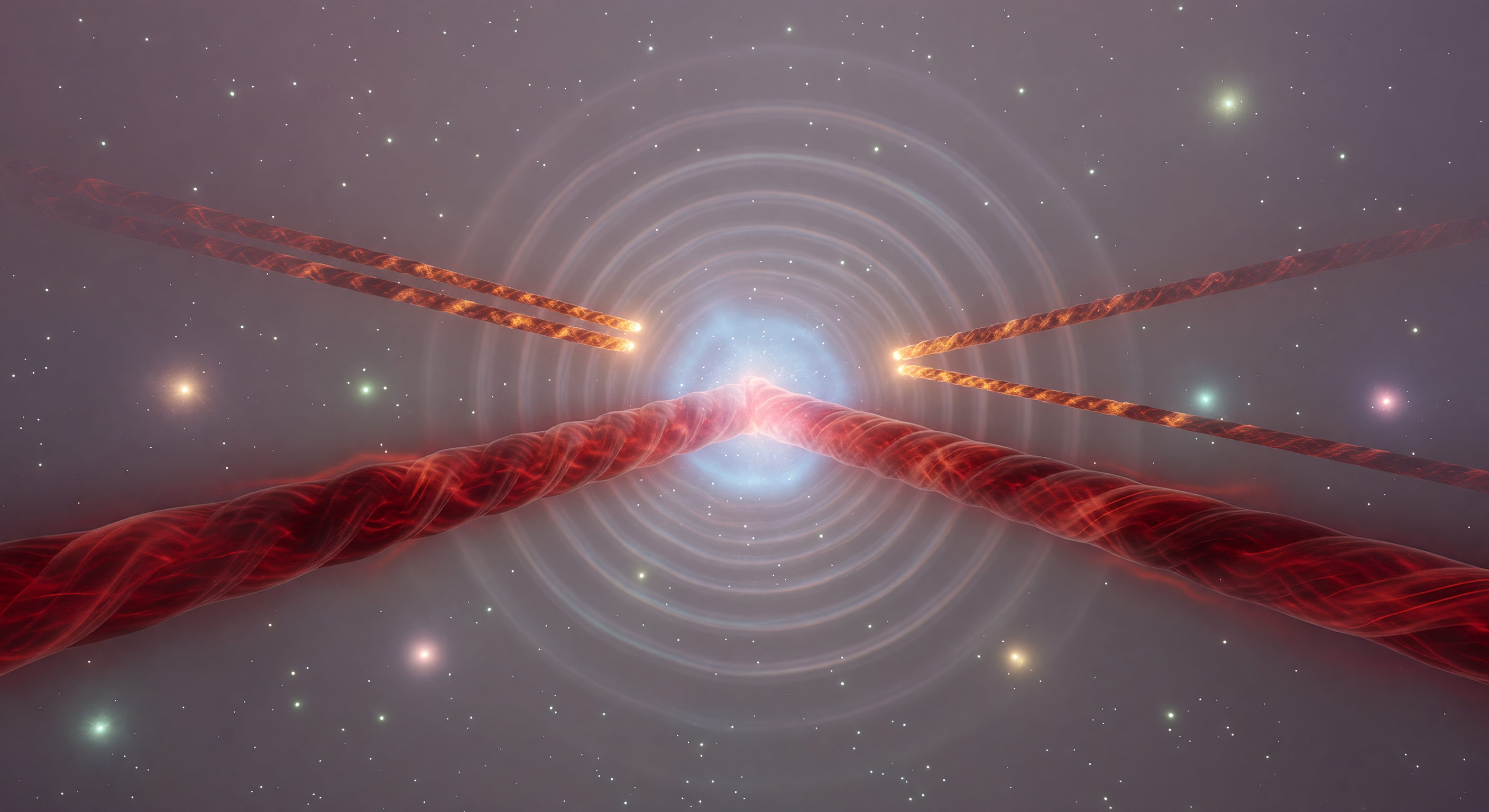
You are hovering inside the chromodynamic substrate of space itself, at the precise instant a flux tube — a rope of compressed color field carrying roughly one GeV of stored energy per femtometer of length — tears open at its midpoint in a spherical nucleation flash, the vacuum surrendering to the unbearable tension by conjuring two new quark-antiquark pairs directly from nothing. This is string breaking, the fundamental mechanism by which QCD confinement enforces its absolute law: rather than allowing color charge to separate freely, the field pours its accumulated energy into fresh matter, sealing each severed end with a new quark and re-establishing confinement on a shorter rope, an act of creation that takes place in roughly 10⁻²³ seconds and cannot, in any thermodynamic sense, be undone. The parent flux tube was not a classical object but a self-organized filament of non-perturbative gluon field, maintained at near-constant diameter by the balance between chromodynamic pressure and the confining vacuum condensate surrounding it, and the concentric iridescent wavefronts now propagating outward are not sound or light but disturbances in that condensate — ripples in broken chiral symmetry, displacing the virtual-pair sea that fills what would otherwise be empty space. The daughter ropes recoil in opposite directions, each anchored by its new quark endpoint into a configuration already racing toward hadronization, while the ambient violet-gray medium continues its ceaseless background flicker of virtual condensation and dissolution, indifferent to the geological rupture that has just reorganized the local topology of color charge.
Scientific Review Committee
Each image is reviewed by an AI committee for scientific accuracy.
Claude
Image: Adjust
Caption: Adjust
I largely agree with the previous reviewer's assessment, though I want to push certain points further and add new observations.
On SCIENTIFIC PLAUSIBILITY: The core topology is correct — two flux tube segments recoiling from a central rupture point, with a luminous nucleation event at the break. This is a defensible pedagogical rendering of string breaking in QCD. However, I have specific concerns. First, the flux tubes are rendered as braided, rope-like structures with what appear to be double-helix striations. While visually evocative, this implies internal twist structure that has no analogue in the gluon field configuration of a real flux tube, which is better described as a roughly cylindrical, azimuthally symmetric color-electric field condensate. The braiding inadvertently suggests classical mechanical tension rather than chromodynamic confinement. Second, the two scales of 'rope' — a thinner, orange upper pair and a thicker, darker red lower pair — are ambiguous. Are these meant to represent the two daughter flux tubes post-breaking, or four separate objects? The caption suggests two daughter tubes recoiling, but the image reads as four distinct filaments, which is scientifically confusing and could imply a different event topology entirely. Third, the concentric wavefronts are a reasonable metaphor for condensate disturbance, but their perfect circularity and even spacing evoke classical wave optics more than the non-perturbative QCD vacuum fluctuations described. The starfield background, while aesthetically pleasing, adds no scientific information and slightly undermines the 'inside the chromodynamic substrate' framing the caption establishes.
On VISUAL QUALITY: The image is technically accomplished. The volumetric glow at the center, the color gradients from deep red to orange-gold at the endpoints, and the layered transparency of the wavefronts are all well-executed. There are no obvious rendering artifacts. The central blue-white flash is appropriately luminous without being distracting. My main quality concern is the ambiguity introduced by the four-rope geometry — it creates compositional confusion at the image's most scientifically critical point.
On CAPTION ACCURACY: The caption is richly detailed and scientifically sophisticated, referencing chiral symmetry breaking, the virtual-pair sea, and the ~10⁻²³ second timescale. Most of these concepts are only loosely implied by the image rather than depicted. The four-filament ambiguity is the sharpest mismatch: the caption clearly describes two daughter ropes recoiling, but the image shows what could easily be read as four. The 'concentric iridescent wavefronts' are present and match well. The 'ambient violet-gray medium' matches the background adequately.
Recommendation: The image warrants 'adjust' rather than 'regenerate' because the fundamental concept is correctly captured and the execution is visually strong. Specific adjustments should include clarifying the two-versus-four filament ambiguity (perhaps by making the upper and lower pairs clearly connect into two continuous post-break segments), softening the braiding to reduce the mechanical rope connotation, and possibly introducing some asymmetry or irregularity in the wavefronts to better suggest non-perturbative vacuum fluctuations rather than classical wave propagation.
On SCIENTIFIC PLAUSIBILITY: The core topology is correct — two flux tube segments recoiling from a central rupture point, with a luminous nucleation event at the break. This is a defensible pedagogical rendering of string breaking in QCD. However, I have specific concerns. First, the flux tubes are rendered as braided, rope-like structures with what appear to be double-helix striations. While visually evocative, this implies internal twist structure that has no analogue in the gluon field configuration of a real flux tube, which is better described as a roughly cylindrical, azimuthally symmetric color-electric field condensate. The braiding inadvertently suggests classical mechanical tension rather than chromodynamic confinement. Second, the two scales of 'rope' — a thinner, orange upper pair and a thicker, darker red lower pair — are ambiguous. Are these meant to represent the two daughter flux tubes post-breaking, or four separate objects? The caption suggests two daughter tubes recoiling, but the image reads as four distinct filaments, which is scientifically confusing and could imply a different event topology entirely. Third, the concentric wavefronts are a reasonable metaphor for condensate disturbance, but their perfect circularity and even spacing evoke classical wave optics more than the non-perturbative QCD vacuum fluctuations described. The starfield background, while aesthetically pleasing, adds no scientific information and slightly undermines the 'inside the chromodynamic substrate' framing the caption establishes.
On VISUAL QUALITY: The image is technically accomplished. The volumetric glow at the center, the color gradients from deep red to orange-gold at the endpoints, and the layered transparency of the wavefronts are all well-executed. There are no obvious rendering artifacts. The central blue-white flash is appropriately luminous without being distracting. My main quality concern is the ambiguity introduced by the four-rope geometry — it creates compositional confusion at the image's most scientifically critical point.
On CAPTION ACCURACY: The caption is richly detailed and scientifically sophisticated, referencing chiral symmetry breaking, the virtual-pair sea, and the ~10⁻²³ second timescale. Most of these concepts are only loosely implied by the image rather than depicted. The four-filament ambiguity is the sharpest mismatch: the caption clearly describes two daughter ropes recoiling, but the image shows what could easily be read as four. The 'concentric iridescent wavefronts' are present and match well. The 'ambient violet-gray medium' matches the background adequately.
Recommendation: The image warrants 'adjust' rather than 'regenerate' because the fundamental concept is correctly captured and the execution is visually strong. Specific adjustments should include clarifying the two-versus-four filament ambiguity (perhaps by making the upper and lower pairs clearly connect into two continuous post-break segments), softening the braiding to reduce the mechanical rope connotation, and possibly introducing some asymmetry or irregularity in the wavefronts to better suggest non-perturbative vacuum fluctuations rather than classical wave propagation.
Grok
Image: Adjust
Caption: Adjust
I concur with both previous reviewers on the 'adjust' ratings for image and caption, as the visualization captures the essence of QCD string breaking in a compelling, symmetric composition but stumbles on key representational details that undermine precision at the quark scale.
SCIENTIFIC PLAUSIBILITY (adjust): The core event—a central nucleation flash severing a flux tube into recoiling daughter segments with propagating wavefronts—is conceptually sound and aligns with lattice QCD simulations of string breaking, where ~1 GeV/fm energy converts to a new q-qbar pair in ~10^-23 s. The red-to-orange color gradient evokes color charge flow, the blue-white burst fits pair creation from vacuum energy, and endpoint glows suggest quarks. The violet-gray medium with sparkling virtual particles aptly represents the chiral condensate and virtual-pair sea. However, agreements with Claude: the heavy braiding on all filaments (visible as twisted double-helix patterns on the thicker central red tubes and thinner outer orange ones) misleadingly anthropomorphizes flux tubes as mechanical ropes, whereas real non-perturbative gluon fields are smoother, flux-tube models (e.g., Cornell potential) predict near-cylindrical symmetry without twist. The four-arm symmetry (two upper orange, two lower red) creates ambiguity—caption specifies 'two new quark-antiquark pairs' yielding 'two daughter ropes,' but this reads as four separate filaments or a pre-break parent with split ends, confusing the topology. Concentric rings are too perfectly radial and evenly spaced, implying isotropic classical waves rather than anisotropic vacuum disturbances from gluon self-interaction. Starfield background dilutes the 'chromodynamic substrate' immersion; replace with denser, irregular flicker for condensate fluctuations. No major scale cues needed for femtometer realm, but dynamics feel static despite recoil implication.
VISUAL QUALITY (high, merits adjust not regenerate): Excellently rendered stylized abstraction—volumetric glows, depth-of-field blur on rings, transparent layering, and glow falloff are artifact-free and immersive. Coherent quantum aesthetic (not photorealistic, appropriately non-classical). Minor: over-symmetry reduces perceived quantum randomness; faint aliasing on braid edges.
CAPTION ACCURACY (adjust): Strong thematic match—recoiling daughters, midpoint tear, iridescent wavefronts, indifferent flickering medium all visually echoed. Mismatches: caption's 'two daughter ropes' vs. image's four-filament parse; 'self-organized filament... at near-constant diameter' vs. variable-thickness braids; 'ripples in broken chiral symmetry' loosely implied by rings but lacks asymmetry; thermodynamic irrevocability and exact timescale not depictable but uncontradicted. Caption's sophistication exceeds image's literal support, risking overinterpretation.
Constructive adjustments: (1) Unbraid filaments for smooth cylindrical tubes, unify into exactly two post-break segments (e.g., fade central connection). (2) Irregularize/add jitter to wavefronts for non-perturbative feel. (3) Swap starfield for chaotic violet-gray foam with transient sparks. (4) Accentuate recoil via motion blur on endpoints. These tweaks would elevate to 'approve' without full regenerate.
SCIENTIFIC PLAUSIBILITY (adjust): The core event—a central nucleation flash severing a flux tube into recoiling daughter segments with propagating wavefronts—is conceptually sound and aligns with lattice QCD simulations of string breaking, where ~1 GeV/fm energy converts to a new q-qbar pair in ~10^-23 s. The red-to-orange color gradient evokes color charge flow, the blue-white burst fits pair creation from vacuum energy, and endpoint glows suggest quarks. The violet-gray medium with sparkling virtual particles aptly represents the chiral condensate and virtual-pair sea. However, agreements with Claude: the heavy braiding on all filaments (visible as twisted double-helix patterns on the thicker central red tubes and thinner outer orange ones) misleadingly anthropomorphizes flux tubes as mechanical ropes, whereas real non-perturbative gluon fields are smoother, flux-tube models (e.g., Cornell potential) predict near-cylindrical symmetry without twist. The four-arm symmetry (two upper orange, two lower red) creates ambiguity—caption specifies 'two new quark-antiquark pairs' yielding 'two daughter ropes,' but this reads as four separate filaments or a pre-break parent with split ends, confusing the topology. Concentric rings are too perfectly radial and evenly spaced, implying isotropic classical waves rather than anisotropic vacuum disturbances from gluon self-interaction. Starfield background dilutes the 'chromodynamic substrate' immersion; replace with denser, irregular flicker for condensate fluctuations. No major scale cues needed for femtometer realm, but dynamics feel static despite recoil implication.
VISUAL QUALITY (high, merits adjust not regenerate): Excellently rendered stylized abstraction—volumetric glows, depth-of-field blur on rings, transparent layering, and glow falloff are artifact-free and immersive. Coherent quantum aesthetic (not photorealistic, appropriately non-classical). Minor: over-symmetry reduces perceived quantum randomness; faint aliasing on braid edges.
CAPTION ACCURACY (adjust): Strong thematic match—recoiling daughters, midpoint tear, iridescent wavefronts, indifferent flickering medium all visually echoed. Mismatches: caption's 'two daughter ropes' vs. image's four-filament parse; 'self-organized filament... at near-constant diameter' vs. variable-thickness braids; 'ripples in broken chiral symmetry' loosely implied by rings but lacks asymmetry; thermodynamic irrevocability and exact timescale not depictable but uncontradicted. Caption's sophistication exceeds image's literal support, risking overinterpretation.
Constructive adjustments: (1) Unbraid filaments for smooth cylindrical tubes, unify into exactly two post-break segments (e.g., fade central connection). (2) Irregularize/add jitter to wavefronts for non-perturbative feel. (3) Swap starfield for chaotic violet-gray foam with transient sparks. (4) Accentuate recoil via motion blur on endpoints. These tweaks would elevate to 'approve' without full regenerate.
Gemini
Image: Adjust
Caption: Adjust
As a member of the committee, I concur with the previous assessments that the image requires adjustment to align with the scientific rigor of the provided description.
1. SCIENTIFIC PLAUSIBILITY: The primary issue is the topological ambiguity. The caption describes a single flux tube snapping into two daughter ropes, but the image depicts a complex junction of at least four, possibly six, distinct filaments. This suggests a multi-particle collision or a complex vertex rather than the fundamental string-breaking event described. Furthermore, the braided, 'helical' texture of the tubes is a misleading metaphor; a chromodynamic flux tube is a localized energy density of the gluon field and would be better represented as a smooth, cylindrical volume of light or field-intensity rather than a mechanical rope. The 'starfield' background is also a macroscopic trope that contradicts the 'chromodynamic substrate'—at this scale, the vacuum should appear as a dense, turbulent foam of virtual fluctuations, not distant points of light.
2. VISUAL QUALITY: The rendering is aesthetically high-quality, with excellent use of volumetric lighting and depth of field. However, the perfect circularity of the wavefronts feels more like classical optics than the non-perturbative, chaotic nature of QCD.
3. CAPTION ACCURACY: There is a significant mismatch between the 'two daughter ropes' mentioned in the text and the multiple filaments shown in the image. The caption's mention of a 'violet-gray medium' is somewhat reflected in the background tint, but the visual 'stars' undermine the description of a virtual-pair sea.
Suggested Adjustments: Simplify the scene to show exactly two recoiling segments. Remove the braided texture in favor of a more fluid, field-like appearance. Replace the astronomical starfield with a more chaotic, flickering 'quantum foam' texture to represent the vacuum condensate.
1. SCIENTIFIC PLAUSIBILITY: The primary issue is the topological ambiguity. The caption describes a single flux tube snapping into two daughter ropes, but the image depicts a complex junction of at least four, possibly six, distinct filaments. This suggests a multi-particle collision or a complex vertex rather than the fundamental string-breaking event described. Furthermore, the braided, 'helical' texture of the tubes is a misleading metaphor; a chromodynamic flux tube is a localized energy density of the gluon field and would be better represented as a smooth, cylindrical volume of light or field-intensity rather than a mechanical rope. The 'starfield' background is also a macroscopic trope that contradicts the 'chromodynamic substrate'—at this scale, the vacuum should appear as a dense, turbulent foam of virtual fluctuations, not distant points of light.
2. VISUAL QUALITY: The rendering is aesthetically high-quality, with excellent use of volumetric lighting and depth of field. However, the perfect circularity of the wavefronts feels more like classical optics than the non-perturbative, chaotic nature of QCD.
3. CAPTION ACCURACY: There is a significant mismatch between the 'two daughter ropes' mentioned in the text and the multiple filaments shown in the image. The caption's mention of a 'violet-gray medium' is somewhat reflected in the background tint, but the visual 'stars' undermine the description of a virtual-pair sea.
Suggested Adjustments: Simplify the scene to show exactly two recoiling segments. Remove the braided texture in favor of a more fluid, field-like appearance. Replace the astronomical starfield with a more chaotic, flickering 'quantum foam' texture to represent the vacuum condensate.
Matania — Synthesis
Image: Adjust
Caption: Adjust
The committee is unanimous across all four reviewers in recommending adjustment for both image and caption. There is broad consensus that the visualization succeeds at a conceptual and aesthetic level — the central nucleation flash, the color gradients suggesting color charge flow, the volumetric glow, and the concentric wavefronts all cohere into a visually accomplished and pedagogically functional depiction of QCD string breaking. The rendering quality is consistently praised as high, and the fundamental event topology is judged scientifically defensible as a stylized abstraction. However, the committee identifies three recurring and serious concerns that prevent approval. First, the filament ambiguity: every reviewer independently flagged that the image reads as four or more distinct filaments rather than two daughter flux tube segments, directly contradicting the caption's description of two recoiling daughter ropes and introducing genuine topological confusion about what event is being depicted. This is the sharpest and most consequential mismatch. Second, the braided rope texture: all reviewers agree that the double-helix striations on the flux tubes misleadingly invoke classical mechanical tension and internal twist structure, neither of which has any analogue in the gluon field configuration of a real chromodynamic flux tube, which is better characterized as a smooth, roughly cylindrical color-electric field condensate. Third, the background: the astronomical starfield is widely flagged as a macroscopic trope that undermines the caption's framing of the scene as occurring inside a chromodynamic substrate; reviewers consistently recommend replacing it with a denser, more turbulent vacuum foam aesthetic. The perfectly circular, evenly spaced wavefronts are also noted by multiple reviewers as evoking classical wave optics rather than non-perturbative QCD vacuum fluctuations. On the caption side, the committee finds it scientifically sophisticated and thematically well-matched but overspecified relative to what the image can visually support, with the two-versus-four filament discrepancy being the most concrete and correctable mismatch.
Other languages
- Français: Corde Brisée, Hadron Né
- Español: Cuerda Rota, Hadrón Naciente
- Português: Corda Partida, Hádron Nascente
- Deutsch: Saitenriss, Hadron Geburt
- العربية: انقطاع الوتر، ميلاد الهادرون
- हिन्दी: स्ट्रिंग टूट, हैड्रॉन जन्म
- 日本語: 弦の断裂、ハドロン誕生
- 한국어: 끈 절단, 하드론 탄생
- Italiano: Corda Spezzata, Adrone Nato
- Nederlands: Snaar Knap, Hadron Geboorte
That said, there are a few scientific and visual caveats. The scene looks more like a macroscopic, space-in-the-vacuum interpretation than a true quark-scale depiction, so the starfield-like background and large concentric rings are metaphorical rather than physically literal. The flux tubes are also rendered as thick braided ropes, which is an understandable artistic choice but not a realistic microscopic representation. The central blue-white burst and circular wavefronts work as pedagogical cues, though the “ripples in condensate” are speculative and not something we can directly image in this form.
Caption-wise, the description matches the image well overall: it shows a string breaking event with two recoiling daughter tubes and a luminous central rupture. However, the text is more detailed and specific than the image can fully support, especially regarding the vacuum condensate ripples, virtual-pair sea, and exact thermodynamic language. Those elements are thematically appropriate but visually only implied. So this is a good near-match, but not a perfect one.