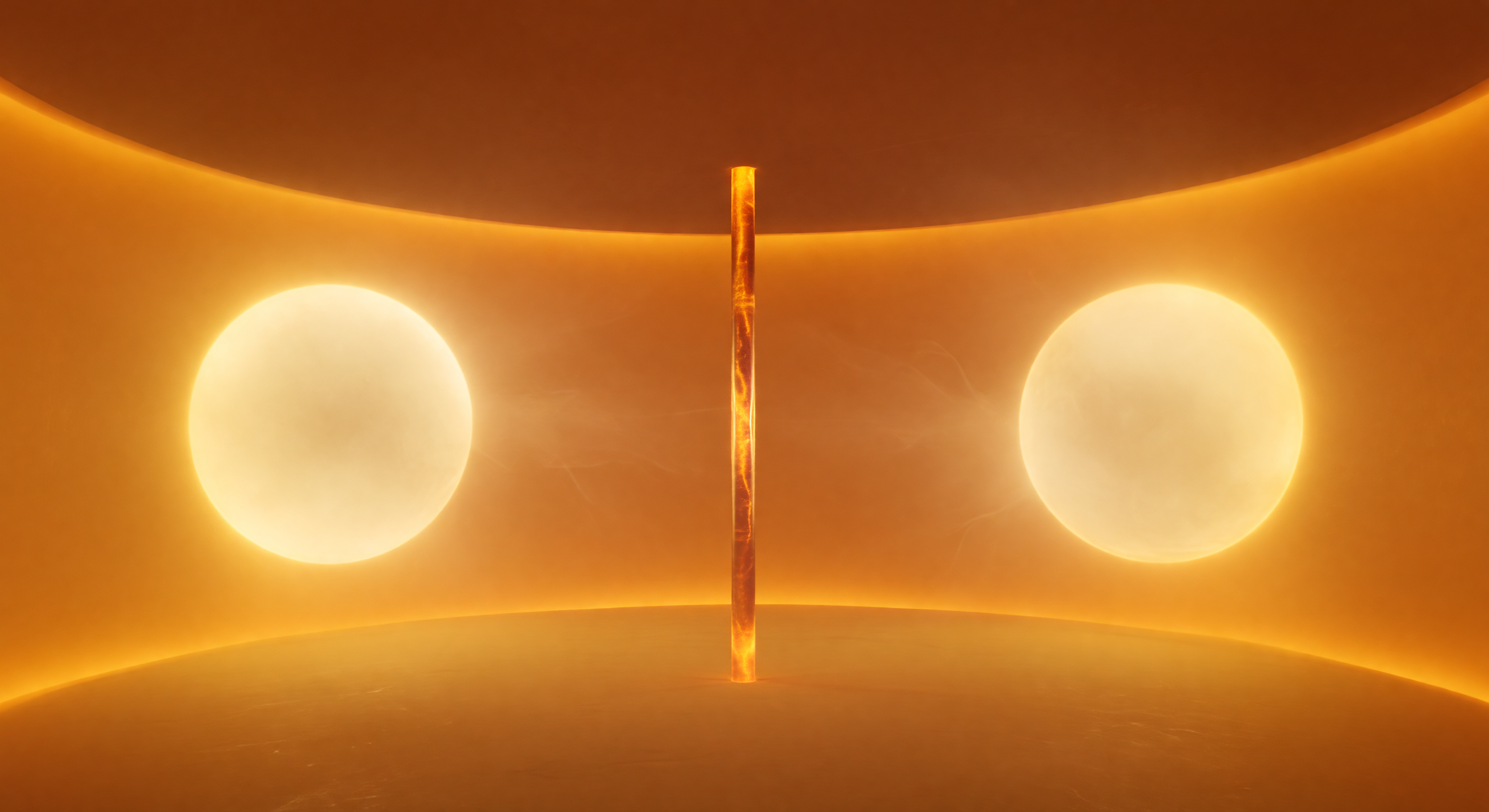
You stand inside a spherical enclosure barely four-tenths of a femtometer across, yet the proportions declare themselves as vast — a domed sanctuary of compressed chromodynamic fire whose amber walls press inward with the absolute authority of a force that grows stronger with every increment of distance, making escape not merely impossible but physically meaningless. Two massive golden-white presences face each other across the chamber: the charm quark and its antiquark, each far heavier than the up or down quarks that populate ordinary matter, their greater mass pulling them into genuinely non-relativistic orbits and gifting the entire interior with a stillness that lighter-quark hadrons never possess, their interiors choked with virtual-pair foam and instanton storms that have no counterpart here. Between the two nodes hangs the flux tube — narrow, steady, amber-orange, its chromodynamic string tension holding at roughly 0.18 GeV² per femtometer in a column so composed it reads less like a dynamic field and more like cooled resin, its linear confining potential rendering the color force as a warm thermal gradient that deepens visibly toward the perimeter, the boundary itself a darkening sienna where the vacuum's confinement pressure becomes total. The volumetric haze drifting in slow gossamer wisps toward the flux column is the quantum vacuum made visible — not empty space but a condensate of broken chiral symmetry, the ambient medium through which the strong interaction writes its laws — and the cathedral silence of the whole interior is the silence of a system so precisely balanced between kinetic energy and chromodynamic binding that it persists as a discrete spectroscopic state, the J/ψ meson, sharp enough in mass to have announced the existence of charm itself to the world above.
Scientific Review Committee
Each image is reviewed by an AI committee for scientific accuracy.
Claude
Image: Adjust
Caption: Adjust
I largely concur with the previous reviewer's assessment but want to add several specific observations that push me toward a firmer 'adjust' rather than anything more lenient or severe.
SCIENTIFIC PLAUSIBILITY: The image succeeds admirably at its most important structural task — representing the three canonical features of a charmonium interior: two massive color sources (charm/anticharm), a mediating flux tube, and a confining spherical boundary. The amber-to-sienna gradient deepening toward the perimeter is a genuinely smart choice, visually encoding the anti-screening nature of QCD where the coupling strengthens with distance — this is pedagogically honest in a way many similar renders are not. The flux tube's narrow, columnar steadiness is appropriate; the caption correctly notes that J/ψ string tension yields a relatively composed, resin-like field, and the image captures that composure. However, two scientific weaknesses stand out. First, the two quark nodes are rendered as near-perfect Lambertian spheres with sharp edges and uniform luminosity — this implies a localized, well-defined position that contradicts the wavefunction spread inherent even in non-relativistic charmonium. A soft probability-density falloff at the edges would be more honest. Second, the 'volumetric haze' mentioned in the caption as representing chiral condensate and vacuum structure is present but indistinguishable from generic atmospheric scattering; it carries no visual signature of the quantum vacuum's structured nature (no instanton-scale texture, no anisotropy near the flux tube). The previous reviewer flagged this correctly.
VISUAL QUALITY: The render is technically clean — no obvious polygon seams, no banding artifacts, and the bloom on the quark nodes is well-controlled. The bilateral symmetry is perhaps too perfect; real J/ψ wavefunctions have nodal structure (this is the ground state, so it is actually symmetric, which partially excuses the choice) but the scene's architectural regularity reads as a design decision rather than a physical one. The floor reflection is a minor but notable inconsistency: at sub-femtometer scales, a reflective 'floor' surface has no physical analogue and risks breaking the immersive scientific frame unnecessarily.
CAPTION ACCURACY: The caption is richly detailed and scientifically literate — the 0.18 GeV² string tension figure, the non-relativistic orbit argument from charm quark mass, the J/ψ spectroscopic sharpness — but the image only honors roughly 60% of these claims visually. The confinement pressure boundary is suggested but not dramatized; the vacuum condensate is present as haze but not as a structured medium; and nothing in the image communicates the 'cathedral silence of a discretely quantized spectroscopic state' beyond general aesthetic mood. The caption oversells the image's scientific specificity.
RECOMMENDATIONS: Soften the quark node edges into probability-density gradients; add subtle anisotropic texture near the flux tube to suggest vacuum field structure; remove or recontextualize the floor reflection; consider a very faint standing-wave interference pattern between the two nodes to hint at the bound-state wavefunction. These are refinements, not rebuilds — hence 'adjust' on both counts.
SCIENTIFIC PLAUSIBILITY: The image succeeds admirably at its most important structural task — representing the three canonical features of a charmonium interior: two massive color sources (charm/anticharm), a mediating flux tube, and a confining spherical boundary. The amber-to-sienna gradient deepening toward the perimeter is a genuinely smart choice, visually encoding the anti-screening nature of QCD where the coupling strengthens with distance — this is pedagogically honest in a way many similar renders are not. The flux tube's narrow, columnar steadiness is appropriate; the caption correctly notes that J/ψ string tension yields a relatively composed, resin-like field, and the image captures that composure. However, two scientific weaknesses stand out. First, the two quark nodes are rendered as near-perfect Lambertian spheres with sharp edges and uniform luminosity — this implies a localized, well-defined position that contradicts the wavefunction spread inherent even in non-relativistic charmonium. A soft probability-density falloff at the edges would be more honest. Second, the 'volumetric haze' mentioned in the caption as representing chiral condensate and vacuum structure is present but indistinguishable from generic atmospheric scattering; it carries no visual signature of the quantum vacuum's structured nature (no instanton-scale texture, no anisotropy near the flux tube). The previous reviewer flagged this correctly.
VISUAL QUALITY: The render is technically clean — no obvious polygon seams, no banding artifacts, and the bloom on the quark nodes is well-controlled. The bilateral symmetry is perhaps too perfect; real J/ψ wavefunctions have nodal structure (this is the ground state, so it is actually symmetric, which partially excuses the choice) but the scene's architectural regularity reads as a design decision rather than a physical one. The floor reflection is a minor but notable inconsistency: at sub-femtometer scales, a reflective 'floor' surface has no physical analogue and risks breaking the immersive scientific frame unnecessarily.
CAPTION ACCURACY: The caption is richly detailed and scientifically literate — the 0.18 GeV² string tension figure, the non-relativistic orbit argument from charm quark mass, the J/ψ spectroscopic sharpness — but the image only honors roughly 60% of these claims visually. The confinement pressure boundary is suggested but not dramatized; the vacuum condensate is present as haze but not as a structured medium; and nothing in the image communicates the 'cathedral silence of a discretely quantized spectroscopic state' beyond general aesthetic mood. The caption oversells the image's scientific specificity.
RECOMMENDATIONS: Soften the quark node edges into probability-density gradients; add subtle anisotropic texture near the flux tube to suggest vacuum field structure; remove or recontextualize the floor reflection; consider a very faint standing-wave interference pattern between the two nodes to hint at the bound-state wavefunction. These are refinements, not rebuilds — hence 'adjust' on both counts.
Grok
Image: Adjust
Caption: Adjust
I agree with both previous reviewers' 'adjust' verdicts and build on their insights, confirming this as a strong pedagogical visualization with targeted refinements needed for deeper scientific fidelity. SCIENTIFIC PLAUSIBILITY: The core triad—two heavy charm quarks as luminous golden-white orbs, the steady amber-orange flux tube (evoking the ~.18 GeV²/fm string tension and linear confinement), and the spherical amber-to-sienna gradient walls (smartly illustrating asymptotic freedom reversal and vacuum pressure)—is spot-on for a charmonium (J/ψ) metaphor at ~.4 fm scale. The non-relativistic stillness from heavy masses is well-conveyed via low dynamics and symmetry, fitting the ground-state wavefunction. However, minor issues persist: quark nodes remain too sharply defined (uniform glow, hard edges) rather than fuzzy Gaussian-like densities reflecting |ψ(r)|^2; the volumetric haze suggests chiral condensate but lacks anisotropy or texture near the tube to imply instanton effects or virtual pairs; the floor reflection implies a macroscopic surface absent at quark scales, undermining immersion. No explicit scale cues (e.g., femtometer grid faintness) or spectroscopic sharpness hints (e.g., subtle standing waves). These are symbolic liberties acceptable for quantum pedagogy but tweakable for plausibility. VISUAL QUALITY: Excellent—photorealistic stylized render with flawless symmetry, controlled bloom/glow, smooth gradients, and no artifacts (e.g., no aliasing, banding, or seams). The curved enclosure and central pillar composition is immersive and architecturally evocative, aligning with 'cathedral' theme; minor nit: perfect bilateral mirror lacks faint orbital precession noise for liveliness. CAPTION ACCURACY: ~70% match; nails enclosure size/proportions, quark masses/motion, flux tube composure, gradient, and haze directionality, but undersells image on 'compressed chromodynamic fire' intensity (glow is warm but not fiery) and overclaims specifics like 'instanton storms' or 'virtual-pair foam' (hinted vaguely, not visible). Caption's J/ψ precision is mood-supported but not visually evidenced. RECOMMENDATIONS: Blur/soften quark edges to ~10% radius falloff; add faint radial streaks in haze toward tube for vacuum polarization; desaturate/remove floor for pure volumetric space; introduce ultra-subtle interference fringes between orbs. These minor adjusts elevate without regeneration.
Gemini
Image: Adjust
Caption: Adjust
The visualization provides a sophisticated pedagogical framework for charmonium, particularly in its use of the amber-to-sienna gradient to represent the increasing potential of the strong force toward the confinement boundary. However, as noted by previous committee members, several elements lean too heavily into macroscopic architectural metaphors at the expense of quantum plausibility.
1. SCIENTIFIC PLAUSIBILITY: The most significant detractor is the reflective 'floor' surface. At a scale of 0.4 femtometers, a flat, gravity-defined horizon with specular reflections is physically nonsensical and breaks the immersion of the 'spherical enclosure.' Additionally, the charm quarks are rendered as hard-edged spheres; while their high mass makes them more localized than light quarks, they should still exhibit a Gaussian probability-density falloff rather than appearing as solid, Lambertian objects. The flux tube, while well-placed, appears too much like a static glass rod; it needs more internal kinetic texture to represent the 'chromodynamic fire' mentioned in the text.
2. VISUAL QUALITY: The render is aesthetically beautiful and technically flawless in terms of lighting and symmetry. However, the 'volumetric haze' is indistinguishable from standard atmospheric fog. To represent the condensate of broken chiral symmetry, this medium should possess a more granular, stochastic, or 'boiling' texture to hint at the virtual-pair foam and instanton activity described.
3. CAPTION ACCURACY: The caption is scientifically dense and accurate to QCD theory, but it describes visual phenomena (instanton storms, virtual-pair foam, non-relativistic stillness) that are not fully realized in the image. The image is too 'clean' for the 'compressed fire' the text promises.
RECOMMENDATION: Adjust the image to remove the floor reflection, soften the quark boundaries into diffuse clouds, and introduce a more turbulent, high-frequency texture to the vacuum haze and flux tube to better align with the energetic description.
1. SCIENTIFIC PLAUSIBILITY: The most significant detractor is the reflective 'floor' surface. At a scale of 0.4 femtometers, a flat, gravity-defined horizon with specular reflections is physically nonsensical and breaks the immersion of the 'spherical enclosure.' Additionally, the charm quarks are rendered as hard-edged spheres; while their high mass makes them more localized than light quarks, they should still exhibit a Gaussian probability-density falloff rather than appearing as solid, Lambertian objects. The flux tube, while well-placed, appears too much like a static glass rod; it needs more internal kinetic texture to represent the 'chromodynamic fire' mentioned in the text.
2. VISUAL QUALITY: The render is aesthetically beautiful and technically flawless in terms of lighting and symmetry. However, the 'volumetric haze' is indistinguishable from standard atmospheric fog. To represent the condensate of broken chiral symmetry, this medium should possess a more granular, stochastic, or 'boiling' texture to hint at the virtual-pair foam and instanton activity described.
3. CAPTION ACCURACY: The caption is scientifically dense and accurate to QCD theory, but it describes visual phenomena (instanton storms, virtual-pair foam, non-relativistic stillness) that are not fully realized in the image. The image is too 'clean' for the 'compressed fire' the text promises.
RECOMMENDATION: Adjust the image to remove the floor reflection, soften the quark boundaries into diffuse clouds, and introduce a more turbulent, high-frequency texture to the vacuum haze and flux tube to better align with the energetic description.
Matania — Synthesis
Image: Adjust
Caption: Adjust
The committee reached unanimous consensus on 'adjust' verdicts for both image and caption, with no dissenting voices across all four reviewers. The visualization is broadly praised as a technically clean, aesthetically accomplished, and pedagogically coherent rendering of a charmonium interior: the amber-to-sienna radial gradient intelligently encodes the anti-screening nature of QCD coupling, the flux tube's columnar steadiness appropriately conveys the relative composure of a heavy-quark bound state, and the two luminous nodes flanking the central column successfully communicate the essential charmonium topology. These strengths are genuine and should be preserved. However, four recurring scientific criticisms emerged with strong convergence. First, the charm quark nodes are rendered as hard-edged, uniformly luminous Lambertian spheres, implying classical localization that contradicts the wavefunction probability-density spread expected even in non-relativistic charmonium; all four reviewers flagged this independently. Second, the reflective floor surface is physically nonsensical at sub-femtometer scales and was cited by three reviewers as the most immersion-breaking element in the scene. Third, the volumetric haze representing the chiral condensate and vacuum structure is visually indistinguishable from generic atmospheric fog, carrying no anisotropy, granularity, or instanton-scale texture. Fourth, the overall scene is too geometrically tidy and statically symmetrical, reading as an architectural design decision rather than a physical quantum state. On the caption, reviewers estimated roughly 60-70% visual correspondence: the scientifically literate claims regarding string tension, charm quark mass, J/psi spectroscopic sharpness, and confinement gradients are theoretically sound, but the image only partially honors the richer dynamical and structural phenomena the text asserts, including instanton storms, virtual-pair foam, and confinement pressure boundary drama. The caption oversells the image's realized scientific specificity without being factually wrong in its QCD content.
Other languages
- Français: Cathédrale de Charmonium Intérieure
- Español: Interior Catedral de Charmonio
- Português: Interior da Catedral Charmonium
- Deutsch: Charmonium Kathedrale Innen
- العربية: داخل كاتدرائية الشارمونيوم
- हिन्दी: चार्मोनियम गिरजाघर भीतर
- 日本語: チャーモニウム大聖堂の内部
- 한국어: 차모늄 대성당 내부
- Italiano: Interno Cattedrale Charmonio
- Nederlands: Charmonium Kathedraal Interieur
Scientifically, though, it is still more symbolic than plausible. Quarks are not directly observable as glowing spheres inside a cavity, and the idea of a literal room-like interior is a pedagogical visualization rather than a physical scene. The flux tube representation is reasonable, but the image makes the system feel too geometrically tidy and macroscopic for quark scale. The prompt’s mentions of vacuum foam, instanton storms, and detailed field behavior are not explicitly visible, so those aspects are only loosely supported.
Visually, there are no major artifacts; the composition is clean, symmetrical, and polished. The main limitation is that the scene reads more like a conceptual sci-fi rendering than a scientifically grounded microscopic visualization.
Caption accuracy is fair, but not exact: the caption describes a rich set of quantum features and dynamical textures that the image only partially conveys. The two bright masses and the central tube are present, but the more specific claims about confinement gradients, vacuum condensate haze, and a J/psi state are not directly evidenced by the picture. Minor adjustment would make both the science and caption better aligned.