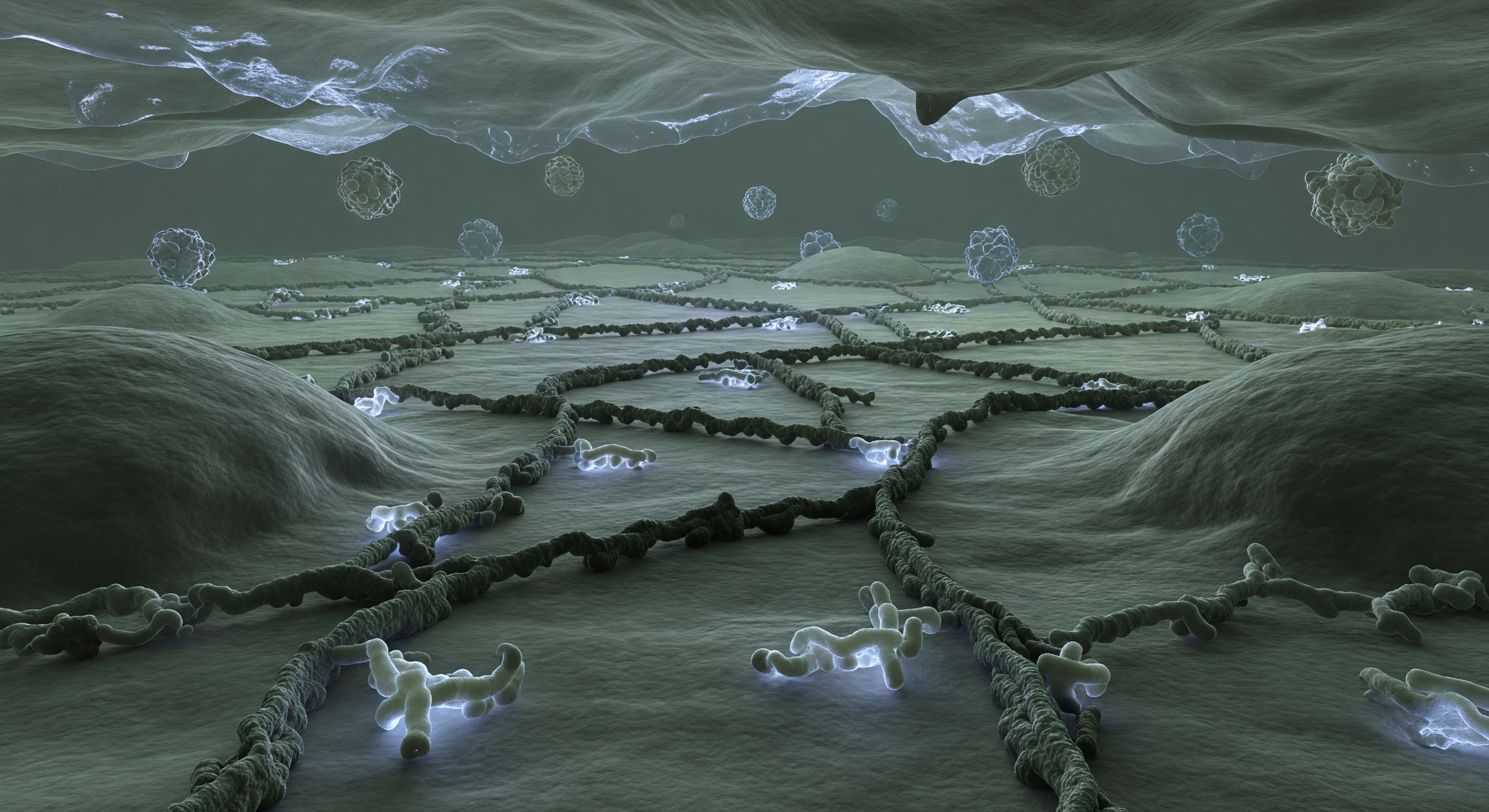
You stand on the broad, weathered expanse of a vaccinia poxvirus surface, looking out across a grey-green plateau nearly 360 nanometers wide — a vast, nearly flat continent of biological matter whose horizon curves only faintly at the edges, where the brick falls away into the surrounding cytoplasmic void. Beneath your feet, the outer lipid-protein membrane is softly wrinkled, its shallow folds catching a diffuse, sourceless bluish light — the aggregate electrochemical glow of a charged surface suspended in physiological medium, where Debye layers just a nanometer thick concentrate ions into luminous pools in every hollow. Ahead and behind, parallel ridges of surface tubules rise to roughly waist height, running in loosely aligned rows across the landscape like compressed ropes of oxidized pewter, their surfaces matte and granular, bulging and bifurcating unpredictably — the signature of a virion architecture that obeys no icosahedral symmetry, no repeating geodesic logic, only the raw, asymmetric complexity that makes poxviruses among the most structurally anomalous particles in virology. To either side, the terrain drops into the lateral body regions, broad lobes of amorphous protein material pressing outward against the membrane like buried forms under canvas, casting wide teal-grey shadows in the diffuse thermal ambience of a medium held at 37°C — a world where Brownian bombardment from surrounding water molecules delivers constant, violent kicks, and every surface contact is a potential biochemical event.
Other languages
- Français: Crête de brique poxvirus
- Español: Cresta de ladrillo poxvirus
- Português: Crista de tijolo poxvirus
- Deutsch: Pockvirus-Ziegelgrat
- العربية: سير على حافة بكسفايروس
- हिन्दी: पॉक्सवायरस ईंट-शिखर सैर
- 日本語: ポックスウイルスの煉瓦稜線
- 한국어: 폭스바이러스 벽돌 능선
- Italiano: Cresta di mattoni del poxvirus
- Nederlands: Poxvirus bakstenen richel