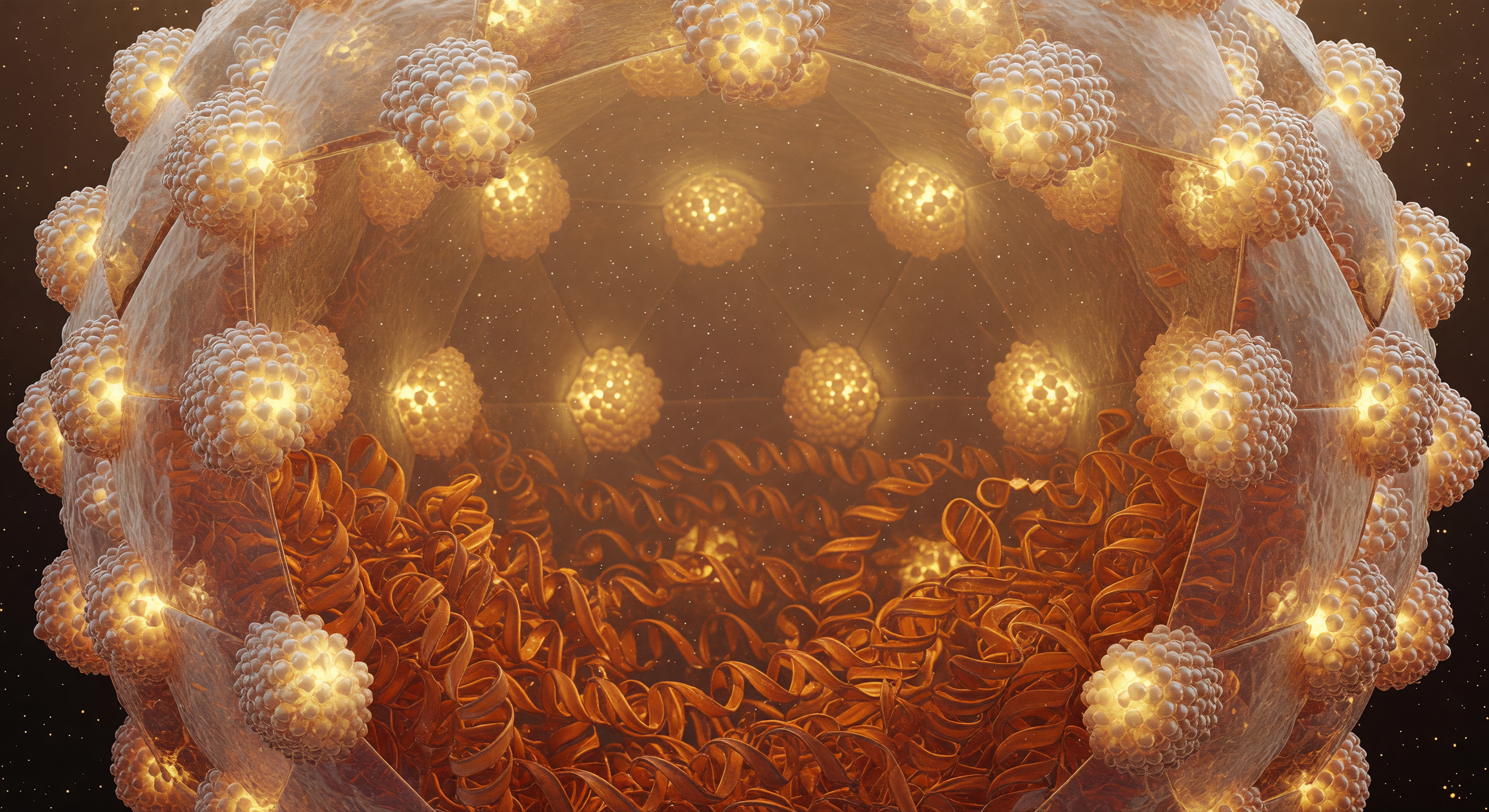
You stand at the geometric center of a self-assembled protein cathedral, entirely enclosed by a 36-nanometer icosahedral shell built from 240 copies of a single hepatitis B core protein folded into interlocking hexameric and pentameric capsomers — a T=7 triangulation number meaning the assembly logic required precisely seven quasi-equivalent protein environments to close the sphere without defect. The inner wall above and around you is not smooth but deeply textured: each capsomer rises 4 to 5 nanometers from the curved surface as a dense cluster of beta-barrel folds, their polypeptide backbones packed so tightly that the boundary between one protein and the next is a question of hydrogen bonds and van der Waals contacts rather than any visible gap, the twelve pentameric vertices where five-fold symmetry closes the geodesic logic glowing slightly brighter in the warm amber phosphorescence as though structural tension made visible. Beneath you, the packaged pregenomic RNA — a 3.5-kilobase transcript destined for reverse transcription into the viral DNA genome — fills the interior in dense, compressed coils of burnt orange, the helical strands pressing against one another and against the inner capsid wall with electrostatic and steric forces that keep the entire mass under measurable internal pressure, while the thermal agitation of the surrounding aqueous medium at 37 degrees Celsius drives constant micro-oscillations through both genome and protein shell simultaneously. The space between coiled RNA and protein wall is not vacuum but dense aqueous solution — magnesium ions, polyamines, and a continuous flux of water molecules, each water molecule striking the capsid interior roughly ten billion times per second, the cumulative effect of that thermal bombardment rendering the entire structure not rigid but dynamically trembling, a thermodynamic equilibrium held in place not by rigidity but by the statistical average of ten thousand molecular forces canceling one another out at every instant.
Other languages
- Français: Au cœur d'une capside
- Español: Dentro de la cápside viral
- Português: Interior da Cápside Viral
- Deutsch: Im Ikosaedrischen Kapsid
- العربية: داخل الغلاف الفيروسي
- हिन्दी: कैप्सिड के भीतर
- 日本語: 正二十面体カプシドの内部
- 한국어: 캡시드 내부 풍경
- Italiano: Dentro la Capside Icosaedrica
- Nederlands: Binnen het Virale Capside