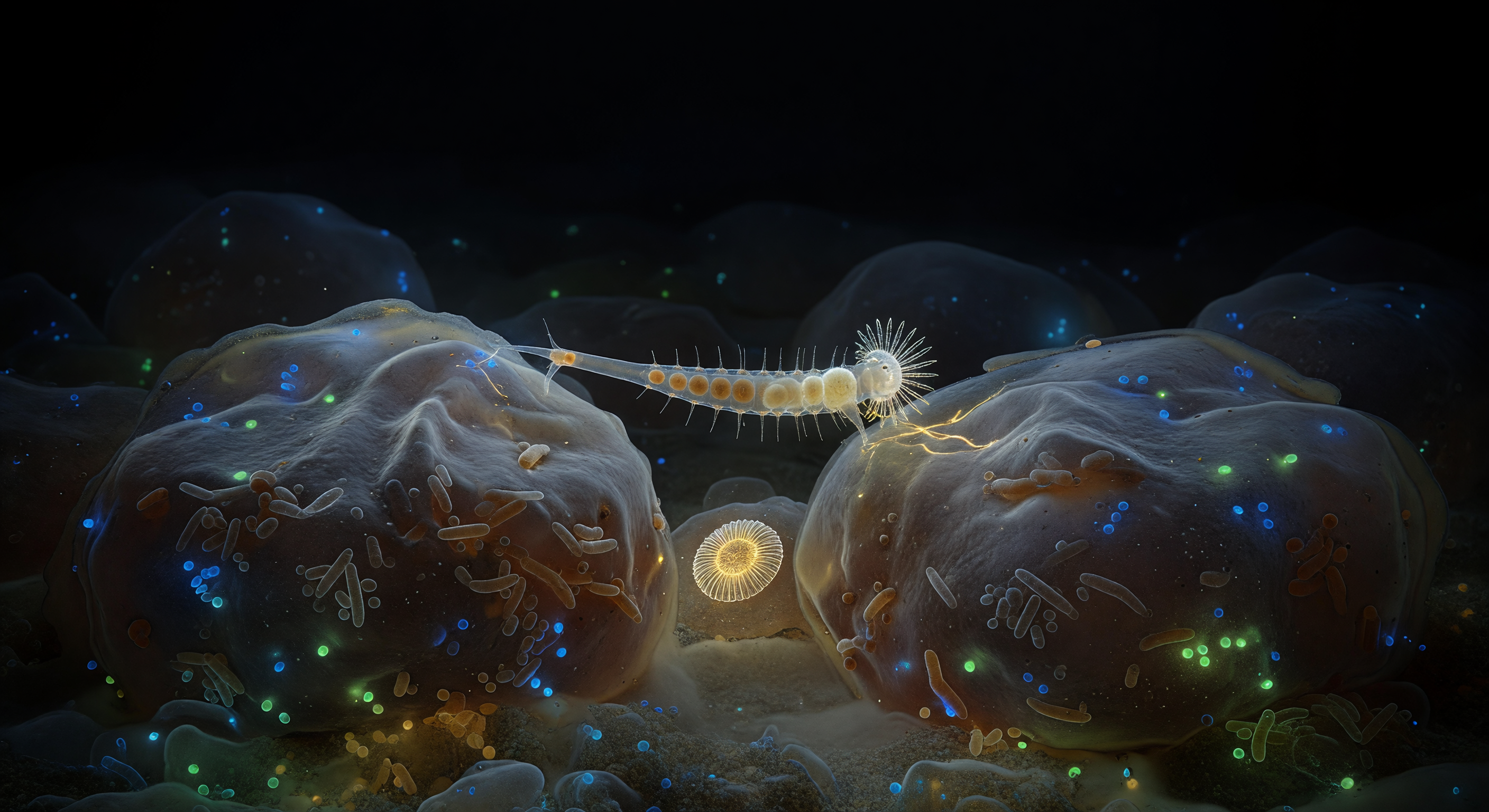
You float in near-total darkness at the boundary between water and packed sediment, a twilight zone measured in micrometers where two rose-gray quartz boulders — each the size of a building from where you hover — press close together, their surfaces mantled in a thick honey-amber layer of extracellular polymeric substance studded with rod-shaped bacteria visible as granular inclusions pressed against the gel from within. Through the narrow gap between them, a single Nitzschia diatom frustule glows with warm gold radiance, its silica ribs and geometric striae precise as architecture against the surrounding organic chaos. The body you inhabit — a Philodina bdelloid rotifer — is stretched nearly to transparency across that gap, its posterior foot cemented fast to trailing quartz by pedal-gland secretions, its trunk drawn thin as blown glass while the fully extended corona fans forward in a trembling iridescent aureole, each trochal disc beating its cilia in metachronal waves that refract the diatom's gold light into spectral filaments across the amber biofilm. Across the sediment floor, scattered clusters of bacterial bioluminescence pulse cold blue-green in the gel matrix, casting the undersides of neighboring boulders in cerulean wash and deepening the amber EPS to rich sienna where the two color temperatures collide — a labyrinth of grain-boulders stretching away into impenetrable darkness, lit only by one silica relic and ten thousand quiet bacterial collaborators.
Other languages
- Français: Navigation sur sol biofilm
- Español: Navegación por suelo biofilm
- Português: Navegação no chão biofilme
- Deutsch: Biofilm-Dschungelboden Navigation
- العربية: تنقل في غابة الغشاء الحيوي
- हिन्दी: बायोफिल्म जंगल तल यात्रा
- 日本語: バイオフィルム密林の探索
- 한국어: 생물막 밀림 바닥 탐색
- Italiano: Navigazione sul fondo biofilm
- Nederlands: Biofilm junglevloer navigatie