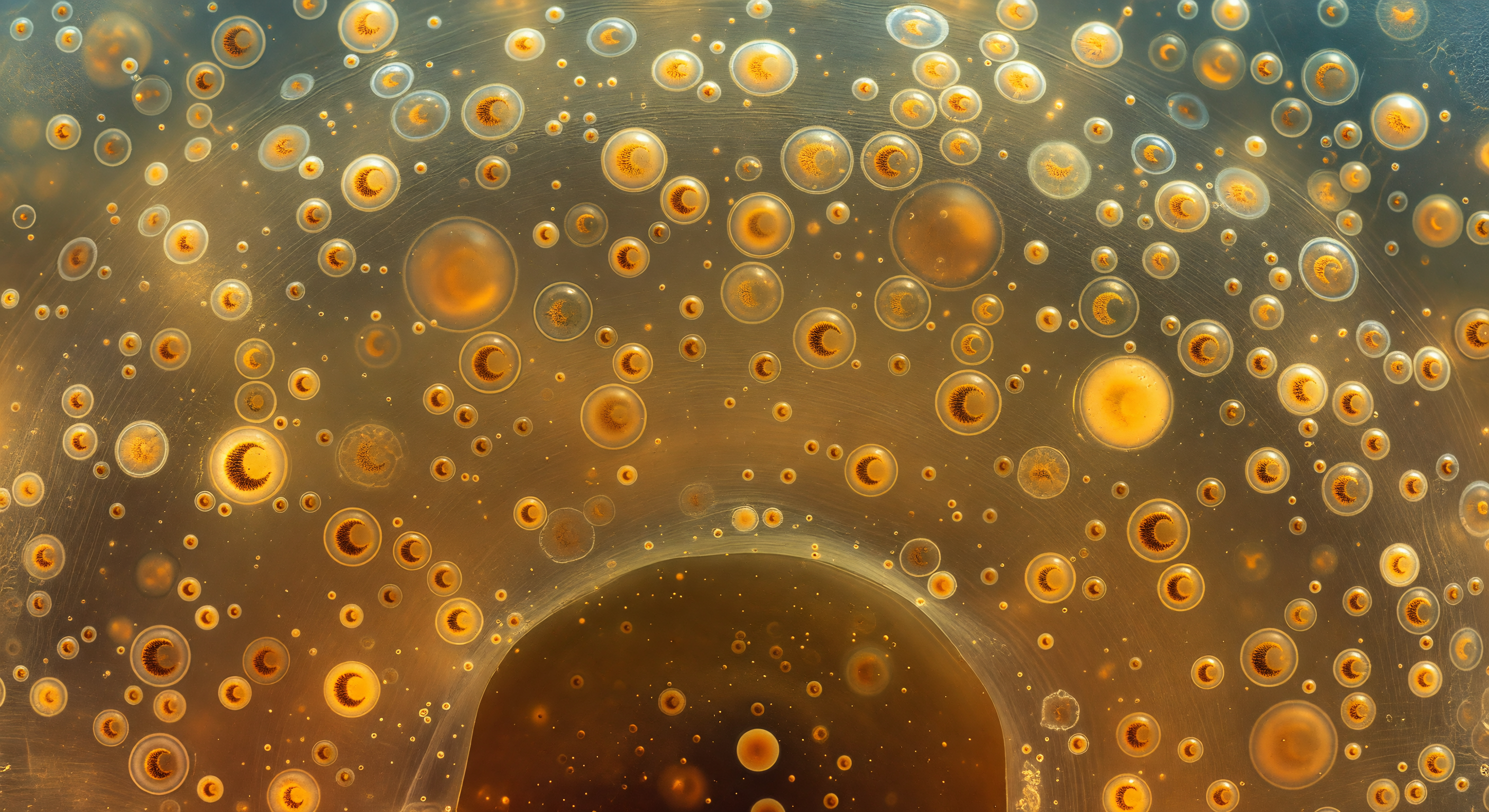
You are suspended within the living interior of a colonial Collodarian's calymma, a trembling amber gel that presses around you with the soft, total intimacy of warm honey — neither liquid nor solid, but a viscoelastic ectoplasm threaded through with barely visible glycoprotein filaments that catch the light like frost on glass. In every direction, zooxanthellae hang motionless in suspension, warm golden-brown spheres of ten to fifteen microns each, stabilized against settling by the gel's own resistance to flow and quivering only with the ceaseless nanometer-scale whisper of Brownian motion; within the nearest cells, C-shaped dinokaryotic nuclei curve like amber crescents, their condensed chromosomes permanently visible as a consequence of the permanently condensed state unique to dinoflagellate chromatin. Scattered among the symbionts, lipid vacuoles swell to thirty or forty microns — enormous clear spheres that refract the ambient light into bright crescents and cast golden caustic rings onto whatever floats behind them, serving the colony as both buoyancy organs and light-concentrating lenses that funnel photons deeper into the symbiont cloud. Far above, diffuse ocean light filters down through the colonial matrix and is transformed layer by layer into the deep amber luminescence filling this space, the photosynthetic pigments of countless zooxanthellae — fucoxanthin, peridinin, chlorophyll — absorbing the blue and remitting chemical energy that flows outward as carbon fixed in the sun-warmed gel. The curved wall of the central capsule looms at the edge of visibility, a sealed organic membrane where ectoplasm ends and endoplasm begins, enclosing the nucleus and silica-deposition machinery in a world you cannot enter — a boundary between two cellular continents, dark and absolute.
Other languages
- Français: Intérieur doré de symbiotes
- Español: Interior nube simbionte dorada
- Português: Interior dourado de simbiontes
- Deutsch: Goldenes Symbionten-Wolkeninnere
- العربية: داخل سحابة الكائنات الذهبية
- हिन्दी: स्वर्णिम सहजीवी मेघ अंतर
- 日本語: 黄金の共生雲の内側
- 한국어: 황금 공생 구름 내부
- Italiano: Interno dorato di simbionti
- Nederlands: Gouden symbiontwolk interieur