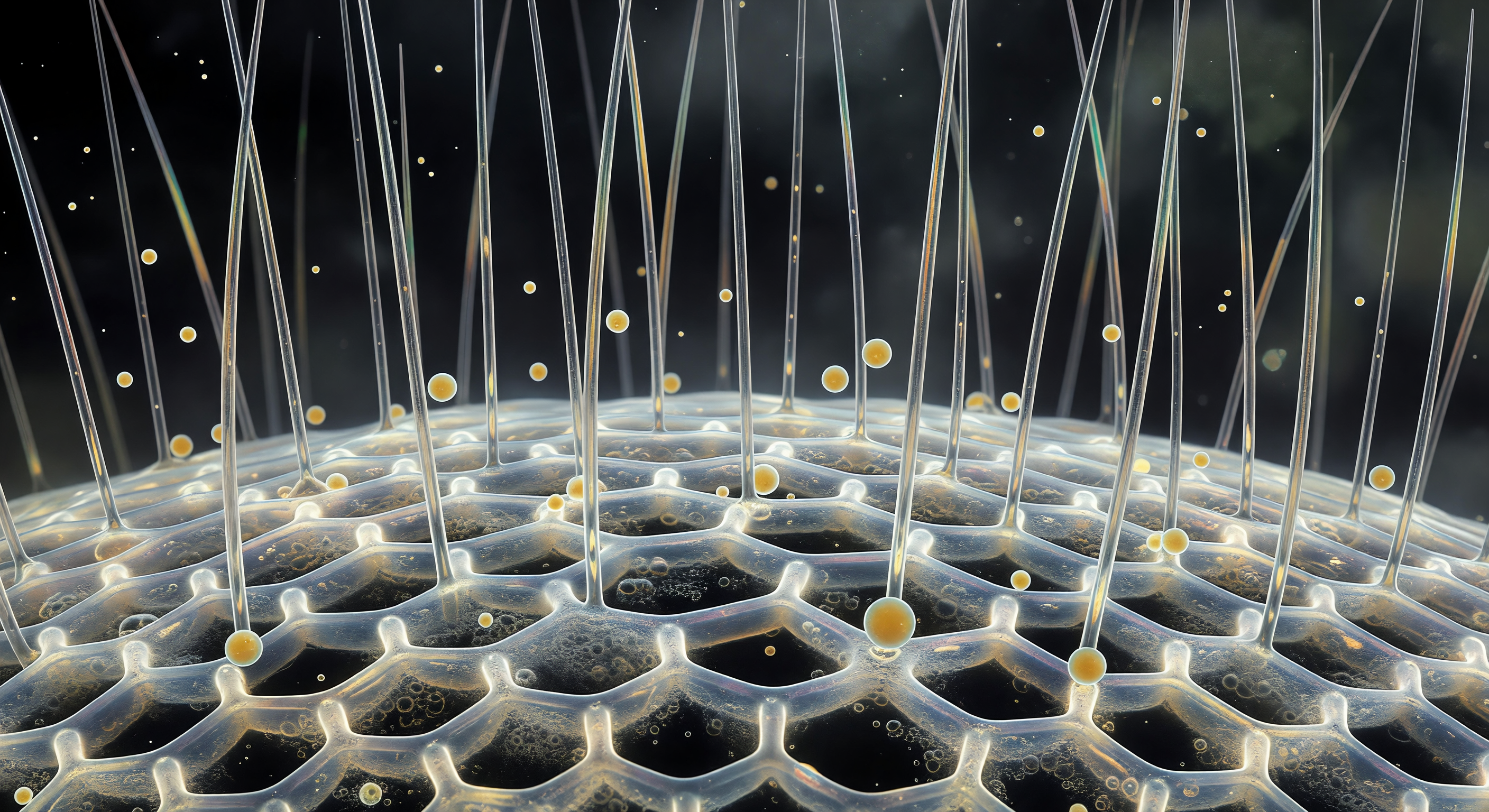
You stand on a mineral world no wider than a human hair, its floor an endless repeating grammar of hexagonal and pentagonal panes — the outer silica lattice of a living Spumellarian radiolarian, each strut where opaline glass thickens glowing faintly amber, each node catching oblique light as a hard silver point above a razor shadow. Through the dark pore-voids beneath your feet, the cell's intracapsular calymma trembles in pale gold: a vacuolated, living foam in constant submicron motion, the metabolic interior of an organism that has been building such lattices, dissolving them back into the sea, and building them again for over half a billion years. Rising from the pore rims and lattice nodes all around you, a dense forest of axopodia climbs into the near-black liquid overhead — each rod a micron-wide bundle of crystalline microtubule arrays wrapped in glassy membrane, its flanks carrying thin interference fringes of teal and amber where DIC illumination splits around its curvature, the whole forest converging toward tips that dissolve into the diffuse haze of protein-laden seawater fifty microns above. Along three of the nearest shafts, amber vacuoles — membrane-wrapped parcels of captured prey — creep steadily inward at one to five microns per second, drawn by cytoplasmic streaming along the microtubule track inside, each one a warm topaz lantern against absolute cold darkness, carrying digested ocean downward into the architecture below.
Other languages
- Français: Forêt de Lances Axopodiales
- Español: Bosque de Lanzas Axopodiales
- Português: Floresta de Lanças Axopodiais
- Deutsch: Axopodiale Speerwaldebene
- العربية: غابة الرماح الشعاعية
- हिन्दी: अक्षपाद भाला वन सतह
- 日本語: 放射状仮足の槍林面
- 한국어: 축족 창 숲 표면
- Italiano: Foresta di Lance Axopodiali
- Nederlands: Axopodiaal Speerwoudoppervlak