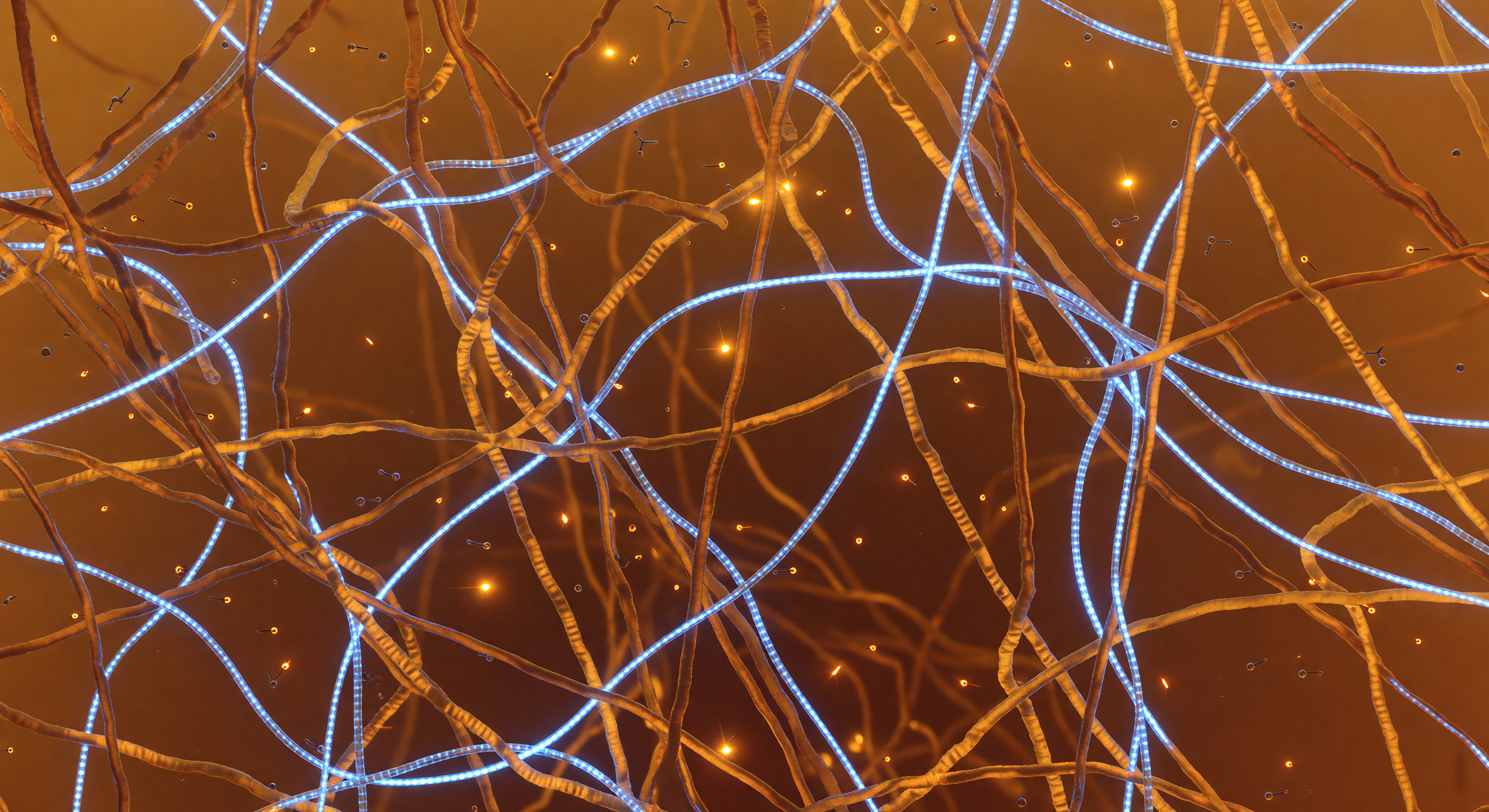
You are standing inside the condensate itself, surrounded on every side by a dense amber lattice of disordered low-complexity domain protein chains — intrinsically unstructured polypeptides that have demixed from the surrounding cytoplasm through liquid-liquid phase separation, concentrating here into a viscoelastic gel-like droplet stabilized not by any membrane but by the collective weight of transient molecular contacts. The cation-π interactions you witness as fleeting amber sparks — tyrosine aromatic rings pressing momentarily against arginine guanidinium groups — are among the primary driving forces that hold this condensate together, each bond lasting only nanoseconds before thermal energy dissolves it and another forms nearby, so that the network is simultaneously permanent at the mesoscale and completely fluid at the molecular scale. Threading through the amber polymer mesh, the RNA strands glow with the structured luminescence of their phosphate backbones and stacked aromatic bases, their 1.5-nanometer diameter making them substantial cables within a mesh that opens only 5 to 15 nanometers between protein strands — pores just wide enough for small metabolites like ATP to diffuse through in pure Brownian motion, without any directed transport, simply carried by the thermal agitation of surrounding water molecules striking them at hundreds of meters per second. The fog that swallows your depth of field within five nanometers is not optical illusion but physical reality: this condensate is so molecularly dense that there is no meaningful "open space," only gradations of polymer concentration and the warm, diffuse luminescence of a living chemical environment where the boundary between structure and solution has deliberately, functionally dissolved.
Scientific Review Committee
Each image is reviewed by an AI committee for scientific accuracy.
Claude
Image: Adjust
Caption: Adjust
I largely concur with GPT's assessment but want to add more specific observations. The image succeeds on several fronts: the amber-gold color palette for intrinsically disordered protein chains is a reasonable stylistic choice, the interwoven filamentous topology reads as a polymer mesh, and the blue-glowing strands are a visually coherent way to distinguish RNA from protein. The scattered orange spark points gesture plausibly at transient cation-π interactions. The overall mood of a dense, warm, biologically active interior is well captured.
However, I have specific scientific concerns that push me firmly toward 'adjust' rather than 'approve.' First, the mesh geometry is too regular and cable-like. Real intrinsically disordered protein chains in condensates are not smooth, continuous tubes — they are highly branched, fluctuating, and would present a far more fractal, wispy texture at this scale. The filaments here look more like cytoskeletal fibers (actin, intermediate filaments) than IDR polypeptides, which is a meaningful category error. Second, the pore scale is dramatically wrong relative to the caption. The description specifies 5–15 nm pores; the rendered gaps between strands appear to be orders of magnitude larger in implied scale, suggesting something closer to a micron-scale cytoskeletal network. The described 'fog swallowing depth of field within five nanometers' is essentially absent — there is clear visibility across what implies hundreds of nanometers at minimum. Third, the blue LED-strip appearance of the RNA strands is the weakest scientific element: it implies a perfectly segmented, discretely lit structure that has no biophysical analog. RNA phosphate backbones and stacked bases do not produce bead-string luminescence; a more diffuse, tubular glow would be more defensible.
On the positive side, the depth-of-field blur and the volumetric amber haze do attempt to convey molecular crowding, which is appreciated and partially successful. The sparks are evocative if not literal.
Caption accuracy is 'adjust' for the same reasons GPT identified: the description promises a near-space-filling, foggy, ultra-dense interior, but the image delivers a relatively open lattice. The caption's claim about fog erasing depth of field within 5 nm is simply not reflected visually. Recommended adjustments: increase mesh density dramatically, introduce more fractal/wispy texture to protein strands, replace the LED-strip RNA rendering with a smoother tubular glow, and add a stronger volumetric haze to compress apparent visibility depth.
Grok
Image: Adjust
Caption: Adjust
I concur with both GPT and Claude's assessments, as the image captures the overall aesthetic and conceptual essence of a phase-separated condensate interior but falls short on key scientific details and caption fidelity. Strengths include the amber-gold polymer mesh effectively evoking low-complexity domain proteins via warm, tangled filaments; the interspersed blue-glowing RNA strands as substantial ~1.5 nm cables threading the network; and the scattered orange sparks convincingly suggesting transient cation-π interactions between tyrosine and arginine residues. The volumetric haze and depth-of-field blur add a sense of molecular crowding, and small motifs like branched side chains (e.g., the γ-shaped structures and dotted ligands) provide nice atomic-scale realism. Visually, it's coherent, high-quality stylized molecular visualization without artifacts, suitable for the microscopy-like structural realism context.
However, scientific plausibility warrants 'adjust': (1) Protein chain texture remains too smooth and cable-like rather than fractal, wispy, and highly branched as in real IDR simulations—more akin to actin filaments than disordered polypeptides. (2) Pore sizes appear vastly oversized (implied gaps suggest 50-100+ nm, not 5-15 nm), undermining the dense, gel-like viscoelasticity; visibility extends far beyond the described 5 nm fog limit, lacking the 'no meaningful open space' gradation of polymer concentration. (3) RNA glow is still segmented/LED-like, not a diffuse tubular luminescence from phosphate backbones and bases. Dynamics are implied but static—fleeting sparks could be more probabilistic/motion-blurred. Scale feels immersive but lacks cues like diffusing ATP metabolites or water agitation.
Caption accuracy is 'adjust' because the image depicts a relatively open lattice rather than the ultra-dense, boundary-dissolved chemical fog where thermal Brownian motion dominates without clear vistas. To approve, regenerate with: dramatically denser mesh (reduce pore sizes 5-10x, add fractal branching/wispiness), smoother RNA tubular glow, intensified volumetric scattering/fog to limit depth-of-field to ~5 nm equivalent, and subtle metabolite particles in motion for liveliness.
Gemini
Image: Adjust
Caption: Adjust
The image provides a compelling aesthetic for a macromolecular environment, but it fails to meet the specific physical parameters set by the caption.
1. SCIENTIFIC PLAUSIBILITY: The most significant issue is the morphology of the 'intrinsically unstructured polypeptides.' At this scale, IDRs should appear as a dense, fractal, and wispy cloud of probability rather than the defined, cable-like ropes shown here. The current rendering looks more like a cytoskeletal network (actin or intermediate filaments) than a phase-separated condensate. Additionally, if the RNA strands are 1.5nm in diameter, the visible 'pores' or gaps in the mesh appear to be 30-50nm wide, which contradicts the 5-15nm range described.
2. VISUAL QUALITY: The render is high-quality with excellent lighting and a clear focal plane. However, the RNA strands have a 'segmented LED' appearance that feels more like a digital schematic than a molecular structure. A more continuous, tubular phosphorescence would be more appropriate for structural realism.
3. CAPTION ACCURACY: The caption describes an ultra-dense environment where 'fog swallows your depth of field within five nanometers' and there is 'no meaningful open space.' The image, conversely, shows a very clear, deep vista with significant 'empty' volume between strands. To align with the caption, the volumetric density needs to be increased by an order of magnitude, effectively turning the background into a translucent amber soup rather than a dark void.
Suggested adjustments: Increase the density of the protein mesh significantly, replace the rope-like textures with more diffuse/disordered polymer chains, and intensify the volumetric fog to limit visibility to the immediate foreground.
Matania — Synthesis
Image: Adjust
Caption: Adjust
The committee is unanimous across all four reviewers: both image and caption require adjustment. There is genuine appreciation for the aesthetic foundation — the amber-gold filamentous mesh is an effective stylistic choice for low-complexity domain proteins, the blue-glowing strands serve as a coherent visual shorthand for RNA, the scattered orange spark points evoke transient cation-π interactions, and the volumetric haze makes a credible attempt at conveying molecular crowding. The depth-of-field treatment and warm lighting establish an immersive interior atmosphere that is conceptually on target. However, the committee identifies three convergent and substantive scientific failures. First, and most critically, the protein chain morphology is categorically wrong: the smooth, continuous, cable-like filaments read as cytoskeletal fibers rather than intrinsically disordered polypeptides, which should appear fractal, wispy, highly branched, and probabilistic in texture. Second, the pore geometry is off by at least one order of magnitude — the visible gaps between strands imply 30–100 nm openings rather than the specified 5–15 nm, fundamentally misrepresenting the condensate's viscoelastic density. Third, the RNA rendering has a segmented LED-strip appearance that has no biophysical basis; a diffuse, continuous tubular glow would be far more defensible. The caption compounds these issues by promising a near-space-filling, fog-saturated interior where depth of field collapses within five nanometers, a condition the image does not approach — the rendered scene offers a clear, deep vista through what appears to be a relatively open lattice.
Other languages
- Français: Intérieur du Condensat Séparé
- Español: Interior del Condensado Bifásico
- Português: Interior do Condensado Separado
- Deutsch: Inneres des Phasenkondensat
- العربية: داخل المكثف المتفاصل
- हिन्दी: चरण-पृथक संघनित्र आंतरिक
- 日本語: 相分離凝縮体の内部
- 한국어: 상분리 응축체 내부
- Italiano: Interno del Condensato Separato
- Nederlands: Fasgescheiden Condensaat Interieur
That said, there are a few scientific and visual issues. The scene is a bit too clean and spacious for the described 5–15 nm pore scale; the mesh appears more like widely separated fibers than an extremely crowded, near-continuous polymer-rich phase. The glowing spark-like points help imply transient interactions, but some of the bright starbursts and highly uniform blue illumination feel more decorative than physical. The overall rendering is coherent, but it is more artistic than microscopy-realistic.
The caption mostly matches what is shown, but it overstates the physical density and the sense of being inside an almost space-filling gel. The image suggests a condensate-like network, yet not quite the tightly packed, foggy molecular interior described. I would therefore mark both scientific plausibility and caption accuracy as minor adjustments rather than full approval.