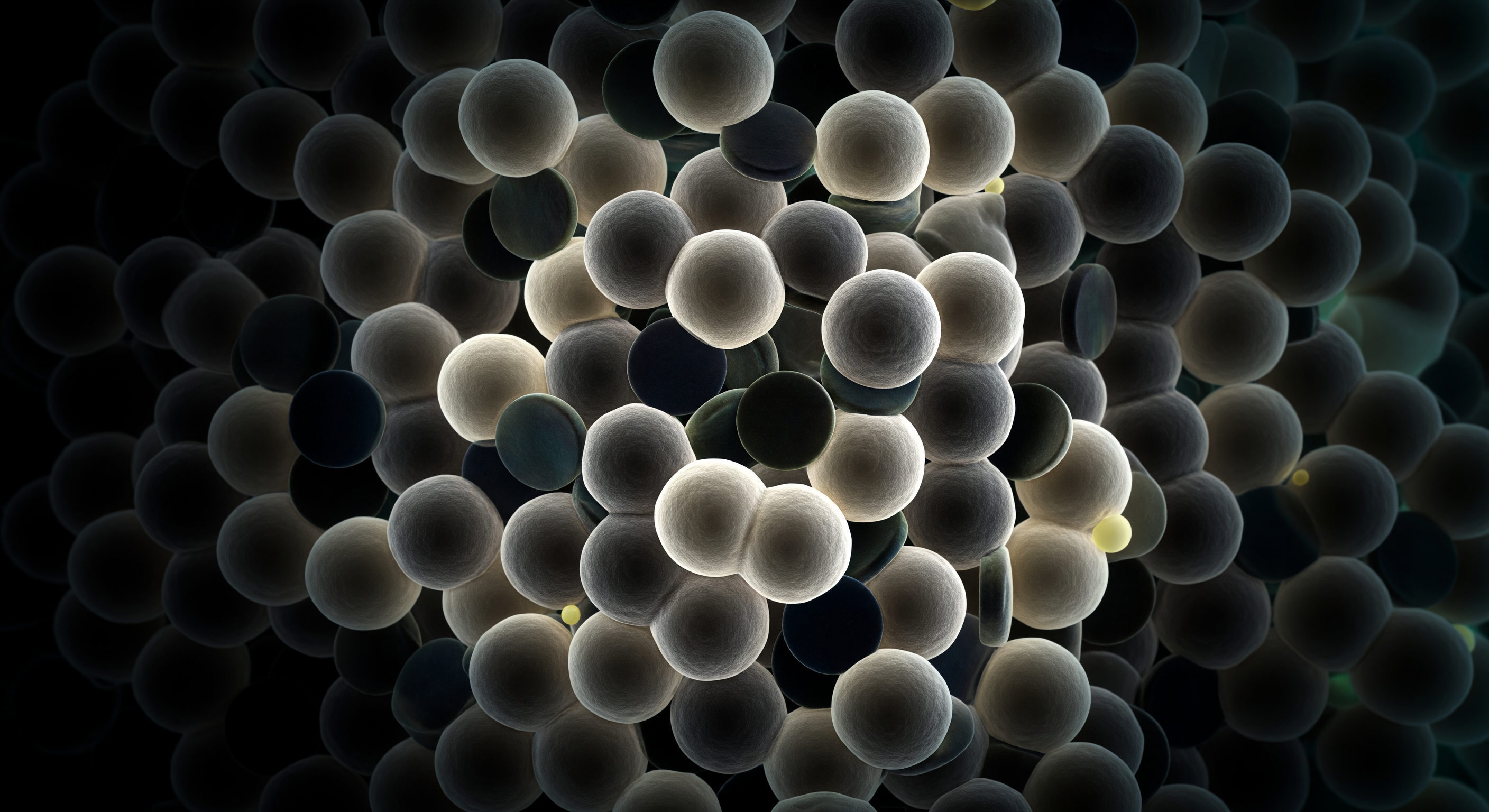
You are suspended inside a sealed geological darkness, compressed into the hydrophobic core of a folded globular protein somewhere between two and five nanometers from any solvent boundary, surrounded on all sides by the interlocking bulk of leucine, valine, and phenylalanine side chains packed at roughly 75% density — a figure that rivals the packing efficiency of crystalline minerals, yet achieved entirely through thermodynamic self-organization. The immediate surfaces press close as softly luminous grey-ivory spheroids, their electron-cloud boundaries touching without merging, held apart by quantum mechanical repulsion operating in fractions of a kilojoule, while flat obsidian discs of phenylalanine rings slice the confined space into sharp-edged alcoves whose shadows are absolute, cast not by light but by the total absence of electron density beyond each aromatic plane. Scattered through this achromatic matrix, two or three methionine sulfur atoms return the ambient contact-glow as deep sulfur-yellow embers — the only warm color in the core, marking atoms whose polarizability makes them slightly more luminescent within the van der Waals field than the surrounding carbon and hydrogen. Far beyond the immediate press of side chains, perhaps ten atomic diameters toward the protein's outer surface, the packing loosens imperceptibly and a cold aqueous blue-green light seeps inward through gaps between secondary structural elements — the faint electromagnetic signature of bulk solvent and churning water dipoles, reaching this buried interior like bioluminescence filtered through still ocean depth, confirming that this core is not a void but a sealed, thermodynamically stable interior whose tectonic quiet hums with sub-angstrom thermal vibrations at 310 Kelvin.
Macromolecules