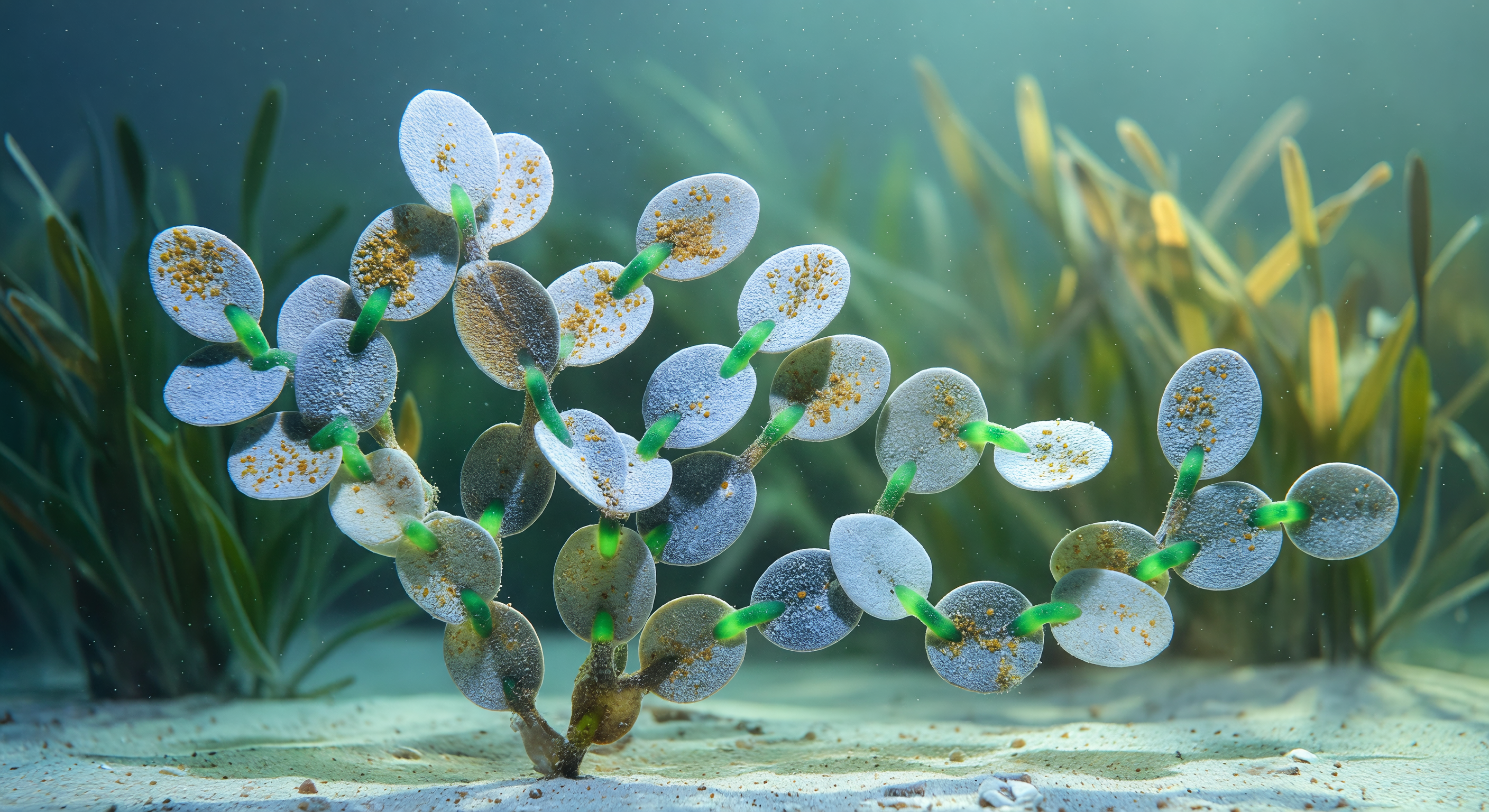
You hover beside the uppermost fork of a *Halimeda* bush, eye-level with its topmost segments, looking along an architecture that reads less like a living thing than like a mineral jeweller's construction — a branching chain of flat, coin-shaped lozenges in chalky aragonite grey, each one articulating with the next through a pinched, intensely vivid-green node where living, unchristallised cytoplasm holds the calcified discs in supple articulation, the whole structure swaying in the residual surge with the slow, weighted rhythm of a necklace. What you are witnessing is one of biology's most radical paradoxes: this entire branching bush, eight centimetres tall, is a single cell — a coenocytic giant unicell whose cytoplasm flows continuously through every segment and node without internal walls, progressively mineralising its own outer cortex into a crust of crystalline aragonite that serves simultaneously as skeleton, grazing deterrent, and carbonate sediment factory for the seafloor below. Across the upper faces of each disc, constellations of ochre-and-gold diatom epiphytes catch the eight-metre-filtered light as warm amber sparks against the cool matte limestone surface, while fine carbonate flour — shed from the segments themselves — drifts through the water column as brief silver motes, a slow mineral snow that will eventually accumulate into the pale buff sediment visible in fragments beneath the lower branches. Behind and beyond, the seagrass blades dissolve entirely into a luminous, shifting bokeh of jade, khaki, and amber-gold, a warm enclosing wall that throws the rigid, fractal precision of this single cell's stone architecture into extraordinary relief.
Other languages
- Français: Forêt d'herbiers à chaînes Halimeda
- Español: Bosque de Halimeda en Pradería Marina
- Português: Floresta de Halimeda em Pradaria Marinha
- Deutsch: Halimeda-Ketten im Seegraswald
- العربية: غابة أعشاب هاليميدا المتشابكة
- हिन्दी: हालीमेडा शृंखला समुद्री घास वन
- 日本語: ハリメダ連鎖海草の森
- 한국어: 할리메다 체인 해초 숲
- Italiano: Foresta di Halimeda tra le Fanerogame
- Nederlands: Halimeda-keten in Zeegraslandschap