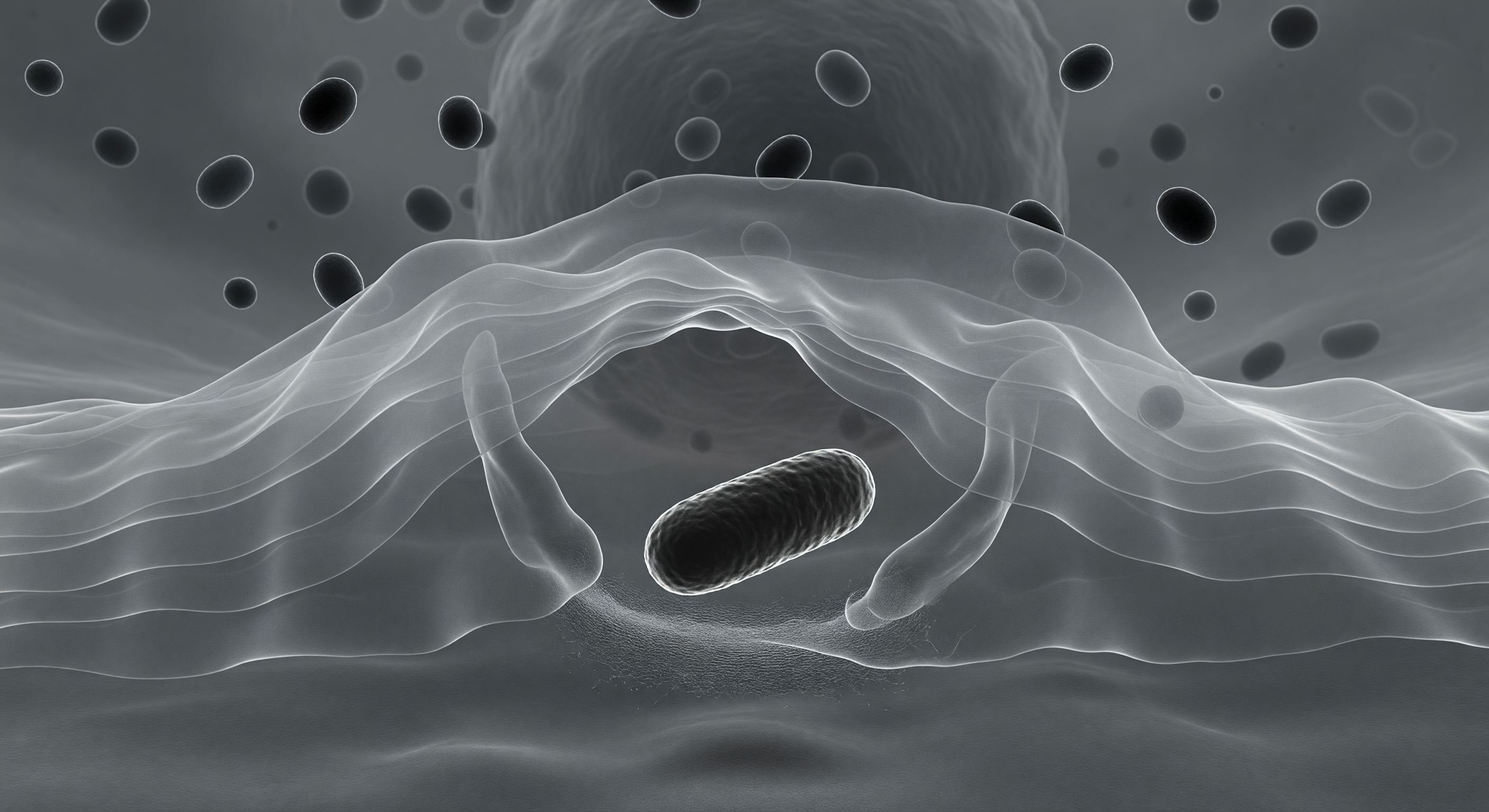
You are pressed against the leading edge of a translucent cytoplasmic veil, watching it arc forward and close around a dense, rod-shaped bacterium like slow cupped hands completing a gesture that has been rehearsed a billion times across evolutionary time. The lamellipodium surrounding you is actin-rich and gel-like — neither liquid nor solid but a living meshwork of polymerized filaments that push the membrane forward through coordinated treadmilling, driven by Arp2/3-nucleated branching just micrometers beneath the advancing tip. The bacterium ahead, roughly two micrometers long, is already nearly engulfed: receptor-ligand binding between surface opsonins and the macrophage's Fc and complement receptors triggered this entire choreography, propagating a zipper-like signal around the prey's circumference that recruits more actin, extends more pseudopod, seals the phagosomal cup. Behind you, the lysosomal granules drifting in the thickening cytoplasm are the bacterium's near future — enzyme-loaded compartments that will fuse with the nascent phagosome and reduce the entire dark monolith ahead to molecular salvage. The geometry of the enclosure is almost complete, and in the cold, directionless DIC light that encodes depth in shadow and mass in tone, the whole scene carries the weight of something architectural and inevitable, a structure solving itself.
Other languages
- Français: Engloutissement phagocytaire du macrophage
- Español: Fagocitosis del macrófago
- Português: Engolfamento fagocítico do macrófago
- Deutsch: Phagozytose durch Makrophagen
- العربية: ابتلاع البلعمي للضامة
- हिन्दी: मैक्रोफेज का भक्षण आलिंगन
- 日本語: マクロファージの貪食包囲
- 한국어: 대식세포의 식균 포획
- Italiano: Fagocitosi del macrofago
- Nederlands: Fagocytische omhelzing macrofaag