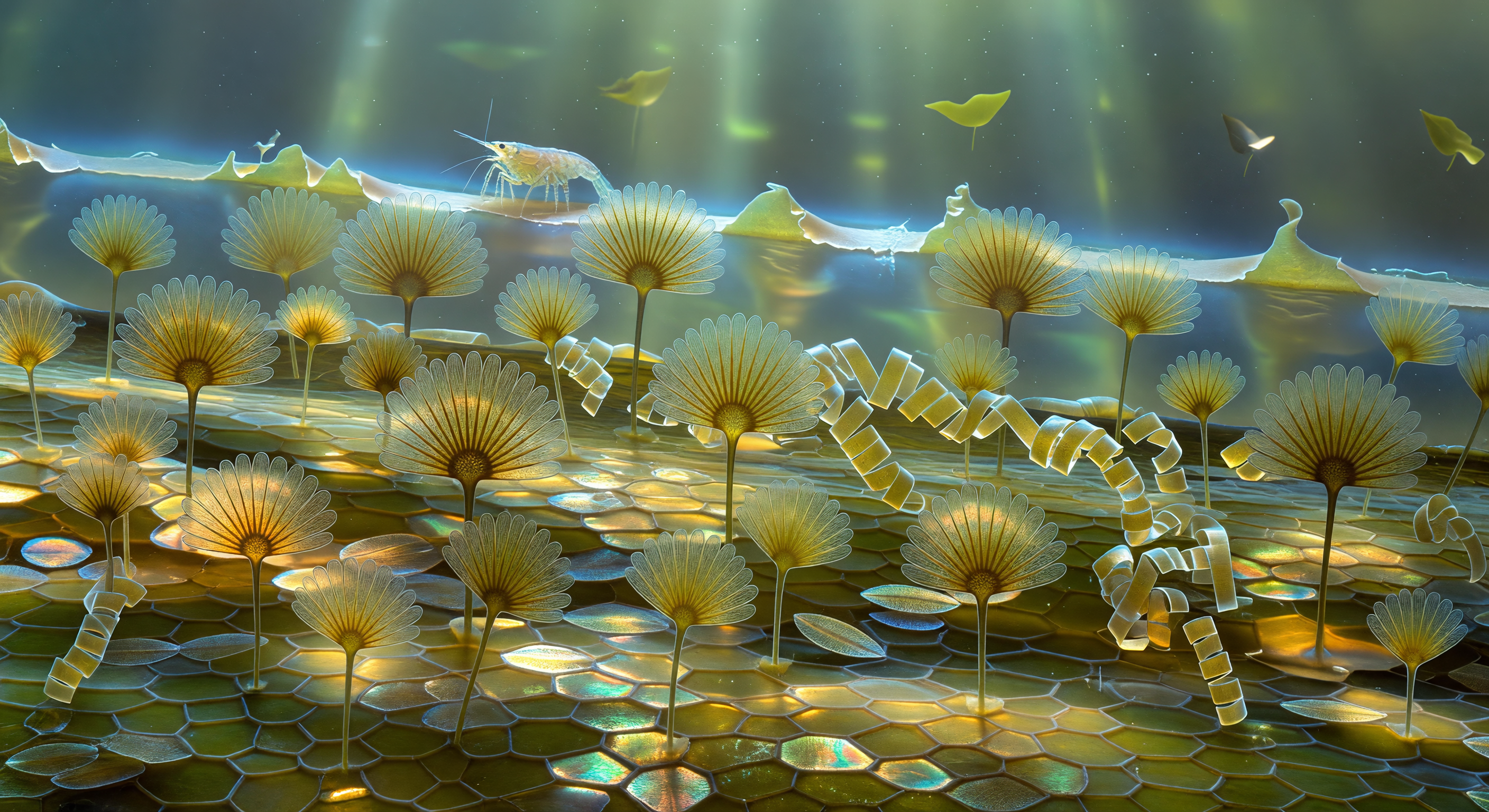
You hover a hundred micrometers above the surface of a giant kelp blade, *Macrocystis pyrifera*, which spreads beneath you like an undulating continent of olive and amber — its enormous plant cells tessellating the surface in a waxy, translucent mosaic, the whole landscape trembling as slow caustic curtains of blue-green shallow-water light sweep through the column above and set every surface flickering between gold and shadow. This blade is not bare: a layered biofilm civilization coats it in pale amber extracellular polysaccharide and mucilage, a barely visible matrix that catches low-angle light with a faint iridescent sheen, within which several distinct diatom species have colonized every available niche of substrate, light, and flow regime. Dominating the middle distance, *Licmophora* colonies rise on slender mucilage stalks — each a perfect flabellate fan of twenty to forty elongate silica frustules arranged in golden-brown arcs thirty to sixty micrometers wide, their finely striated valves glowing warm amber and throwing interference colors of teal and copper as caustic light refracts through them, swaying almost imperceptibly in the slow surge current like a microscopic forest echoing the kelp canopy far above. Between them, *Cocconeis* valves lie flush and nearly invisible against the kelp cells — elliptical silica shields pressed tight to the substrate by their own raphe system, camouflaged in the green-brown EPS — while *Rhabdonema* ribbon bundles coil in loose zigzag spirals through the mid-ground, their bright silver-gold edges catching the light against the darker matrix. Cutting across the background, a pale scrape scar exposes raw kelp surface where a grazing amphipod — crouching at the far margin of its own devastation, enormous at this scale, a mountain of jointed translucent armor — is still working its mandibles through the biofilm fringe, sending slow pressure waves through the water that set every *Licmophora* fan trembling in unison, golden antennae tuned to the same ancient, animal frequency.
Other languages
- Français: Éventails de Licmophora sur Varech
- Español: Abanicos de Licmophora en Alga
- Português: Leques de Licmophora no Kelp
- Deutsch: Licmophora-Fächer auf Kelp
- العربية: مراوح ليكموفورا على عشبة البحر
- हिन्दी: केल्प पर लिकमोफोरा के पंखे
- 日本語: コンブ葉上のリクモフォラ扇
- 한국어: 켈프 위의 리크모포라 부채
- Italiano: Ventagli di Licmophora su Kelp
- Nederlands: Licmophora-waaiers op Kelp