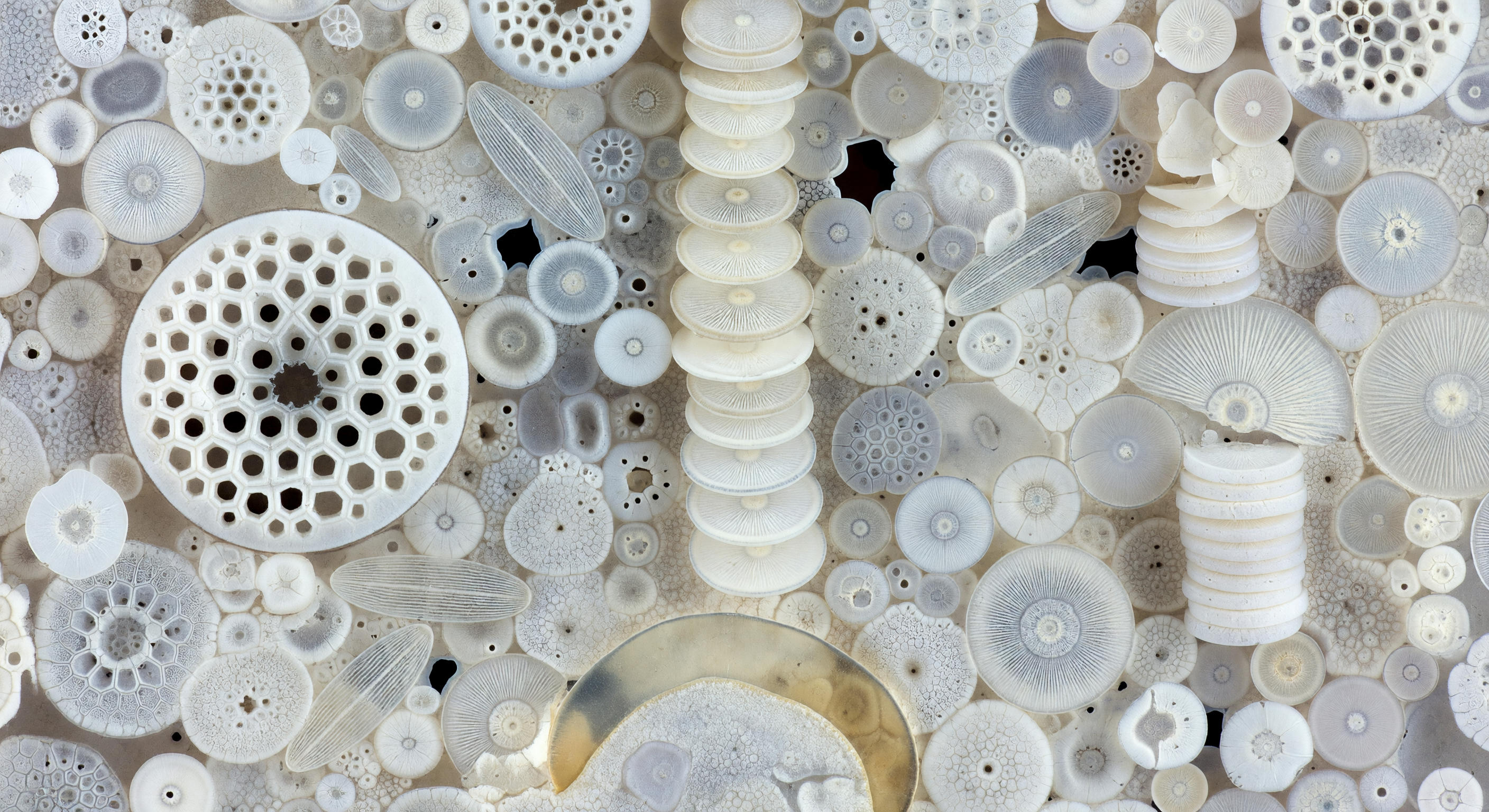
You are suspended within the pale mineral body of a Miocene diatomite, enclosed on every side by ten million years of compressed biological architecture rendered in silica and stone. The dominant structures around you are the frustules of countless diatom species — *Melosira* chains stacked as coin-columns of pale opal-A silica, each valve's concentric radial striae still resolved at microscopic precision; a massive *Stephanopyxis* disc occupying the field like a cathedral wall, its honeycomb loculi preserved in cross-section as chambered voids set into white stone. Between and around these forms, void pore spaces — once pathways for interstitial water during early diagenesis — appear as absolute cold darkness, the negative space that makes the surrounding silica matrix glow by contrast with an ivory, sourceless luminescence. This rock is diatomite: a sedimentary deposit formed when biogenic silica accumulated faster than it dissolved, the frustules compacting under burial pressure but retaining taxonomically identifiable ultrastructure across geological time, their amorphous hydrated silica slowly recrystallizing yet never fully erasing the biological geometry encoded within. Nearby, the smooth translucent curve of a fossil fish scale redirects the diffuse cold light into a faint ochre warmth — the only organic remnant in a world otherwise given entirely to mineral silence, every surface a record of organisms that lived, sank, and became the ground itself.
Other languages
- Français: Coupe de Diatomite Temps Profond
- Español: Sección de Diatomita Tiempo Profundo
- Português: Seção de Diatomita Tempo Profundo
- Deutsch: Diatomit Querschnitt Tiefe Zeit
- العربية: مقطع صخر الدياتوميت الزمن السحيق
- हिन्दी: डायटोमाइट शैल-खंड गहन काल
- 日本語: 珪藻土断面 深遠な時代
- 한국어: 규조토 암석 단면 심원한 시간
- Italiano: Sezione di Diatomite Tempo Profondo
- Nederlands: Diatomiet Doorsnede Diepe Tijd