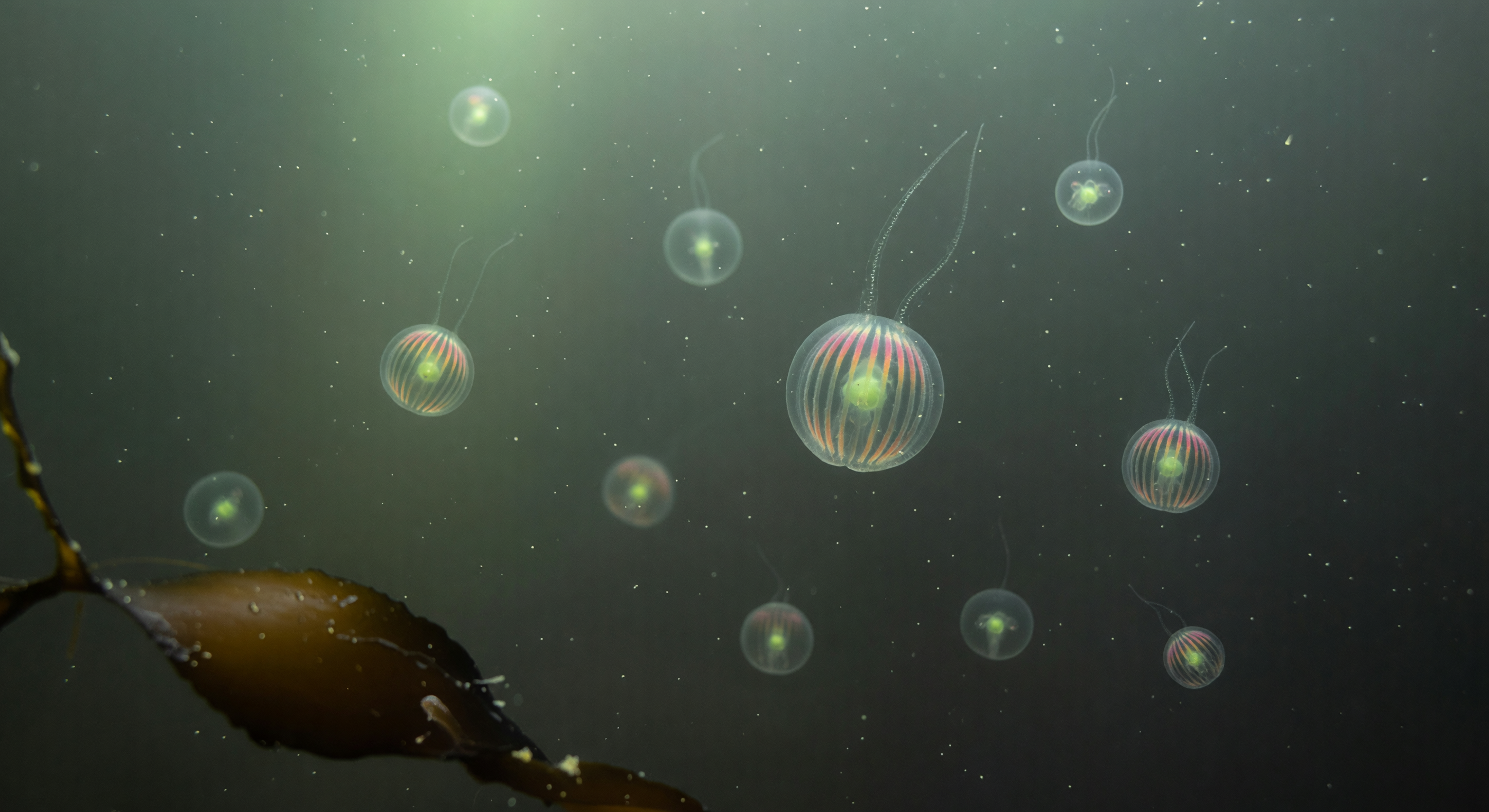
Below fifteen meters in a February sea loch, the peat-stained water filters what little light reaches this depth into a cold, directionless jade, and within that dim suspension a dozen Pleurobrachia pileus hang motionless in the mid-water column — spherical bodies no larger than glass marbles, each one so nearly transparent that they register less as objects than as subtle displacements of the green-grey murk, their curved mesoglea walls refracting a thin lens-flare of ambient light along each equator while soft celery-green gut contents glow faintly at their cores. Each individual belongs to the phylum Ctenophora, animals constructed almost entirely of viscoelastic mesoglea — a collagen-threaded, water-saturated gel whose refractive index is so closely matched to seawater that the body verges on optical erasure. What betrays them is movement: eight comb rows arc over each sphere like the meridians of a tiny world, their fused ciliary plates beating in antiplectic metachronal waves that sweep muted rose and amber iridescence along each band in a rhythm that pulses like slow breathing, a structural color produced not by pigment but by the diffraction of whatever faint light filters down through the plankton-hazed column above. Behind the nearest individual, a pair of gossamer tentacles extend fifteen centimeters into the particulate haze, their colloblast-studded tentilla vanishing entirely into the suspension — invisible fishing lines set inside a cold, pressured world where gelatinous life drifts in loose congregation through water that is itself more biology than emptiness.
Other languages
- Français: Bloom Glacial de Pléurobrachia
- Español: Floración Fría de Pleurobrachia
- Português: Floração Fria de Pleurobrachia
- Deutsch: Pleurobrachia Kalter Loch Schwarm
- العربية: ازدهار بليوروباكيا في البحيرة الباردة
- हिन्दी: प्ल्यूरोब्राकिया शीत लोच प्रस्फुटन
- 日本語: 冷たいロッホのクシクラゲ群生
- 한국어: 차가운 로흐의 플레우로브라키아 번성
- Italiano: Fioritura Fredda di Pleurobrachia nel Loch
- Nederlands: Pleurobrachia Koude Loch Bloei