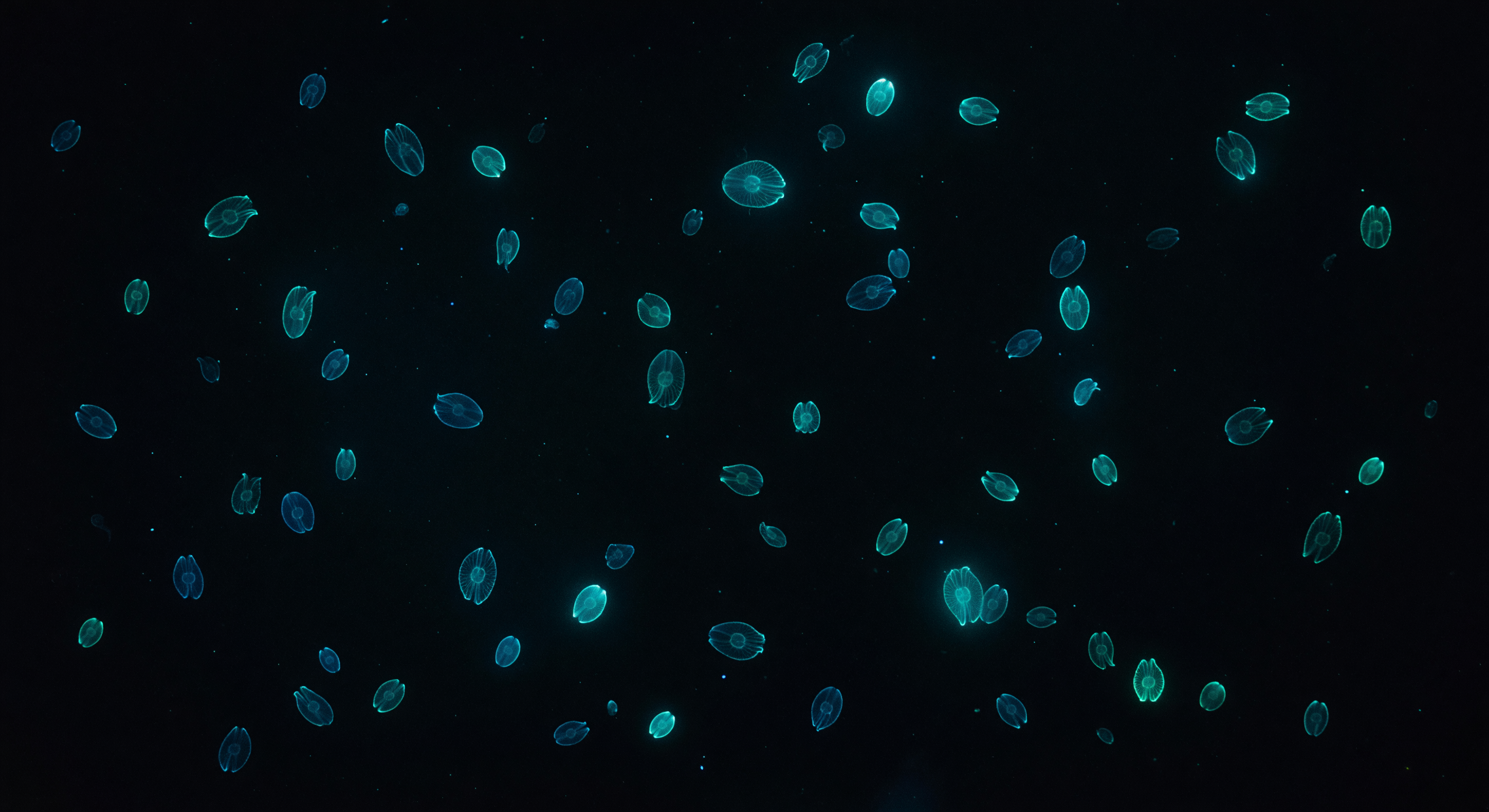
Suspended in the absolute darkness of a moonless ocean, you are surrounded by living geometry — dozens of *Mnemiopsis leidyi* drifting in every direction, their gelatinous bodies so perfectly transparent that they vanish entirely into the black water, leaving only eight ribbons of cold blue-green light to trace each animal's outline against the void. These are the comb rows, eight longitudinal bands of fused cilia whose underlying photocytes fire in a luciferin-luciferase cascade triggered by mechanical disturbance, emitting at precisely 490 nanometers — a teal that exists nowhere on land — as waves of bioluminescent activation travel slowly and repeatedly from the blunt aboral pole down toward the oral end, each traversal taking roughly a second before the row dims and reignites from the top. The mesoglea composing each body is a viscoelastic gel of collagen, glycoproteins, and water refracting light at nearly the same index as seawater itself, so that the animals register only as the faintest curved meniscus, a ghostly lensing distortion where living tissue meets ocean. Farther animals dissolve into soft cyan coronas as suspended marine snow scatters each photon outward before extinguishing it, giving the black water a luminous volumetric texture — shafts of blue-green light extending centimeters into open water, illuminating nothing but the sea itself. The aggregation breathes asynchronously around you, some comb rows mid-pulse, others just igniting, a field of cold living constellations drifting on imperceptible currents through water that is otherwise lightless and absolute.
Other languages
- Français: Lueur Bioluminescente de Minuit
- Español: Resplandor Bioluminiscente Nocturno
- Português: Brilho Bioluminescente da Meia-Noite
- Deutsch: Mitternächtliches Biolumineszenz-Leuchten
- العربية: توهج بيولوجي في منتصف الليل
- हिन्दी: मध्यरात्रि जैवदीप्ति का प्रस्फुटन
- 日本語: 深夜の生物発光の輝き
- 한국어: 한밤의 생물발광 빛무리
- Italiano: Bagliore Bioluminescente di Mezzanotte
- Nederlands: Middernachtelijk Bioluminescent Gloeien