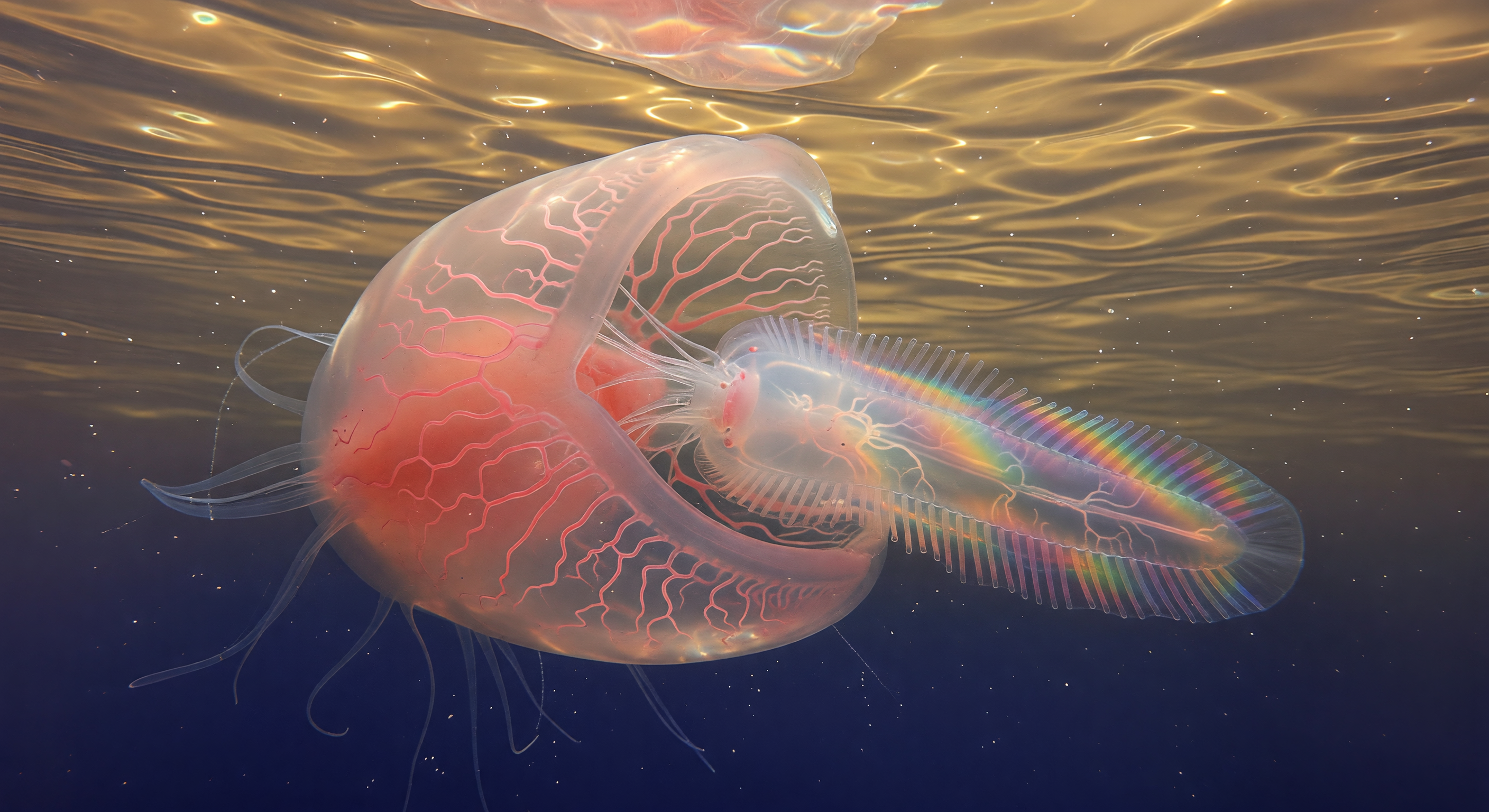
In the warm, glass-clear upper meter of the Gulf Stream, two nearly invisible animals have locked together in a transaction so slow and complete it reads more as merger than predation: a *Beroe cucumis* has stretched its entire macrostome mouth around more than half the body of a *Mnemiopsis leidyi*, and the combined form — perhaps fifteen centimeters from the *Beroe*'s aboral pole to the *Mnemiopsis*'s still-protruding posterior — hangs suspended in a column of luminous cobalt water while late-afternoon caustics sweep golden interference patterns continuously across both translucent bodies. The *Beroe*'s mesoglea, a viscoelastic matrix of collagen and water matched so precisely to the refractive index of the surrounding sea that it reads as tinted air rather than tissue, glows rose-apricot from within, its branching meridional canals mapping a bilateral river delta of digestion in real time, faint pulsations visible through walls only a few cells thick. Where the prey still emerges into open water, its four exposed comb rows continue their metachronal programs at fifteen to thirty beats per second — each ctene plate a fused paddle of ten thousand cilia sweeping structural color from violet through amber to green in rolling cascade, an involuntary rainbow that has not yet received the signal of its own ending. One by one, beginning at the oral end already dissolving inside the predator's pink interior glow, the iridescent flickers lose their rhythm, the last posterior plates still cycling their light into the darkening blue column below as the two gelatinous architectures, almost indistinguishable from the water that composes them, complete their slow exchange.
Other languages
- Français: Béroé Engloutit Mnemiopsis Crépuscule
- Español: Beroe Engulle Mnemiopsis Atardecer
- Português: Beroe Engole Mnemiopsis Pôr do Sol
- Deutsch: Beroe Verschlingt Mnemiopsis Sonnenuntergang
- العربية: بيرو يبتلع منيميوبسيس الغروب
- हिन्दी: बेरो निगलता मनिमिओप्सिस सूर्यास्त
- 日本語: ベロエがクシクラゲを飲む夕暮れ
- 한국어: 베로에 삼키는 므네미옵시스 노을
- Italiano: Beroe Ingoia Mnemiopsis Tramonto
- Nederlands: Beroe Verzwelgt Mnemiopsis Zonsondergang