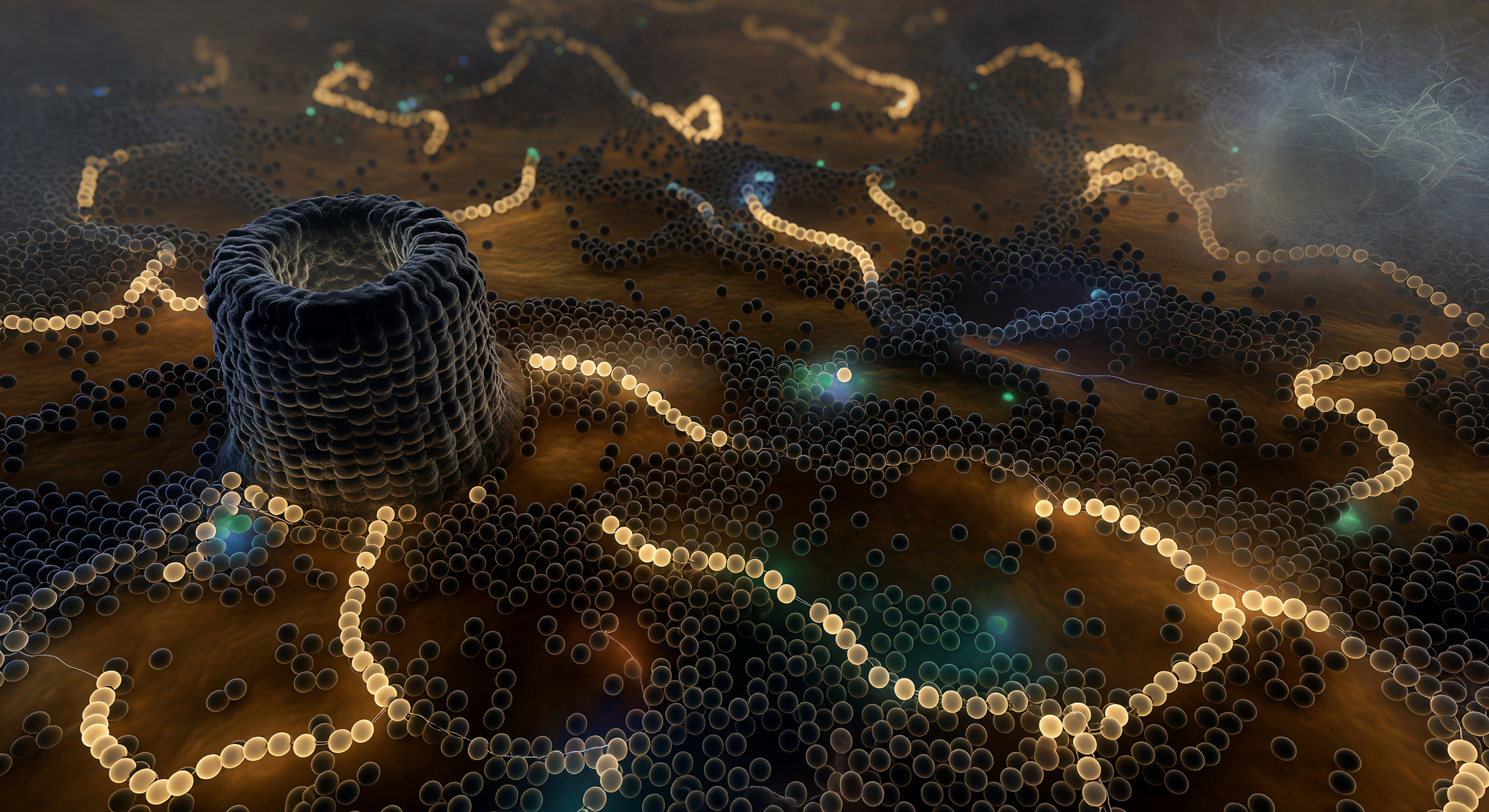
You are submerged inside a living bacterial cell, hovering just beyond the pale fibrous boundary of the nucleoid, and the world around you offers no open space whatsoever — only a warm, amber-resinous gel packed so densely with 70S ribosomes that the gaps between their dark, umber-gray surfaces read less as distance than as mortar between ancient stones, each sphere separated from its neighbor by a mere five to ten nanometers in a medium running at roughly 300 milligrams of protein per milliliter. Threading through this granular press, polysome chains sag across the middle distance like irregular pearl necklaces — six ribosomes strung along barely visible mRNA filaments that glow a faint cream-white before dissolving into deeper brown opacity — actively translating proteins at a rate of fifteen to twenty amino acids per second per ribosome, multiplied across tens of thousands of such machines simultaneously active in this single cell. To the left, a GroEL chaperonin barrel dominates a full quadrant of the scene like a petrified tree stump, its double-ring architecture rendered in deep slate-gray, its hollow central cavity offering a slightly cooler interior where misfolded proteins are sequestered and refolded through ATP-driven conformational cycling. The only color relief in this warm monochrome crush comes from occasional GFP-labeled proteins flaring briefly as small emerald embers before being occluded again by another passing ribosome — transient beacons in a cytoplasm so molecularly crowded that even diffusion is slowed, and the boundary between structured matter and empty solvent has effectively ceased to exist.
Bacteria