Purple Membrane Cathedral Interior
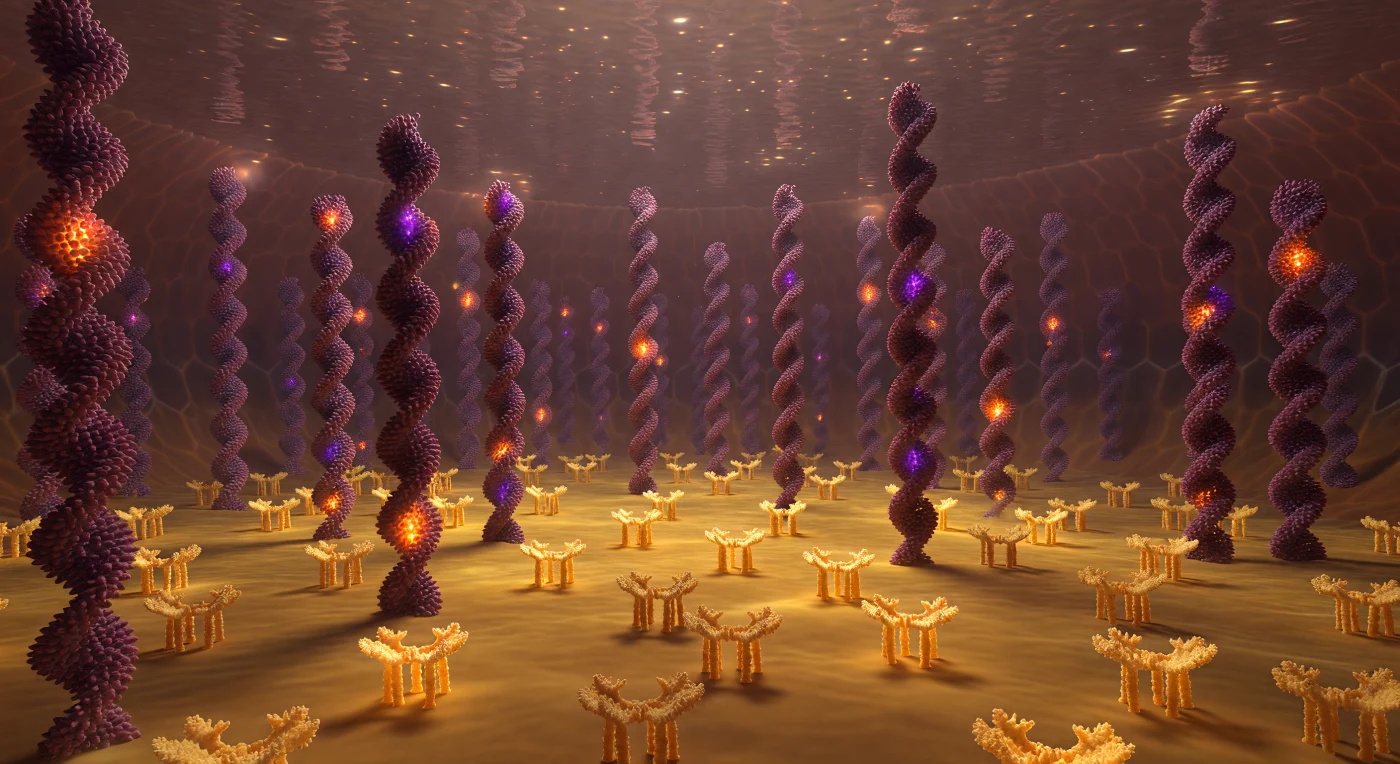
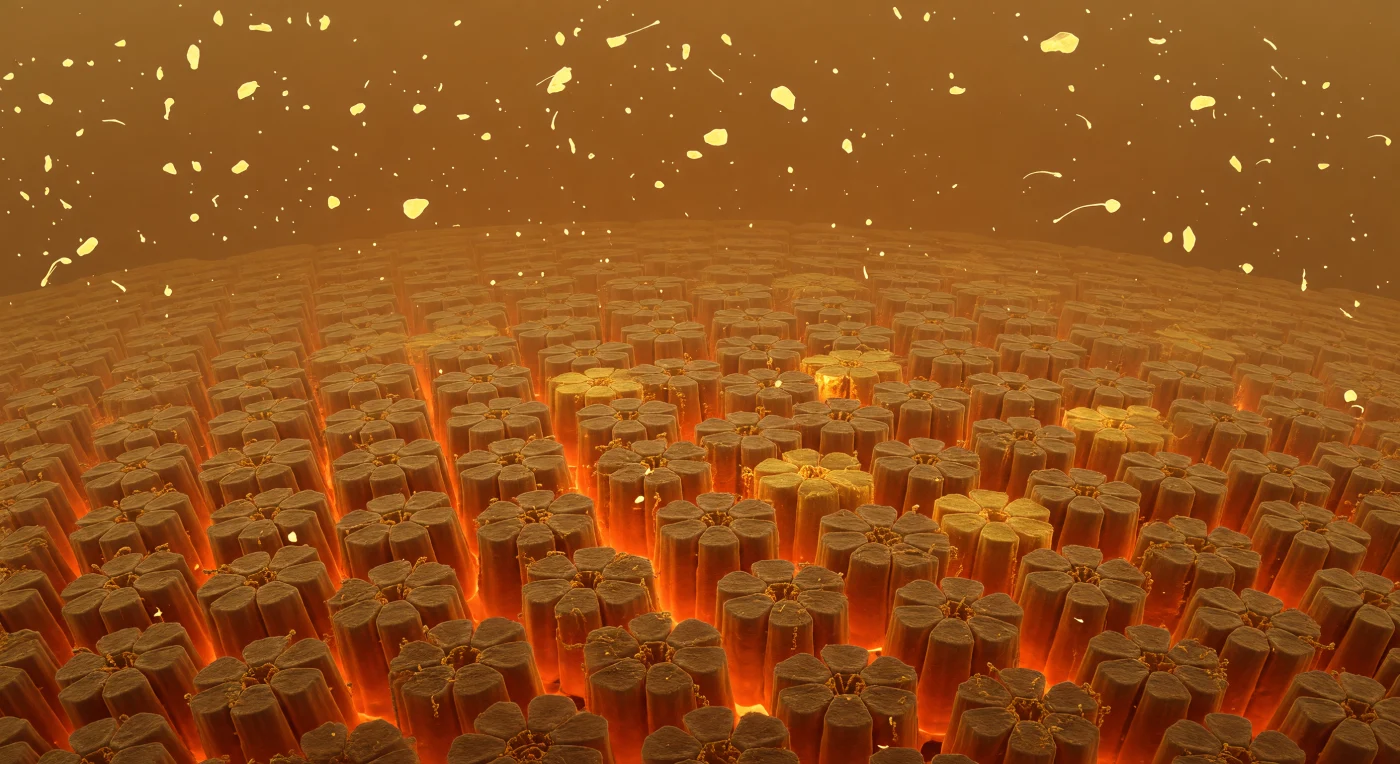
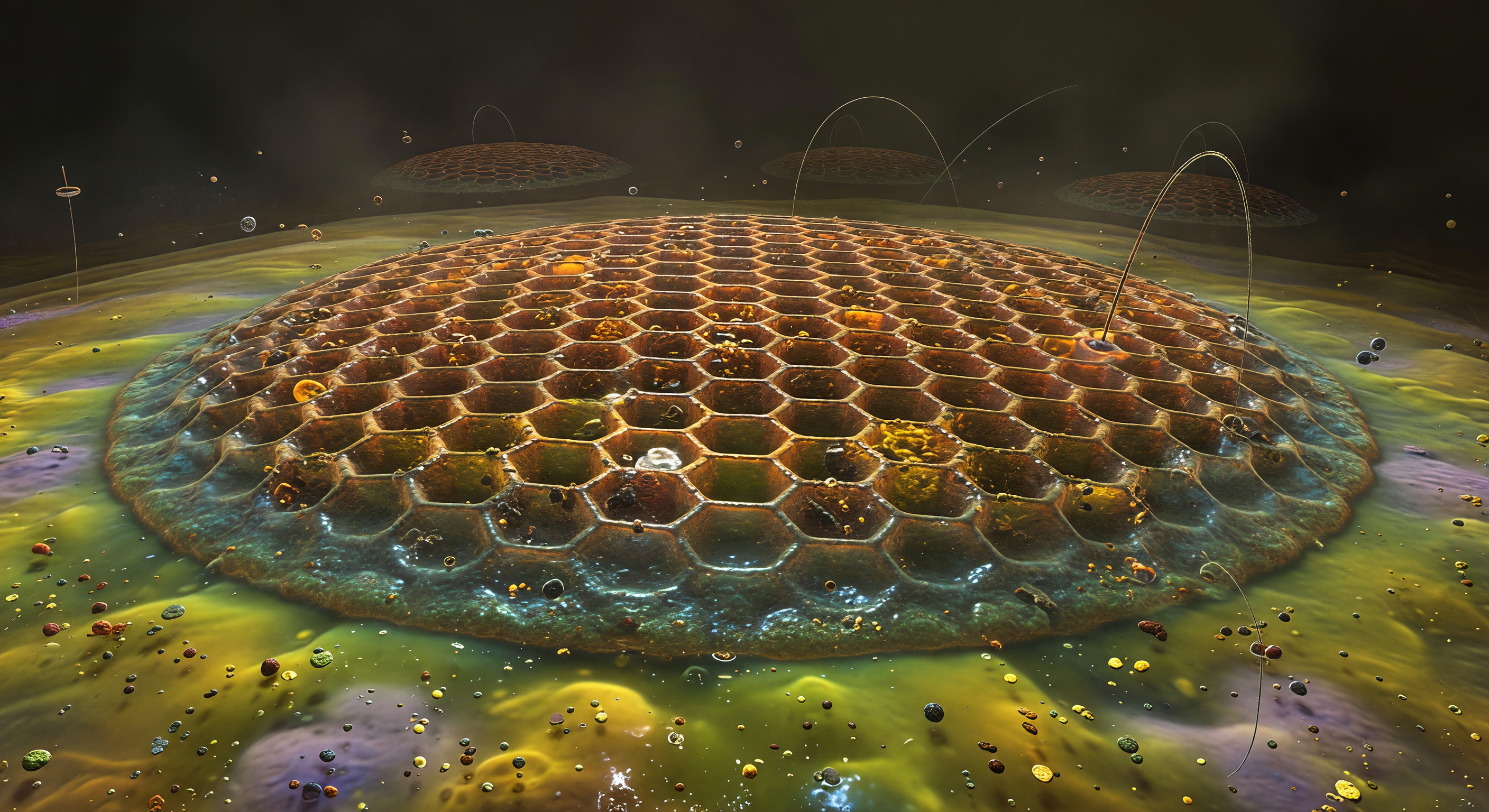
You exist as a dimensionless point suspended nanometers above the inner leaflet of a living archaeal membrane, and what surrounds you reads not as biology but as architecture — a cathedral interior assembled from chemistry alone, its nave defined by the ordered hexagonal forest of bacteriorhodopsin columns rising in violet-black clusters to a curved horizon that bends away in every direction like the inner surface of an enormous sphere. Beneath you, the caldarchaeol tetraether floor undulates in slow thermal breathing, its paired isoprenoid chains catching the sourceless reddish-violet luminescence from above and returning it as warm amber — a wax-glass plain of biological engineering so precise it looks quarried, its subtle corrugations and branching phytanyl texture carrying the fine grain of stone rather than molecule. Each time a scattered photon strikes a retinal chromophore buried within one of the helical columns, a single pillar pulses through deep amber and back again, the isomerization cascade radiating outward into the lipid field as a dying warmth that travels only nanometers before the surrounding molecular crowd absorbs it entirely, leaving only the low distributed glow of a system perpetually converting light into proton gradient. Above, the hyperconcentrated KCl cytoplasm refracts that faint light into prismatic halos around each column's crown, so that the cytoplasmic void overhead has the appearance of a pressurized brine sea viewed from the seafloor — its surface somewhere impossibly distant, and this latticed membrane world beneath it as ancient and geometrically absolute as anything geology has ever produced.