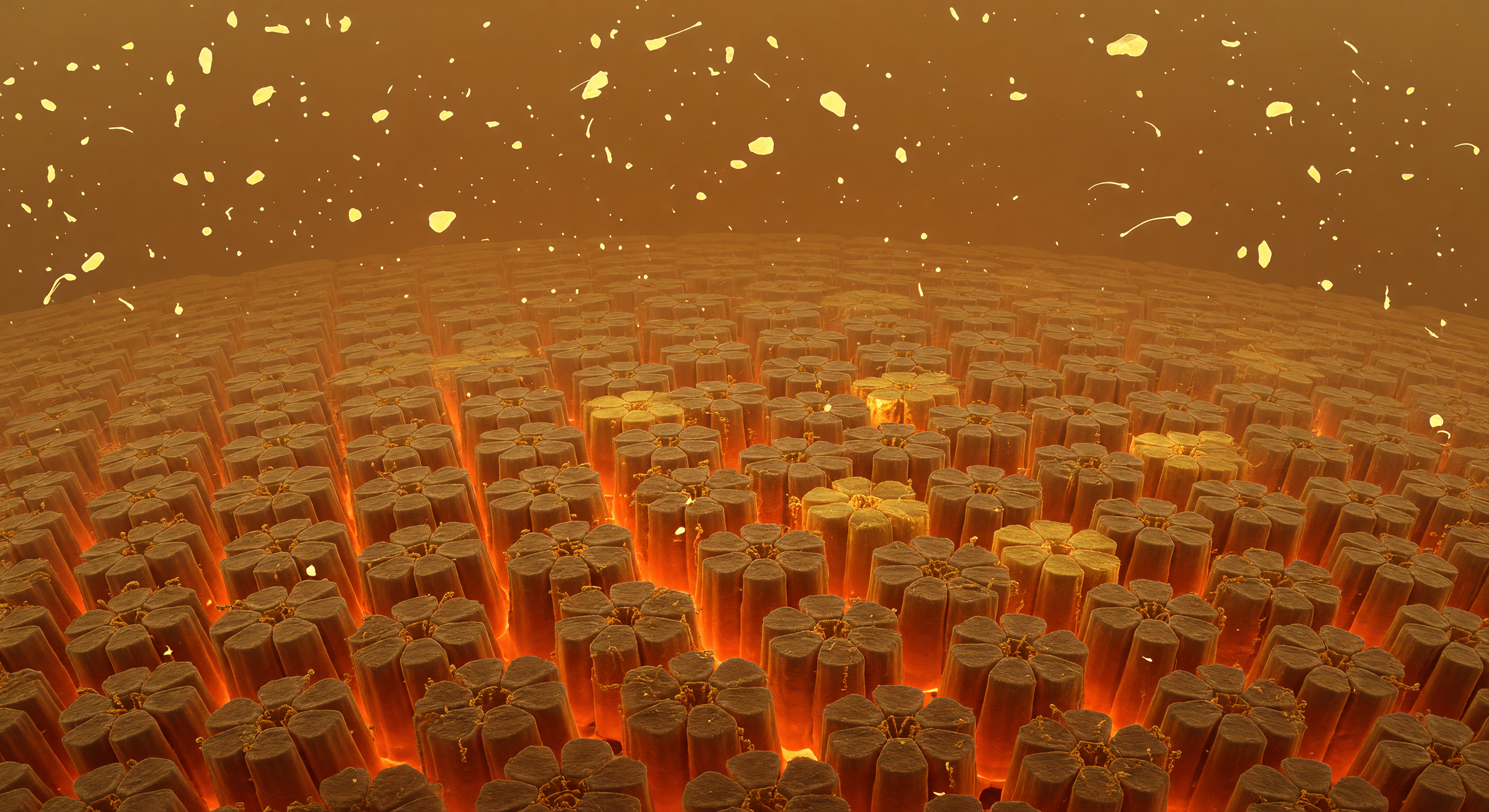
You stand on the outer skin of a living cell, and the world curves away in every direction like the surface of an amber planet whose horizon is measured in micrometers. Beneath your feet stretches an unbroken crystalline plain of interlocking hexagonal glycoprotein rosettes — the S-layer of *Sulfolobus acidocaldarius* — each hexamer roughly the size of a small building at your ten-nanometer scale, its six densely packed beta-barrel subunits rising as burnt-copper pillars with glycan chains quivering at their tips in the ceaseless thermal agitation of 80°C fluid. Between adjacent hexamers, five-nanometer channel-gaps glow with trapped orange luminescence, offering glimpses of the GDGT tetraether membrane monolayer below — not the trilaminar sandwich of ordinary cells but a single seamless slab of isoprenoid-linked lipids, dense and dark as polished resin, its covalently spanned architecture evolved to resist both the proton assault of pH-3 acid and temperatures that would dissolve conventional bilayers. Through the sulfurous ochre haze above — a viscous acidic medium thick with dissolved mineral compounds — pale yellow flakes of elemental sulfur tumble in slow non-ballistic arcs, their trajectories continuously redirected by Brownian collisions, catching the geological amber light in brief cold flashes before vanishing back into the thermal murk of a volcanic hydrothermal environment that has sustained life of this kind for billions of years.
Other languages
- Français: Plaine Hexagonale Dorée
- Español: Llanura Hexagonal Dorada
- Português: Planície Hexagonal Dourada
- Deutsch: Goldene Hexagonale S-Schicht
- العربية: سهل طبقة ذهبية سداسية
- हिन्दी: स्वर्णिम षट्कोणीय परत मैदान
- 日本語: 黄金六角Sレイヤー平原
- 한국어: 황금 육각형 S층 평원
- Italiano: Pianura Esagonale Dorata
- Nederlands: Gouden Hexagonaal S-Laag Vlak