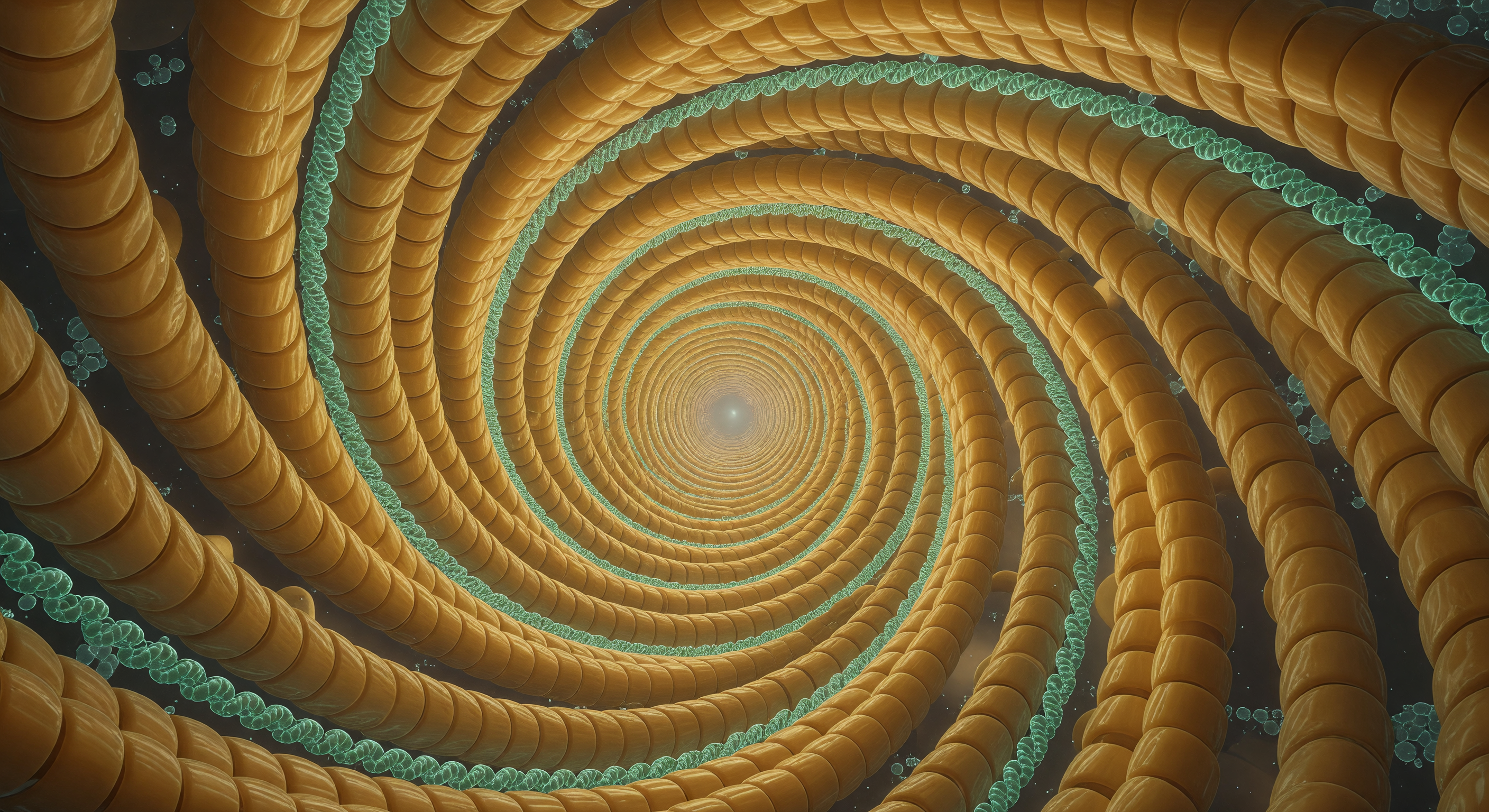
You stand inside a molecular machine older than any nervous system, suspended at the geometric center of a Tobacco Mosaic Virus rod whose walls rise around you in a seamless right-handed helix: 2,130 coat protein subunits, each a compact beta-sheet sandwich of warm ochre and amber, tessellate the tunnel surface with the regularity of a carved bobbin, their ridges and grooves repeating every 2.3 nanometers to produce a corrugated spiral that winds upward and downward into shadow with the precision of machined porcelain. Pressed snug against the inner face of the capsid wall, four nanometers from the axis where you float, the single-stranded RNA genome traces a continuous jade-green thread along a shallow spiral groove, each nucleotide held in electrostatic embrace by arginine residues on the protein surface — a genome not loose but cradled, locked in intimate molecular contact with the shell that both protects and controls it. Looking down the axis, the tunnel extends for what feels like the full length of a cathedral nave before narrowing to a pale circular aperture 300 nanometers distant, its far rim hazed by the thermal fog of water molecules and ions crowding the four-nanometer bore. The protein walls themselves are not still: each subunit breathes with picoscale thermal vibration, the collective motion producing a faint shimmer across the ribbed surface, a reminder that this structure exists not in frozen stillness but at the trembling edge of biological stability, held together by the same thermodynamic logic that allowed it to self-assemble spontaneously from its molecular components in the first place.
Other languages
- Français: Hélice intérieure du virus mosaïque
- Español: Hélice interior del virus mosaico
- Português: Hélice interna do vírus mosaico
- Deutsch: Innere Helix des Tabakmosaikvirus
- العربية: حلزون فيروس فسيفساء التبغ
- हिन्दी: तंबाकू मोज़ेक वायरस आंतरिक कुंडली
- 日本語: タバコモザイクウイルス内部螺旋
- 한국어: 담배 모자이크 바이러스 내부 나선
- Italiano: Elica interna del virus del mosaico
- Nederlands: Binnenste helix tabaksmozaïekvirus