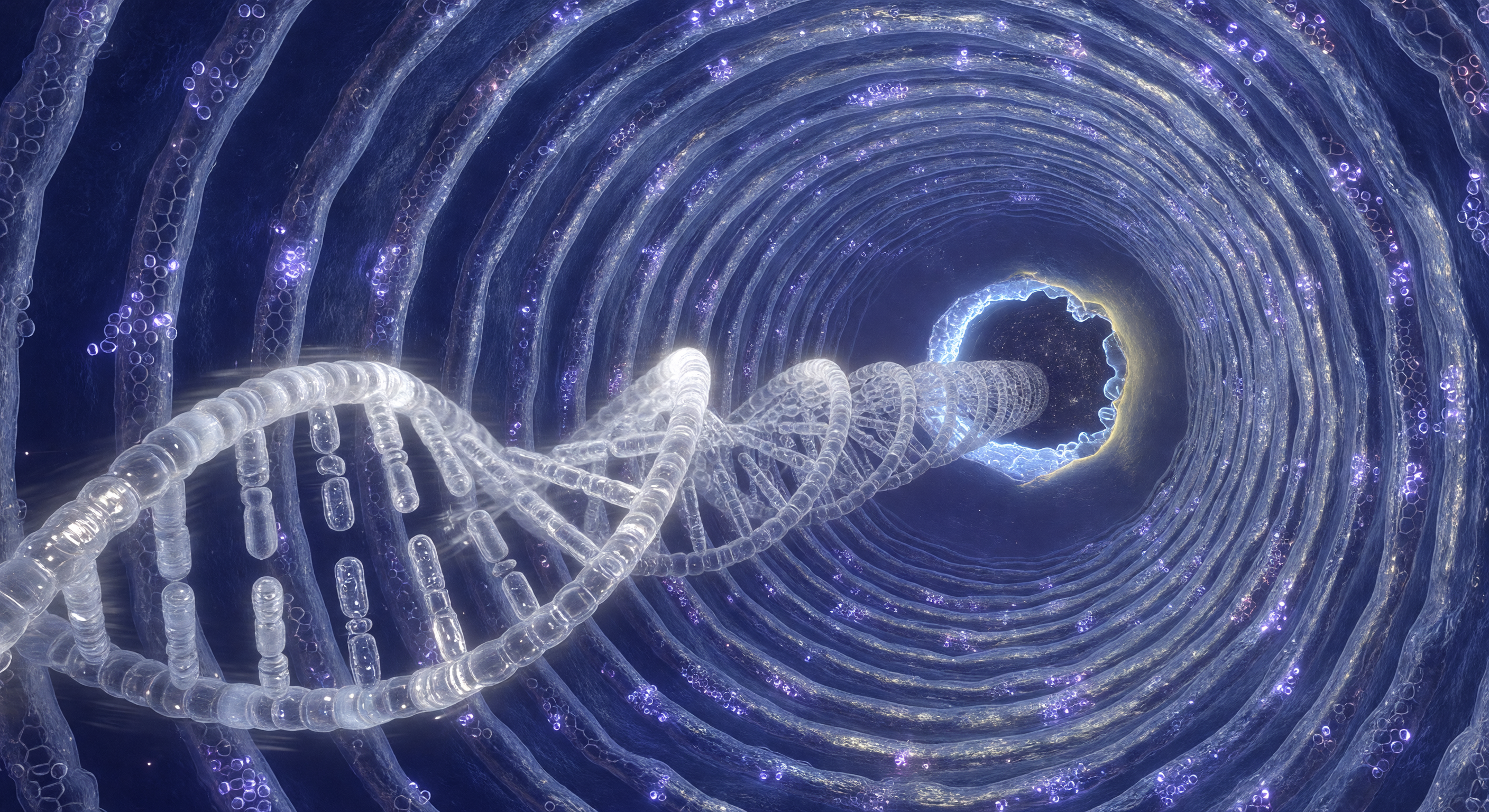
You are standing inside a tunnel no wider than two water molecules laid end to end, the curved walls of stacked protein rings pressing in from every side with their ridged, barrel-vault geometry, each crest of charged amino acid residues glowing in cold violet where arginine and lysine cluster like bioluminescent moss on cave stone. This is the tail channel of bacteriophage lambda, a molecular machine that has spent millions of years evolving a single brutal purpose: the forced delivery of its genome across the armored boundary of a living cell. Through you, at this very instant, a double-stranded DNA helix is erupting at catastrophic speed, driven by roughly six atmospheres of pressure stored in the phage head above — a silver-white rope of molecular glass whose phosphate backbone catches the ambient charge-glow in a continuous flickering sheen, its passage squeezing the electrostatically saturated fluid between strand and wall to near-molecular thinness, shimmering like heat haze above asphalt. Ahead, the exit pore blooms open as a ragged aperture of electric blue-white light where the channel has breached the bacterial inner membrane, lipid molecules displaced outward like a torn diaphragm, their hydrophobic tails briefly exposed as a pale golden fringe around the wound — and beyond that threshold, the bacterium's cytoplasm begins, an unresolvable darkness seething with thermal chaos, waiting to receive a genome that will rewrite the fate of everything it enters.
Other languages
- Français: Couloir d'Éjection de l'ADN
- Español: Corredor de Eyección de ADN
- Português: Corredor de Ejeção de DNA
- Deutsch: Phagen-DNA-Auswurfkanal
- العربية: ممر طرد الحمض النووي
- हिन्दी: फेज डीएनए निष्कासन गलियारा
- 日本語: ファージDNA放出回廊
- 한국어: 파지 DNA 방출 통로
- Italiano: Corridoio di Espulsione del DNA
- Nederlands: Faag DNA Uitstootkanaal