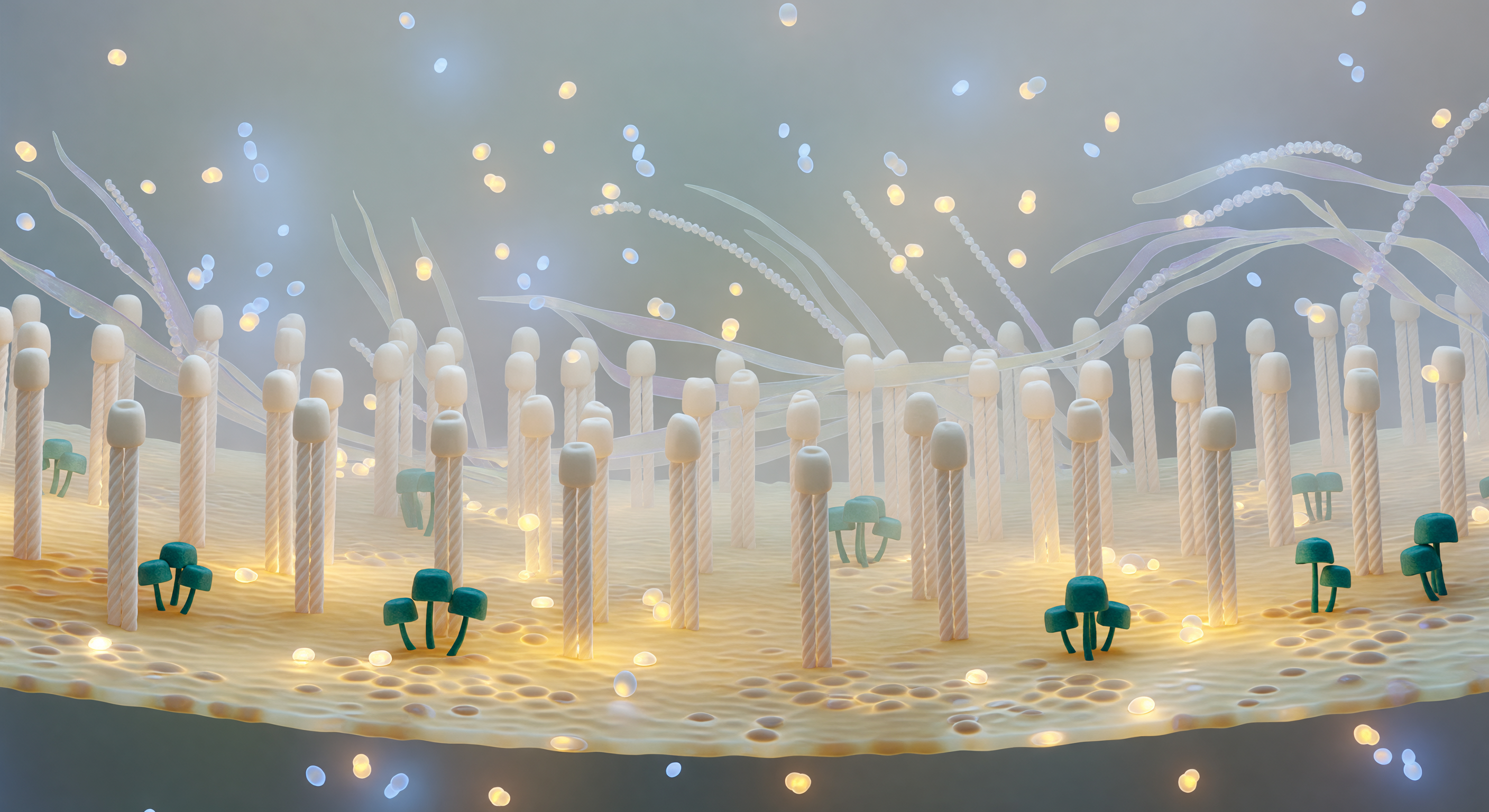
You find yourself drifting at eye level across a world that curves away in every direction, its surface a shimmering plain of warm amber and honey-gold — the fluid lipid bilayer of an influenza virion, alive with the slow thermal undulation of a membrane whose phospholipids and cholesterol-rich microdomains shift and pool in constant Brownian restlessness. Around you, hemagglutinin trimers rise like a dense ivory forest, each a slender three-stranded glycoprotein rod roughly thirteen nanometers tall, their softly swollen crowns packed close enough that the bilayer floor is only glimpsed in narrow amber corridors between them; scattered among them at irregular intervals, neuraminidase tetramers squat wider and lower, their blunt teal-and-verdigris heads catching the cold diffuse light differently and drawing the eye like dark lanterns in a pale wood. The surrounding medium is no vacuum but a luminous biological fog — serum albumin globules drift past like softly glowing amber spheres, sinuous glycoprotein chains and mucin strands trail through the middle distance like translucent kelp in slow current, and the visibility closes in rapidly, dissolving the further rows of pillars into opalescent haze just a handful of molecular lengths away. This is the extracellular milieu at physiological crowding: water behaves here as thick syrup, inertia is meaningless, and every surface encounter carries the potential for a binding event that could determine the fate of an entire infection. The scene holds no sky, no distant horizon, no open space — only this claustrophobically rich, densely inhabited forest of molecular architecture receding into luminous protein fog.
Viruses