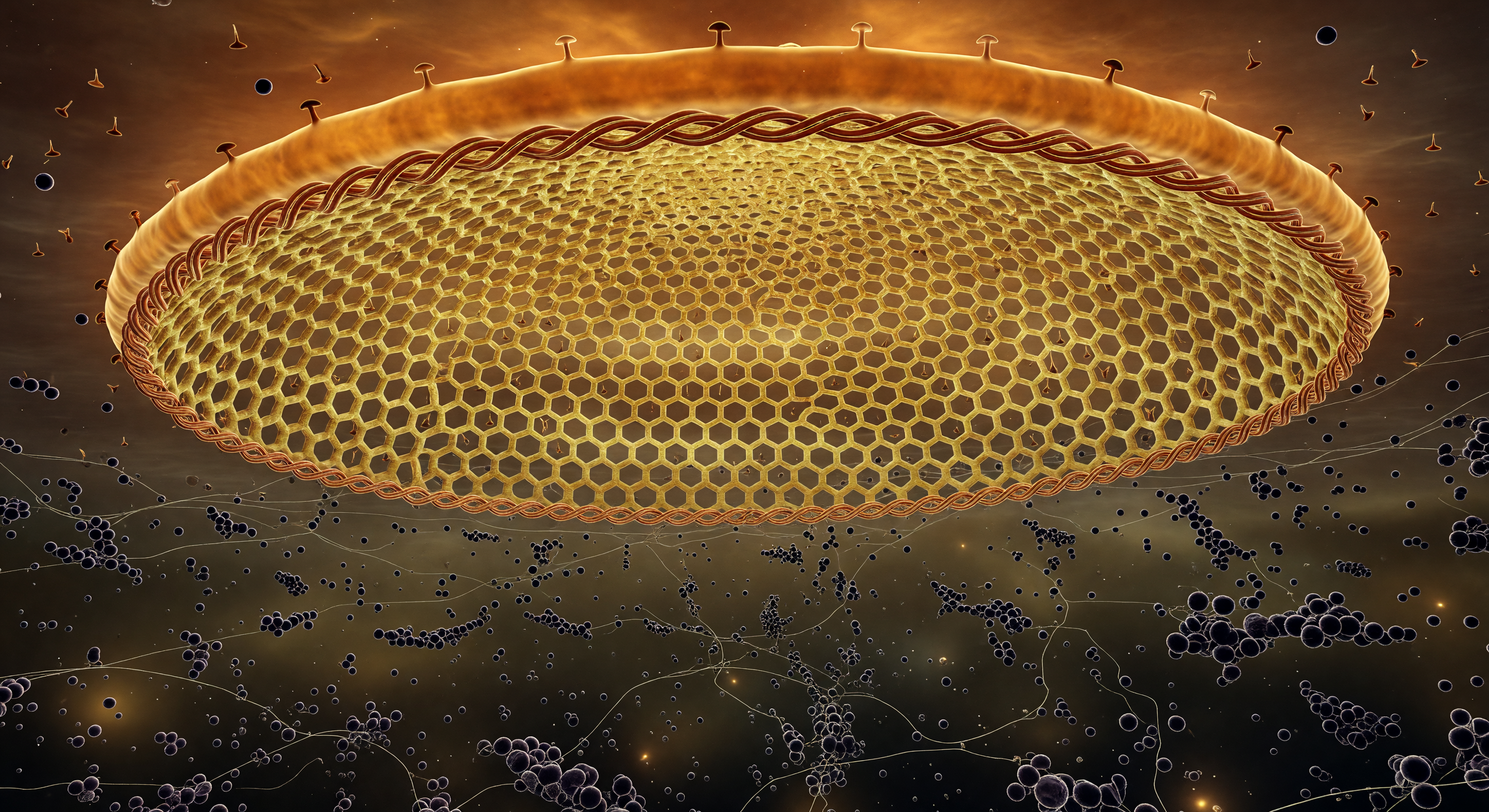
Looking up from inside the forming bud, the curved Gag lattice arches overhead as a vast amber honeycomb, its hexameric rings tessellating across the full span of your visual field in warm ochre and gold, each unit a self-assembled cluster of polyprotein subunits spontaneously adopting this geometry through nothing more than thermodynamic preference and molecular complementarity. This is HIV in the act of becoming — the immature Gag lattice, roughly 8 nanometers per hexameric ring, drives membrane curvature outward into a nascent virion that does not yet exist as an independent particle, the host plasma membrane glowing just beyond as a paired amber sheet, its lipid bilayer barely resolved, interrupted by the dark silhouettes of Env glycoprotein spikes already embedded and waiting. At the constricting neck visible at the dome's far rim, ESCRT-III filaments have been recruited from the host cell's own membrane-remodeling machinery and now spiral inward in a tightening copper coil, each polymer strand a few nanometers wide, their helical contraction preparing to sever the membrane neck in a topology-reversing scission event the cell ordinarily uses to pinch off multivesicular body cargo. Below, the cytoplasm recedes into an impenetrable crowded darkness of ribosomes, RNA strands, and jostling proteins — the thermal violence of that molecular environment invisibly transmitted upward into every element of the dome above, each subunit trembling in place, the entire architecture held together not by rigidity but by the collective statistics of ten thousand weak bonds.
Other languages
- Français: Dôme Bourgeonnant du VIH
- Español: Cúpula de Gemación del VIH
- Português: Cúpula de Brotamento do HIV
- Deutsch: HIV Unreife Knospungskuppel
- العربية: قبة تبرعم فيروس HIV
- हिन्दी: HIV कलिका गुंबद
- 日本語: HIV出芽ドーム
- 한국어: HIV 미성숙 발아 돔
- Italiano: Cupola Gemmante dell'HIV
- Nederlands: HIV Ontluikende Koepel