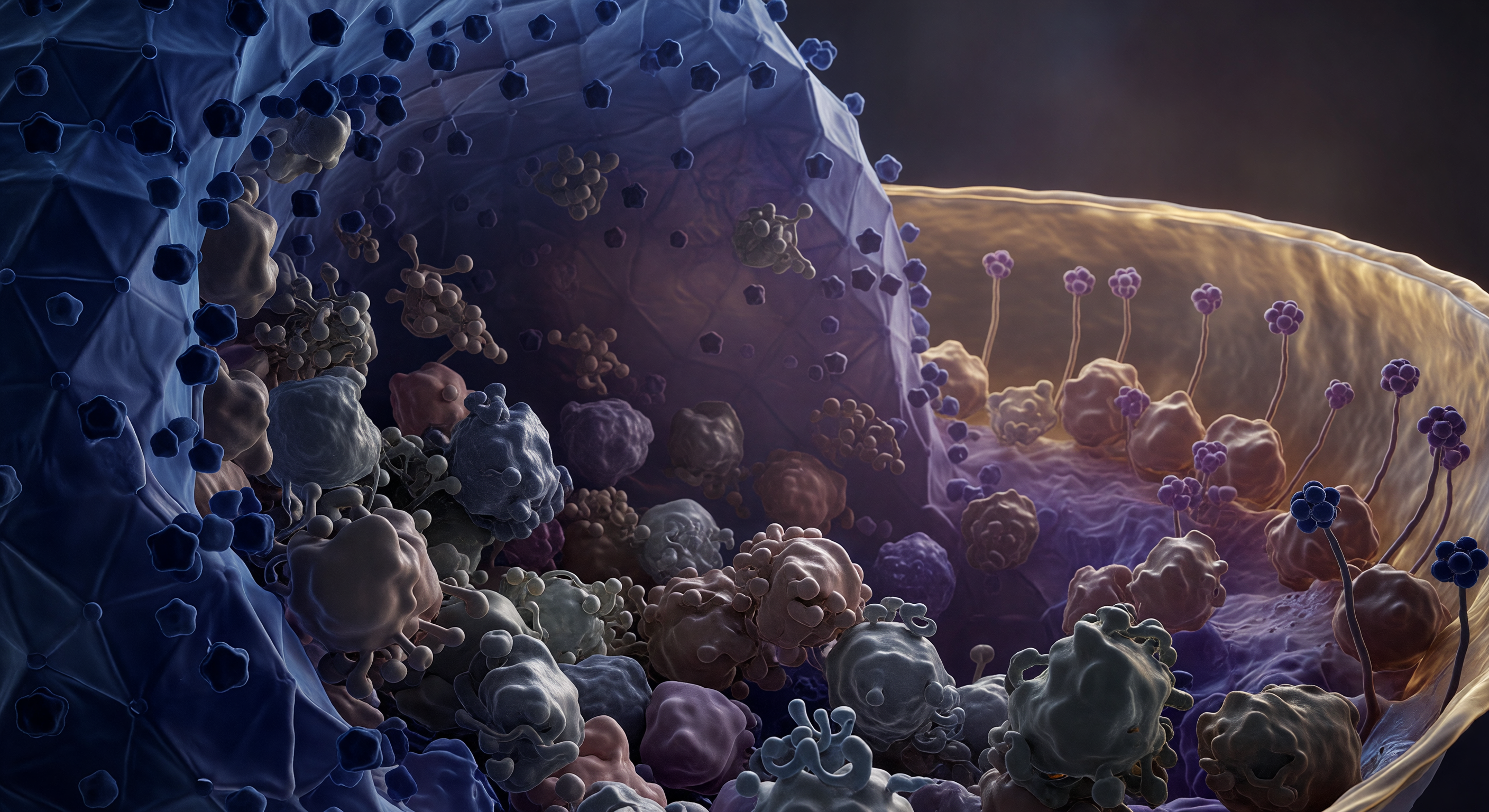
You are suspended inside the tegument layer of a herpesvirus virion, a compressed molecular corridor no wider than forty nanometres, pressed between two opposing architectures of extraordinary scale and character. To your left, the icosahedral capsid wall rises as a faceted cliff of deep cobalt geometry, its pentamer vertices jutting forward as darkened knobs and its triangulated faces curving upward and out of sight like an alien geodesic terrain emitting a cold blue-grey luminescence; to your right, the lipid envelope billows as a molten amber horizon, its two leaflets resolved into a trembling double band of honey gold, glycoprotein stems anchored into its inner face swaying in imperceptible thermal current. Between them, you are fully embedded in the tegument matrix — a near-suffocating density of VP16 and UL36 molecules pressed shoulder to shoulder in muted grey-violet and dusty mauve, their lobed irregular surfaces slick with bound water, edges blurring where hydrophobic contacts merge one protein mass into the next with no open channel anywhere. The tegument is not an inert packing material but a functional command layer, carrying transcriptional activators, capsid-tethering scaffolds, and host-evasion factors that are delivered directly into the newly infected cell upon membrane fusion, hijacking cellular machinery before a single viral gene has been transcribed. Every surface around you trembles in the faint constant jostle of thermal energy, the entire interior held in a frozen instant of molecular pressure — a geological silence, cool from the capsid face, warm from the membranous far wall, and absolutely, impossibly full.
Other languages
- Français: Intérieur du Tégument Herpétique
- Español: Interior del Tegumento Herpético
- Português: Interior do Tegumento Herpético
- Deutsch: Herpesvirus Tegument Innenraum
- العربية: داخل غلاف فيروس الهربس
- हिन्दी: हर्पीसवायरस टेगुमेंट आंतरिक
- 日本語: ヘルペスウイルス外皮内部
- 한국어: 헤르페스바이러스 피막 내부
- Italiano: Interno del Tegumento Herpetico
- Nederlands: Herpesvirus Tegument Binnenste