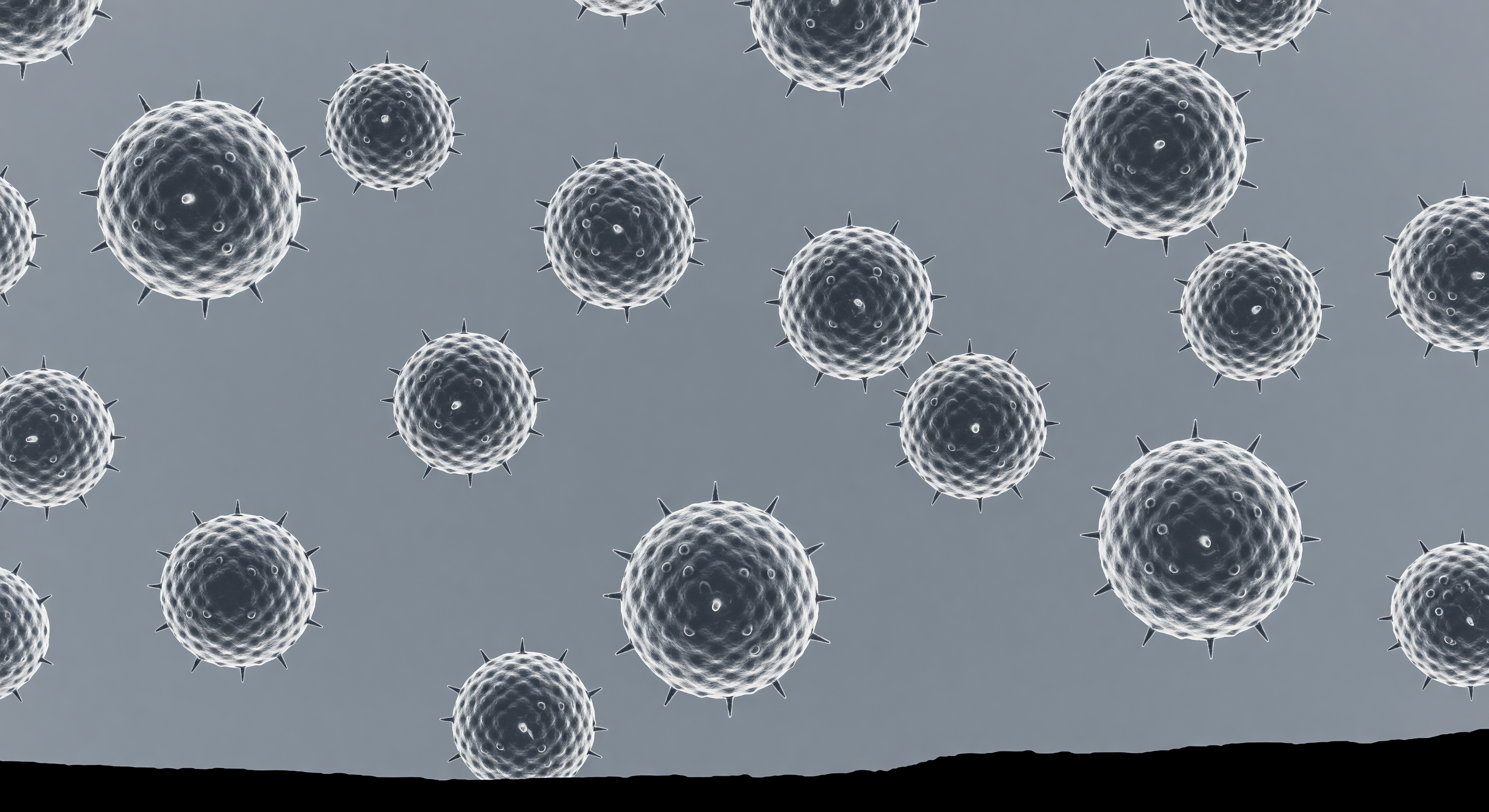
You are suspended in a medium that is not quite solid and not quite nothing — vitrified water, shock-frozen in milliseconds, arresting every molecule mid-motion into a glass that transmits electrons as faithfully as it once transmitted light. Scattered across this featureless grey-silver expanse, icosahedral virions sit embedded in the ice like sunken cathedrals, their capsid surfaces resolved with hallucinatory precision: pentameric and hexameric capsomers arranged in geodesic arrays across each faceted hull, every raised knob four to eight nanometers in relief, the geometry of self-assembly laid bare without shadow or chromatic distortion, rendered purely in the language of electron density — deep charcoal where protein mass is thickest, pale bone-white where the vitrified film thins toward nothingness at the carbon foil's edge. On some particles, trimeric glycoprotein spikes project outward from a faint double-dark lipid bilayer ring, each stalk individually resolved, separated from its neighbors by distances that, at your scale, feel like open country. The carbon foil at the frame's periphery simply ends the world — a sheer black escarpment dropping into absolute vacuum — while between the particles the ice stretches as a vast, sterile tundra in which every Brownian displacement, every diffusing ion, every thermal tremor has been locked permanently into place, the molecular violence of room temperature converted, in the span of milliseconds, into permanent and perfect silence.
Other languages
- Français: Glace Vitreuse Cryo-Électronique
- Español: Perspectiva de Hielo Vitriforme
- Português: Paisagem de Gelo Vitrificado
- Deutsch: Kryovitrifikation Eisschicht Blick
- العربية: منظور الجليد الزجاجي المبرد
- हिन्दी: क्रायो-काँचित हिम परत दृश्य
- 日本語: 凍結ガラス氷膜の視点
- 한국어: 동결 유리화 빙판 전망
- Italiano: Prospettiva Ghiaccio Vetrificato Cryo
- Nederlands: Bevroren Glasijs Perspectief