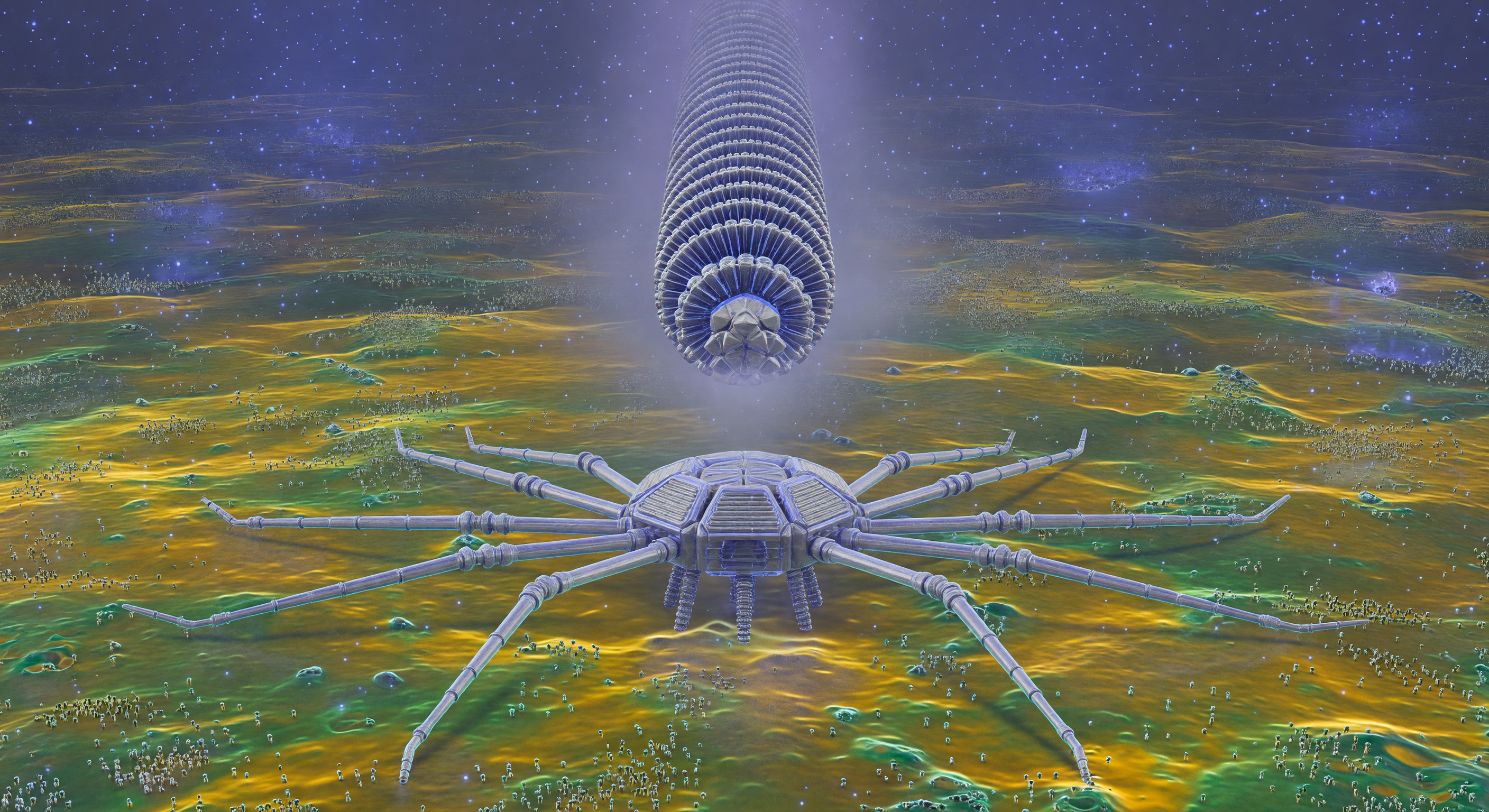
You are flat against the bacterial outer membrane, pressed into a landscape of swaying sugar chains and porin proteins that rise around you like storm-weathered rock formations, the whole plain trembling with the ceaseless percussion of thermal noise. Above you, filling the sky, the hexagonal baseplate of bacteriophage T4 descends with the slow, inevitable geometry of a machine built by evolution over billions of years — sixty nanometers of cold protein architecture, its faceted silver-gray faces housing tightly packed beta-sheet structures that scatter the ambient electron-density glow into faint blue-violet light, six short tail spikes already pressing toward the membrane below. Six long tail fibers splay outward in a radial star, each one jointed at its midpoint like a folding crane arm, their distal tips dimpling the lipopolysaccharide surface hundreds of nanometers away as specialized tip proteins lock with exquisite chemical precision onto specific receptor sugars — an irreversible molecular handshake that has been performed trillions of times across evolutionary history. Rising above the baseplate, the contractile tail sheath vanishes into violet haze, a striated helical column of stacked protein rings machined to tolerances measured in fractions of a nanometer, coiled and loaded like a compressed spring that will soon drive the inner tube through this very membrane in a millisecond injection event you will not survive to observe.
Other languages
- Français: Atterrissage du Bactériophage T4
- Español: Aterrizaje del Bacteriófago T4
- Português: Pouso da Placa Base T4
- Deutsch: T4-Phage Bodenplatte Landung
- العربية: هبوط قاعدة العاثية T4
- हिन्दी: बैक्टीरियोफेज T4 बेसप्लेट अवतरण
- 日本語: T4ファージ基板着地
- 한국어: T4 파지 기저판 착륙
- Italiano: Atterraggio Basale del Batteriofago T4
- Nederlands: T4-Bacteriofaag Basisplaat Landing