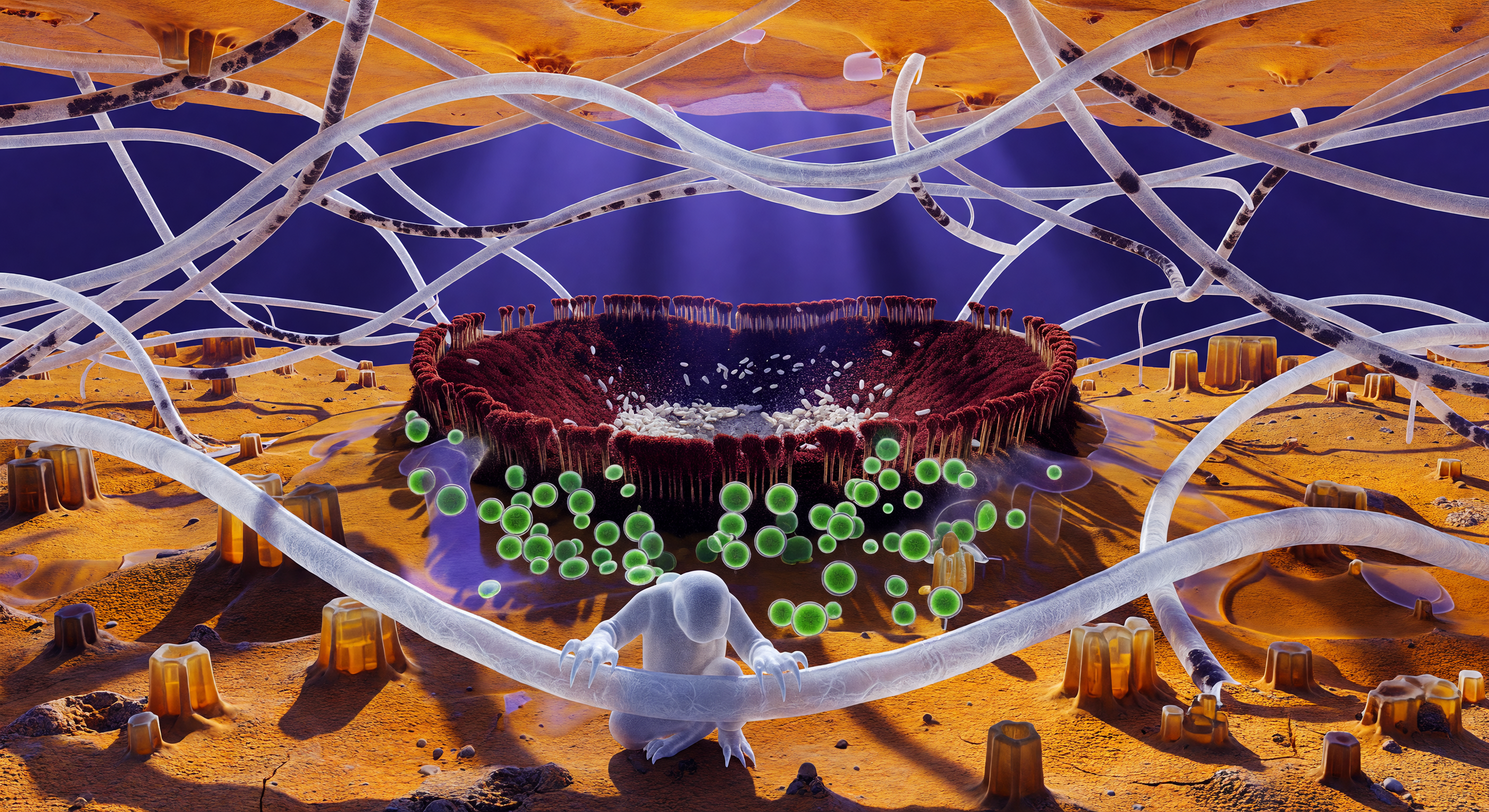
The ground beneath you is not ground — it is a living plateau of compressed fungal and algal tissue, stretching orange and amber in every direction like a sun-scorched badlands, its surface rising into polygonal ridges of packed cortical cells that cast long shadows under alpine ultraviolet arriving with almost physical weight. You cling to a hyphal strand as thick as a ship's rope, its translucent walls revealing slow drifts of cytoplasmic granules moving in the dim interior like silt suspended in still water, the elastic surface yielding fractionally under each curved claw before springing back. This is the living architecture of a Xanthoria parietina thallus — a composite organism in which fungal hyphae provide structural scaffolding and water retention while Trebouxia algal cells, clustered ahead like clusters of luminous green lanterns ten to fifteen micrometres across, drive photosynthesis deep within the cortex, their chloroplasts saturated with harvested light. The thin liquid film coating every surface here obeys surface tension more than gravity, drawing curved meniscus walls between adjacent hyphae that act as natural lenses, bending and amplifying the amber world behind them, while a tardigrade — an animal of perhaps three hundred micrometres, gripping with hooked claws and moving with the slow deliberateness of something for whom viscous drag outweighs inertia — navigates this architecture as a sailor moves through rigging. In the middle distance, the apothecium opens like a caldera, its rust-red walls dense with paraphyses and its interior choked with ivory ascospores tumbling in thermal microcurrents, the entire reproductive apparatus of the fungus exposed and operating at a scale where dust is architecture and stillness is never absolute.
Other languages
- Français: Paroi Rocheuse Lichen Xanthoria
- Español: Roca con Liquen Xanthoria
- Português: Rocha com Líquen Xanthoria
- Deutsch: Xanthoria Flechten Felswand
- العربية: صخرة حزاز زانثوريا
- हिन्दी: जेंथोरिया लाइकेन शिला
- 日本語: キサントリア地衣岩壁
- 한국어: 잔토리아 지의류 암벽
- Italiano: Parete Rocciosa Lichene Xanthoria
- Nederlands: Xanthoria Korstmos Rotswand