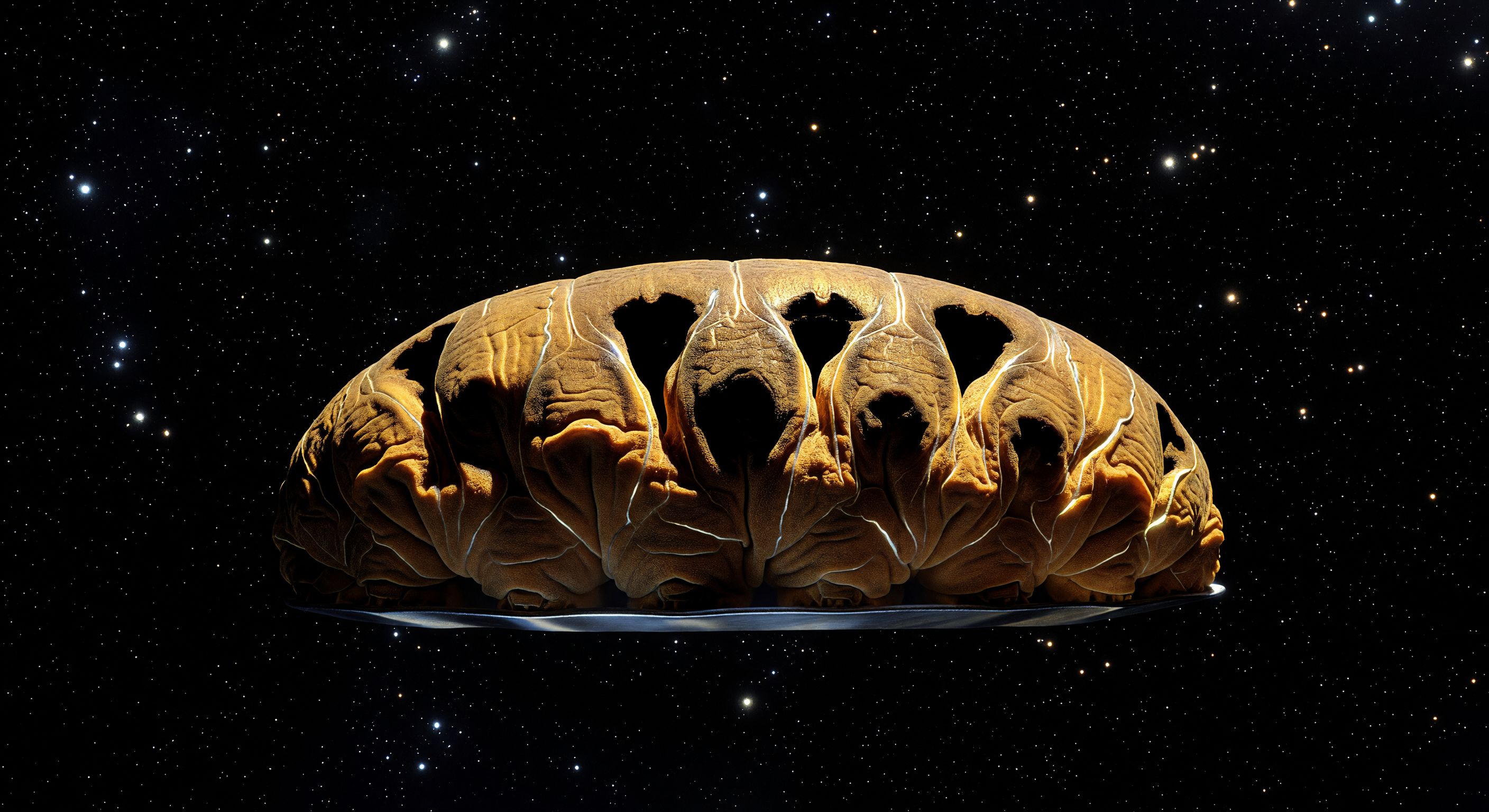
You float at the surface of something that reads, at this scale, exactly like a world — a barrel-shaped moon of amber and sienna, its entire surface an undulating topography of compressed cuticle ridges and valleys, each fold a record of the living animal that once inhabited this contracted shell. This is a tardigrade tun: a state of cryptobiosis in which the animal has retracted its legs, expelled nearly all its water, and reorganized its cellular chemistry around trehalose glass, suspending metabolism so completely that the boundary between dormancy and death becomes philosophically ambiguous. Unfiltered solar radiation — the full spectrum with no atmosphere to edit it — strikes the near hemisphere with surgical precision, illuminating the interlocking polygonal cuticular plates along their crests in warm ochre-gold while the troughs plunge into lightless black, the raking angle transforming the surface into a landscape of simultaneous fire and void that no earthly environment, with its scattering air and diffuse shadows, could ever produce. The terminator line dividing sunlit amber from absolute dark is sharp as a material edge, because in vacuum there is no limb-glow, no gradient, nothing to negotiate the transition between a small, intricate biological structure holding its molecular architecture intact and the indifferent interstellar dark surrounding it in every direction. What makes this scene extraordinary is the equation it makes visible: a few hundred micrometers of compressed cuticle and vitrified cytoplasm, resting on a machined metal substrate somewhere in a laboratory, containing within its wrinkled geometry the complete suspended blueprint of an animal that has outlasted conditions that would reduce most life to chemistry.
Other languages
- Français: Tun face au vide cosmique
- Español: Tun ante el vacío cósmico
- Português: Tun contra o vazio cósmico
- Deutsch: Tonne gegen kosmische Leere
- العربية: الكيس في مواجهة الفراغ الكوني
- हिन्दी: टन बनाम ब्रह्मांडीय शून्य
- 日本語: 宇宙の虚空に浮かぶタン
- 한국어: 우주 공허 속의 툰
- Italiano: Tun contro il vuoto cosmico
- Nederlands: Ton tegen kosmische leegte