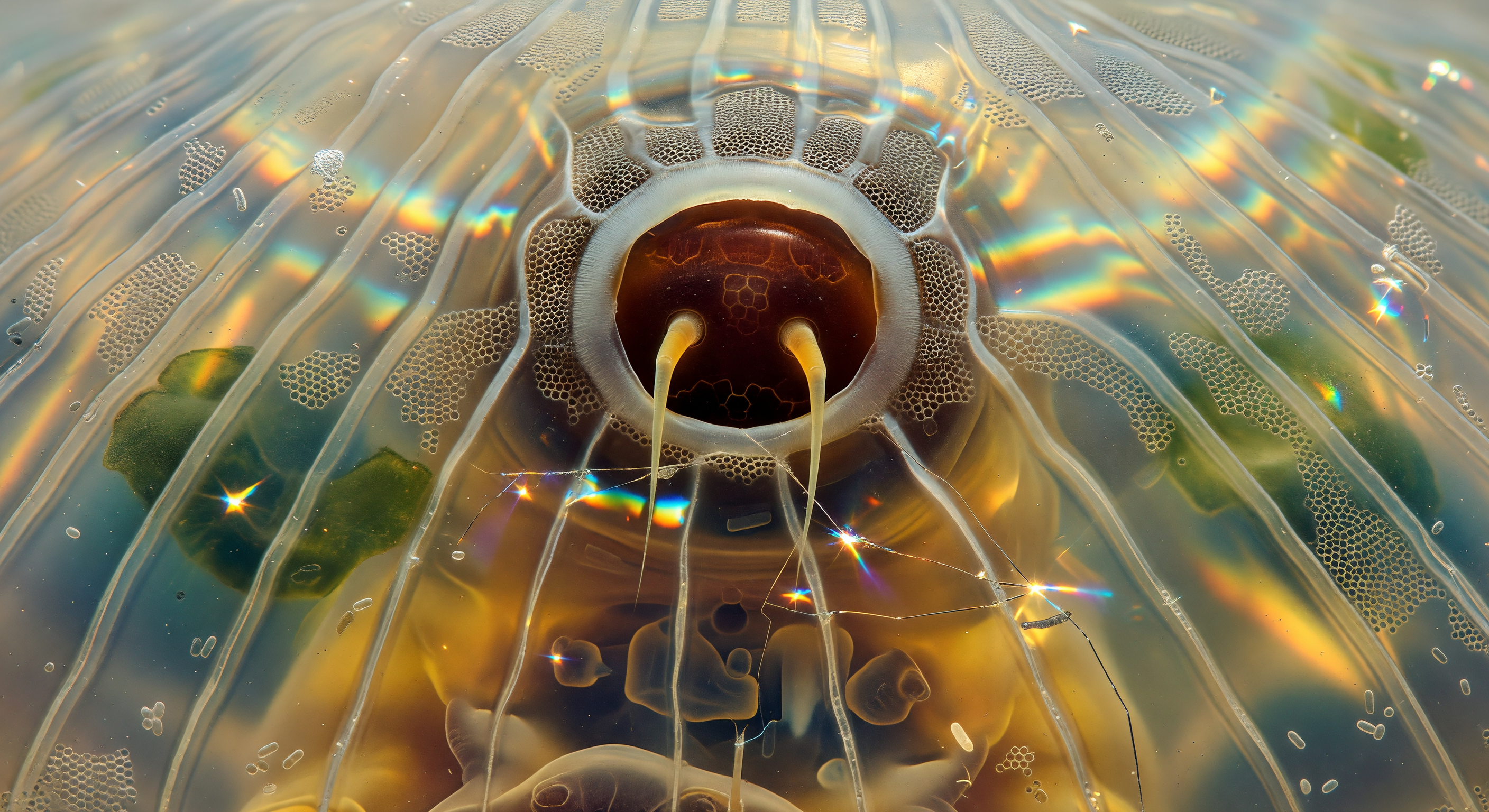
You are suspended just beneath the vaulted underside of a diatom frustule, its parallel silica ribs and hexagonal pore arrays refracting ambient water-light into slow prismatic ribbons of gold, amber, and pale aquamarine that ripple across every wet surface — a cathedral of biosilica geometry stretching across the entire upper field of view, translucent as sea-glass, thick as a structural wall. Bearing down from directly above, the circular mouth of a tardigrade presses seal-tight against the ornate frustule lacework, its pale lip ring forming a perfect gasket while two paired amber stylet lancets — honey-gold, slightly curved, each no thicker than a single frustule rib — have already punched through the silica with hairline precision, micro-fractures spidering outward from each entry point in starburst halos of violet, copper, and electric blue interference color. The stylets are hollow piercing tools, evolutionary solutions to the engineering problem of breaching one of biology's most mechanically resilient natural materials — hydrated amorphous silica — allowing the pharyngeal bulb above, a dark garnet sphere pulsing with muscular rhythm, to generate the suction pressure needed to extract cell contents through the breach. Around the contact zone, the shallow water film catches every shaft of oblique light in curved silver menisci along the silica ridges, bacterial rods drifting in slow Brownian suspension at the periphery, the whole scene a pressurized, crystalline world where predation and architecture are rendered at the same intimate scale.
Other languages
- Français: Stylets percant la frustule
- Español: Estiletes perforando la frústula
- Português: Estiletes perfuram a frústula
- Deutsch: Stilett trifft Frustel
- العربية: وخز الإبرة في الفرستول
- हिन्दी: स्टाइलेट का फ्रस्टुल पर प्रहार
- 日本語: スタイレットが殻壁を刺す
- 한국어: 스타일렛이 규조껍질을 찌르다
- Italiano: Stiletto trafigge la frustola
- Nederlands: Styletten doorboren de frustule