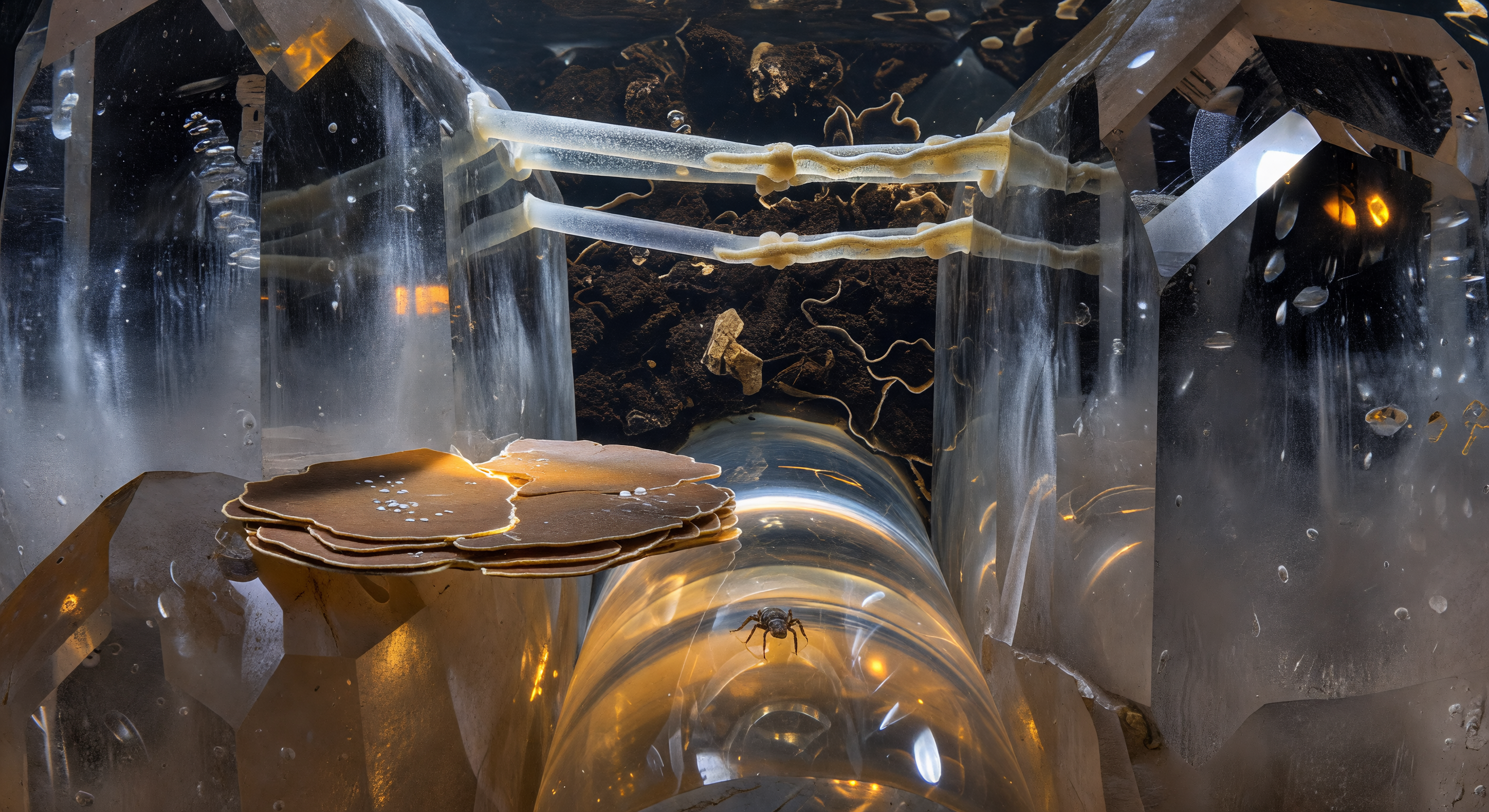
You are suspended at the threshold of a cathedral passage between two immense quartz boulders, your eight stubby legs gripping crystal faces through a meniscus skin of capillary water, surface tension the dominant force holding you to the mineral world rather than any meaningful pull of gravity. The quartz walls rise around you like cliffs of frosted obsidian and pale smoky glass, their conchoidal fracture faces catching diffuse transmitted light from above and refracting it into cold blue-white shards and amber internal glows that pulse through ancient mineral inclusions deep within the crystal matrix. Overhead, two fungal hyphae span the passage like translucent rope bridges of ivory-gold, their cytoplasm a faint granular shadow within glassy tubular walls, while beyond them a dense plug of dark humus seals the far tunnel in near-absolute blackness, its surface a crumbled labyrinth of collapsed organic matter and tannin-stained fragments. Clay platelets jut from the quartz base in laminated ochre shelves, bacterial biofilms glinting as smooth reflective patches against matte mineral texture, and at every water contact point curved menisci catch the light as bright crescent arcs — the physics of adhesion and viscous drag ruling this world entirely. What reads subjectively as an immense cave system of staggering internal complexity is, in physical reality, a soil pore space measured in tens to hundreds of microns, close and vast at once, a universe compressed into the dark architecture between grains.
Other languages
- Français: Labyrinthe de Quartz Souterrain
- Español: Laberinto de Cuarzo Subterráneo
- Português: Labirinto de Quartzo no Solo
- Deutsch: Quarz-Labyrinth im Erdpore
- العربية: متاهة الكوارتز في التربة
- हिन्दी: क्वार्ट्ज भूलभुलैया मृदा रंध्र
- 日本語: 石英の迷宮土壌孔
- 한국어: 석영 미로 토양 기공
- Italiano: Labirinto di Quarzo nel Suolo
- Nederlands: Kwarts Labyrint Bodempora