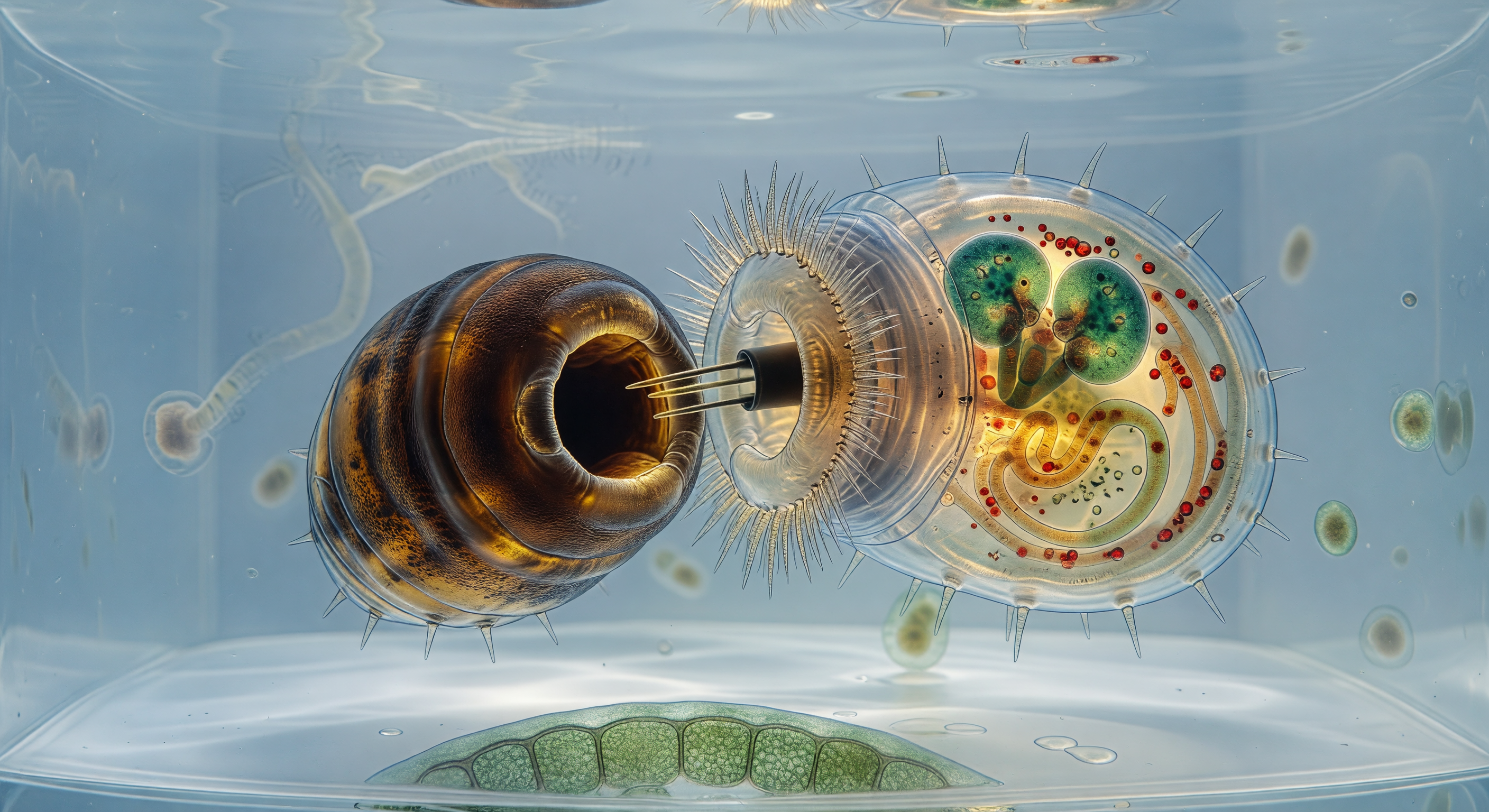
In the cold, cathedral stillness of a thin water film clinging to wet moss, two organisms the length of a dust mote are locked in a moment that will decide one of them. The luminous, lantern-bodied rotifer on the right — its ciliary corona mid-beat, its internal ovaries glowing jade through a transparent body wall — belongs to the phylum Rotifera, filter-feeders so ancient and so successful that bdelloid lineages abandoned sexual reproduction entirely, yet here the strategy of passive gathering meets its limit: *Milnesium tardigradum*, the apex predator of this microscopic ecosystem, presses its fully gaped circular mouth and extended stylet lancets — each one a biological hypodermic 15 to 50 micrometres long, driven by a muscular pharyngeal bulb lined with chitinous placoids — hard against the rotifer's pellicle, dimpling it inward in a crescent of compressed, intensified light. At this scale, the surrounding water is not empty space but a medium of genuine physical consequence: surface tension curves the capillary menisci at the frame's edges into slow glass walls, dissolved organics bend transmitted light in barely perceptible refractive waves, and viscous drag makes every movement a negotiation with the fluid itself rather than a passage through it. What the eye reads as a confrontation between two creatures is also a collision between two ecological strategies — one built on continuous filtration and near-eternal dormancy potential, the other on stylet-driven predation and the pitiless hydraulics of a pharyngeal pump that will, in moments, breach that glowing wall and begin to drink.
Other languages
- Français: Rencontre Prédatrice de Milnesium
- Español: Encuentro Depredador de Milnesium
- Português: Encontro Predatório de Milnesium
- Deutsch: Milnesium Beutegreifer Begegnung
- العربية: لقاء افتراس ميلنيسيوم
- हिन्दी: मिल्नेसियम शिकार मुठभेड़
- 日本語: ミルネシウムの捕食遭遇
- 한국어: 밀네시움 포식 조우
- Italiano: Incontro Predatorio di Milnesium
- Nederlands: Milnesium Predatie Ontmoeting