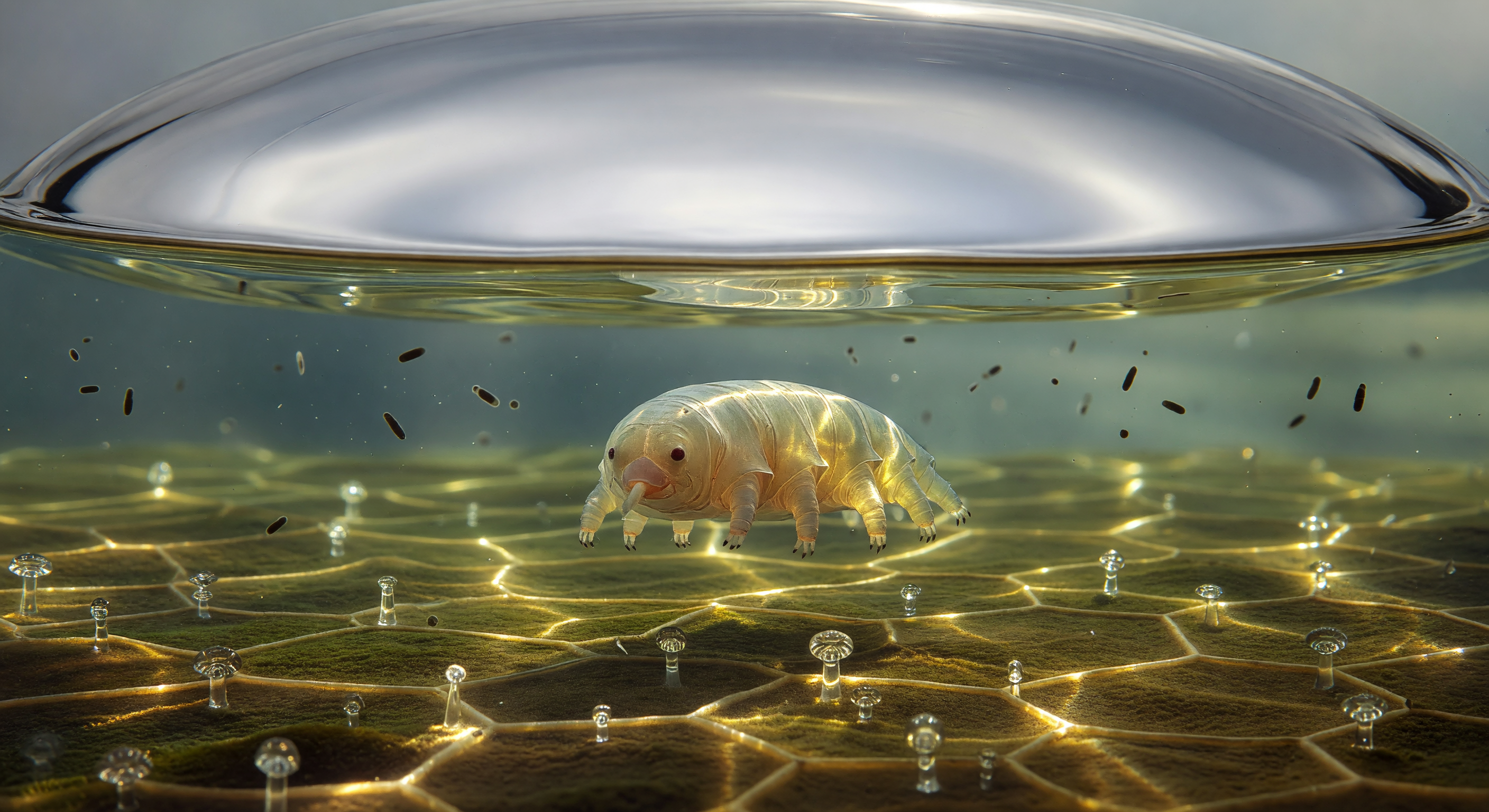
Looking upward from the floor of this shallow interstitial world, the most commanding presence overhead is the water-air interface itself — an immense, gently bowed ceiling of mercury-silver perfection spanning the full upper hemisphere, its surface tension holding a boundary that, at this scale, feels as structural and imposing as vaulted stone. This meniscus is sustained by cohesive forces between water molecules that here dominate over gravity almost entirely, and where it pins against the cellulose walls of adjacent moss cells it climbs in flawless capillary arcs, trembling with an energy density of roughly 72 millinewtons per meter — a force that at human scale would be imperceptible, but here is sufficient to support, trap, or crush a microorganism. Caustic interference patterns — bright filaments born from refraction through the curved interface — sweep slowly across the amber-green mosaic of polygonal moss cells below, pooling into zones of intense illumination and deep shadow that give the flat substrate an unexpected, almost geological drama. At mid-column, a tardigrade drifts in arrested stillness, its translucent gold-amber body bisected by the depth gradient of the film, eight lobopodial legs loosely splayed, its dorsal cuticle catching the cold mirror-light from above while its ventral surface glows with warm transmitted light rising from the biofilm floor — a creature caught between two worlds, simultaneously bathed in silver and gold.
Other languages
- Français: Mer Ménisque Tension Surface
- Español: Mar Menisco Tensión Superficial
- Português: Mar Menisco Tensão Superficial
- Deutsch: Meniskus Meer Oberflächenspannung
- العربية: بحر المنيسكوس توتر سطحي
- हिन्दी: मेनिस्कस सागर पृष्ठ तनाव
- 日本語: メニスカス海面張力
- 한국어: 메니스커스 바다 표면장력
- Italiano: Mare Menisco Tensione Superficiale
- Nederlands: Meniscus Zee Oppervlaktespanning