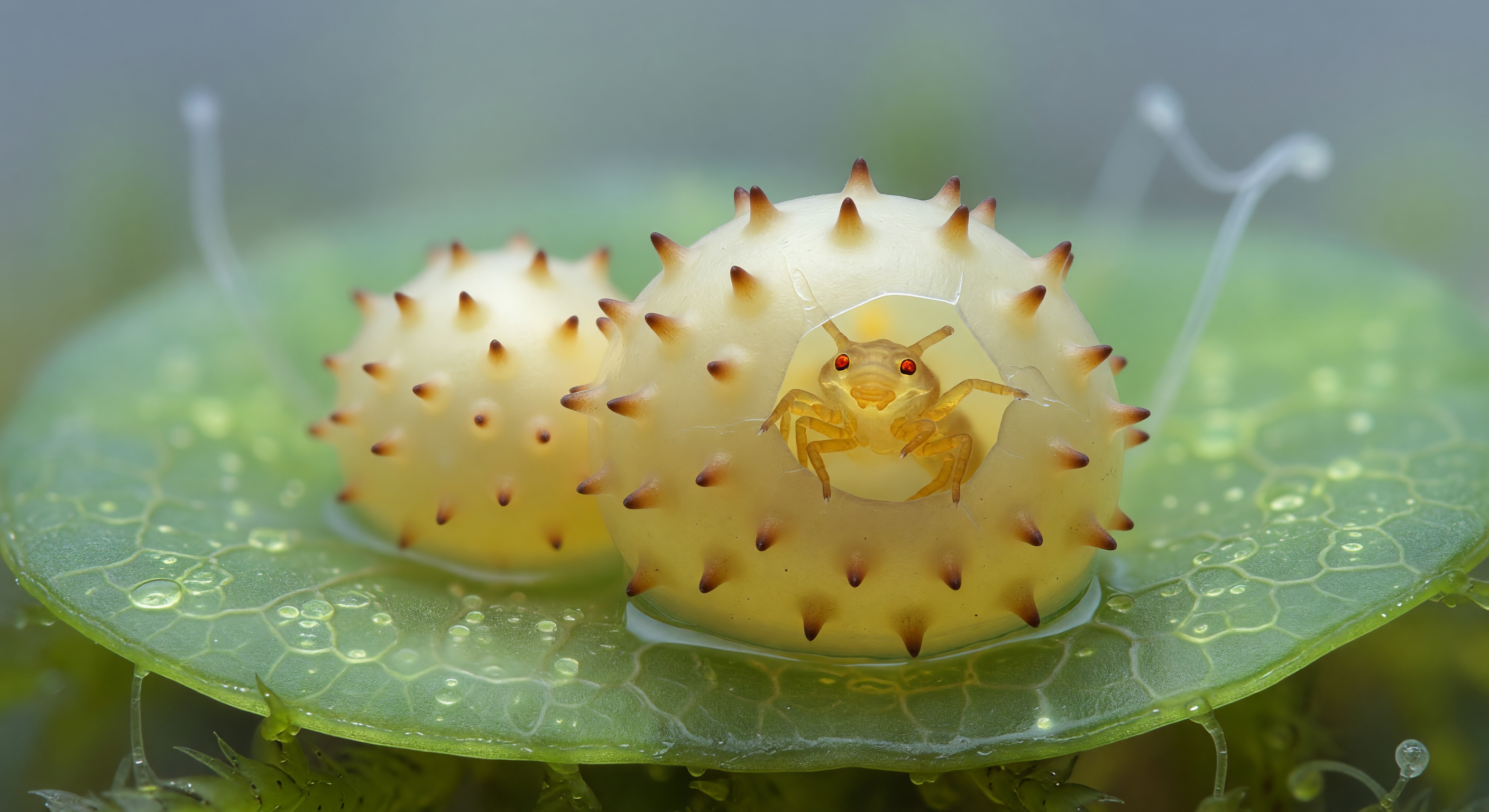
At moss-surface level, the viewer witnesses something that registers less as a biological event than as a geological one: a cream-yellow ovoid the size of a small boulder has cracked along its equatorial seam, and through the widening fracture an 80-micron first-instar Macrobiotus is pushing free, its amber-translucent body already fully articulated, eight stubby legs pressing against the shell edge with unmistakable intention. The egg belongs to a genus known for its elaborately ornamented shells — the conical mushroom-shaped processes studding its surface are species-diagnostic structures, each one a chitin-protein pillar tipped in warm amber-brown, arranged in radial ranks across a shell with the subsurface translucency of fine porcelain, their soft shadows mapping a landscape of extraordinary relief across the cream surface. The hatchling's interior is nearly as transparent as the shell it is abandoning: the midgut appears as a colorless loop, the hemocoel a fluid-filled cavity, nascent muscle bands barely resolved through the cuticle — all of it secondary to the two red-orange eye spots flanking the anterior brain mass, the only truly opaque pigment in the scene, glowing like embers in an otherwise diaphanous body. Behind the emerging animal, two sibling eggs rest against the moss leaf surface, backlit by chloroplast-packed cells glowing in cool jade-green, their identical process-studded forms slightly softened by the few hundred micrometers of depth that constitute the entire world visible here. The whole scene exists within what would be a single dewdrop at human scale, the water film betraying itself only as a faint meniscus gleam where egg meets leaf — gravity irrelevant, surface tension sovereign, and a new animal already fully alive inside a world most eyes will never find.
Other languages
- Français: Éclosion Macrobiotus Première Lumière
- Español: Cría Macrobiotus Primera Luz
- Português: Filhote Macrobiotus Primeira Luz
- Deutsch: Macrobiotus Schlüpfling Erstes Licht
- العربية: فراخ ماكروبيوتوس أول ضوء
- हिन्दी: मैक्रोबायोटस शिशु प्रथम प्रकाश
- 日本語: マクロビオタス孵化初光
- 한국어: 마크로비오투스 부화 첫 빛
- Italiano: Macrobiotus Schiusa Prima Luce
- Nederlands: Macrobiotus Uitgebroed Eerste Licht