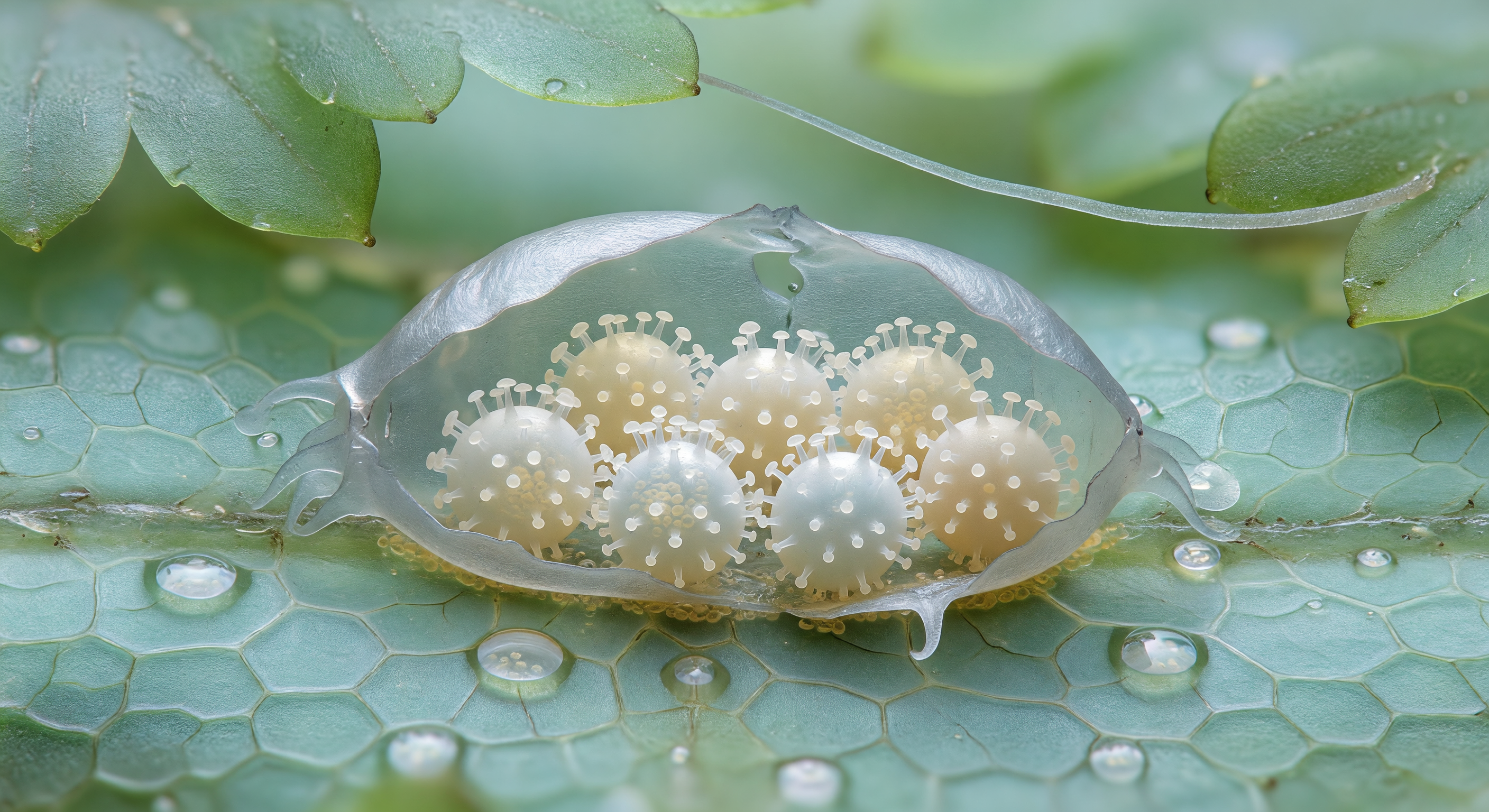
You hover just above the waxy surface of a moss leaf, your entire field of view taken up by a split-open tardigrade exuvia draped across the green terrain like the collapsed hull of a glass vessel — its translucent silver-grey walls catching the soft, jade-filtered light in iridescent interference colors that fade to near-invisibility at the thinnest edges. Inside the gaping cuticle, which has split along its dorsal seam during a recent molt, eight cream-yellow Macrobiotus eggs rest in a loose clutch on a thin amber biofilm of flattened bacteria, each sphere roughly the size of a boulder from your vantage point, their surfaces densely armored with hundreds of mushroom-shaped cuticular processes that scatter ambient light and give each egg a frosted, lantern-like glow. Deep within each shell, barely resolved through two layers of membrane, the earliest rounds of cell division have thickened the interior into a granular mass that transmits light with a warm amber core, evidence that embryogenesis is already underway inside these architecturally intricate, species-diagnostic capsules whose process ornamentation will eventually serve as taxonomic evidence of their identity. The surrounding moss leaf extends away in soft focus, its epidermal cells enormous hexagonal tiles of pale aquamarine, water pooling into meniscus lenses at their raised junction walls — a world where surface tension outweighs gravity, and time is measured in the slow accumulation of cell divisions within these quietly glowing spheres.
Other languages
- Français: Berceau d'œufs Macrobiotus
- Español: Cuna de Huevos Macrobiotus
- Português: Berço de Ovos Macrobiotus
- Deutsch: Macrobiotus Eiergelege Wiege
- العربية: مهد بيض ماكروبيوتوس
- हिन्दी: मैक्रोबायोटस अंड समूह पालना
- 日本語: クマムシ卵塊の揺籠
- 한국어: 완보동물 알 무리 요람
- Italiano: Culla di Uova Macrobiotus
- Nederlands: Macrobiotus Eierkluwen Wieg