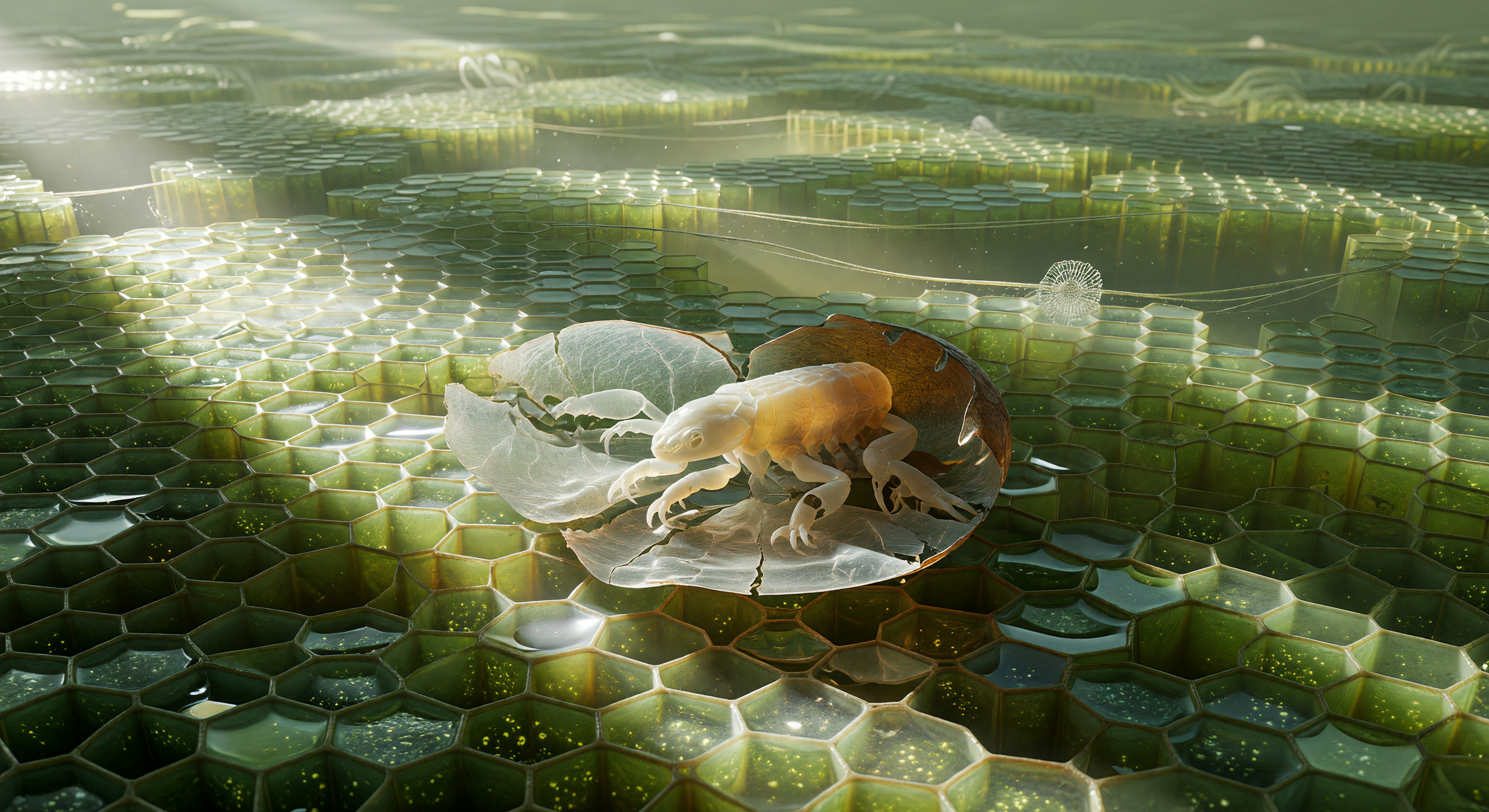
At the center of everything, a body is being born from itself — a tardigrade halfway extracted from the split anterior seam of its own shed cuticle, caught at the precise moment when two versions of the same animal coexist in the same frame. The discarded exuvia is the more immediately astonishing object: a complete hollow effigy, translucent as crinkled glass, its former claw sockets, leg tubes, and dorsal plate impressions all preserved in pale relief as though the cuticle were a mold made from an absence — this is ecdysis, the periodic molt that all ecdysozoans must perform to grow, the old trilaminar chitin-protein exoskeleton split and evacuated while the new cuticle beneath completes its sclerotization over the hours following emergence. The emerging animal reads differently from its ghost: its surface carries a faint warm amber iridescence where cross-linking of the new cuticle matrix has begun but not finished, the forward claws still pearl-soft stubs of unsclerotized cuticle that will harden over the coming hours into the precisely hooked tools used for gripping bryophyte cell walls, the hind legs still partially sleeved within the old leg sheaths so that limb and vacated lumen form a doubled image. Beneath them both, the moss leaf cell surface extends to every horizon — each hexagonal cell wall rising two or three body-lengths as a translucent green-amber rampart packed with chloroplast constellations, the water films pooled at cell junctions pulled into menisci that act as curved mirrors, and thin fungal hyphae crossing the mid-distance like slack rope bridges into a green-gold haze where the world quietly dissolves.
Other languages
- Français: Mue Émergence Lumière Rasante
- Español: Écdisis Emergencia Luz Lateral
- Português: Ecdise Emergência Luz Lateral
- Deutsch: Häutung Auftauchen Seitenlicht
- العربية: ضوء جانبي لانبثاق الانسلاخ
- हिन्दी: निर्मोचन उदय पार्श्व प्रकाश
- 日本語: 脱皮出現サイドライト
- 한국어: 탈피 출현 측면광
- Italiano: Ecdisi Emersione Luce Laterale
- Nederlands: Vervelling Opkomst Zijlicht