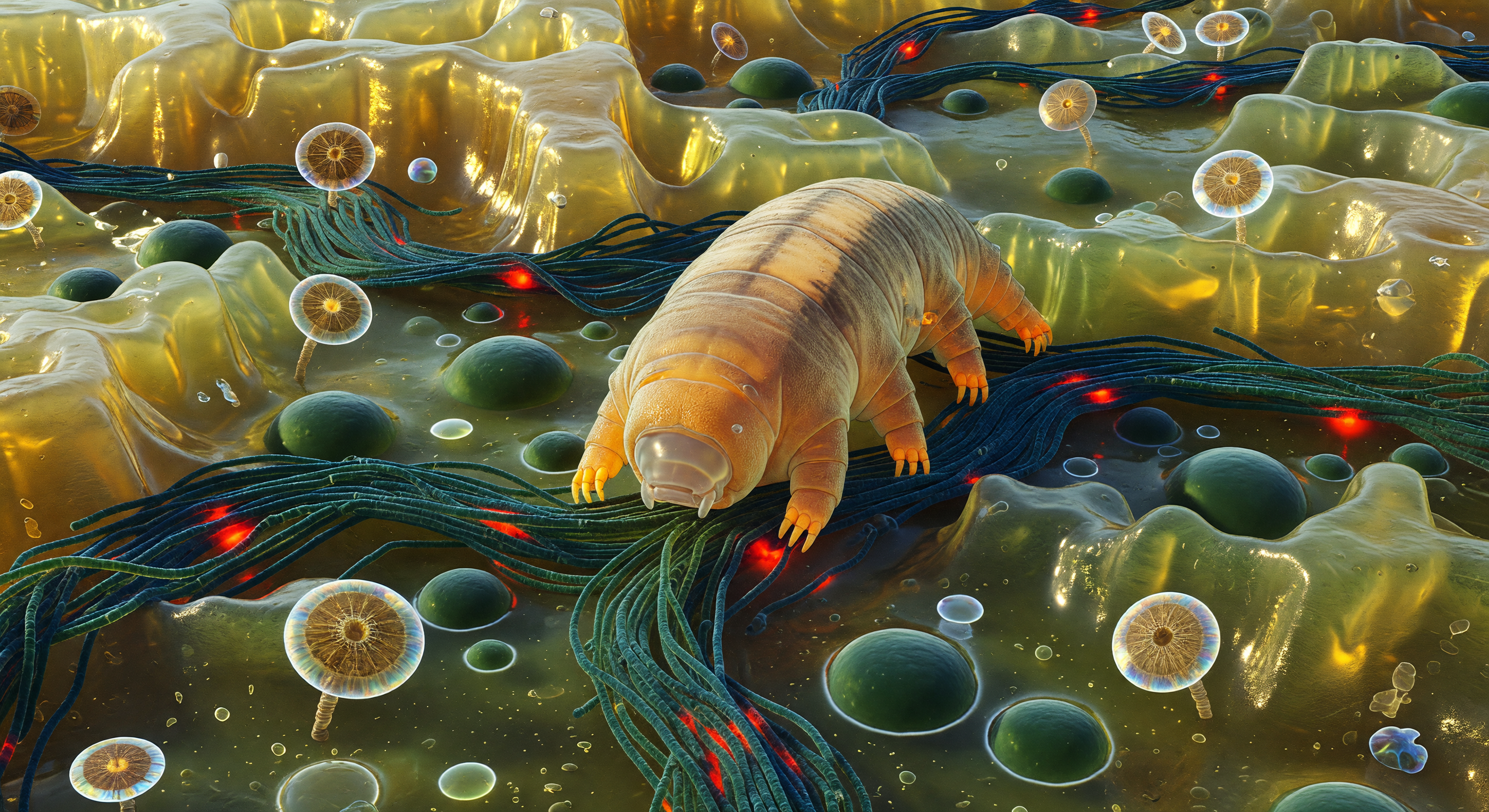
You are standing inside a cyanobacterial mat, eye-level with the extracellular polymeric substance that forms amber towers and channeled ridges around you, each gelatinous column backlit by warm transmitted light until it glows like honey-stained glass. Dense bundles of Oscillatoria trichomes rope across open capillary channels, their blue-green mass occasionally erupting in flares of brick-red autofluorescence where chlorophyll-packed sheaths catch the light, while golden-brown diatom frustules jut from the EPS at oblique angles, their silica geometry refracting pale prismatic halos at every edge. This entire landscape — canyon walls, rope bridges, embedded monuments — is measured in microns, a world where surface tension forms curved walls of glass-like transparency and gravity matters far less than capillary adhesion. Into the foreground of this biofilm prairie, a tardigrade drives its anterior bluntly downward, buccal apparatus pressed against a filament bundle, stylet lancets working to pierce cyanobacterial cells while the pharyngeal bulb pulses visibly through the semi-translucent cuticle; the front legs are splayed and clawed deep into the EPS for purchase, the body arched in a taut muscular bow, rear legs dragging slow furrows through the gel — a creature of perhaps 400 microns commanding the entire scene with the unhurried, deliberate force of something that has survived five mass extinctions.
Other languages
- Français: Prairie de Biofilm Cyanobactérien
- Español: Pradera de Biopelícula Cianobacteriana
- Português: Pradaria de Biofilme Cianobacteriano
- Deutsch: Cyanobakterielle Biofilm-Prärie
- العربية: سهل الغشاء البكتيري الأزرق
- हिन्दी: सायनोबैक्टीरियल बायोफिल्म प्रेयरी
- 日本語: 藍藻バイオフィルムの草原
- 한국어: 남조류 생물막 초원
- Italiano: Prateria di Biofilm Cianobatterico
- Nederlands: Cyanobacterieel Biofilm Prairie