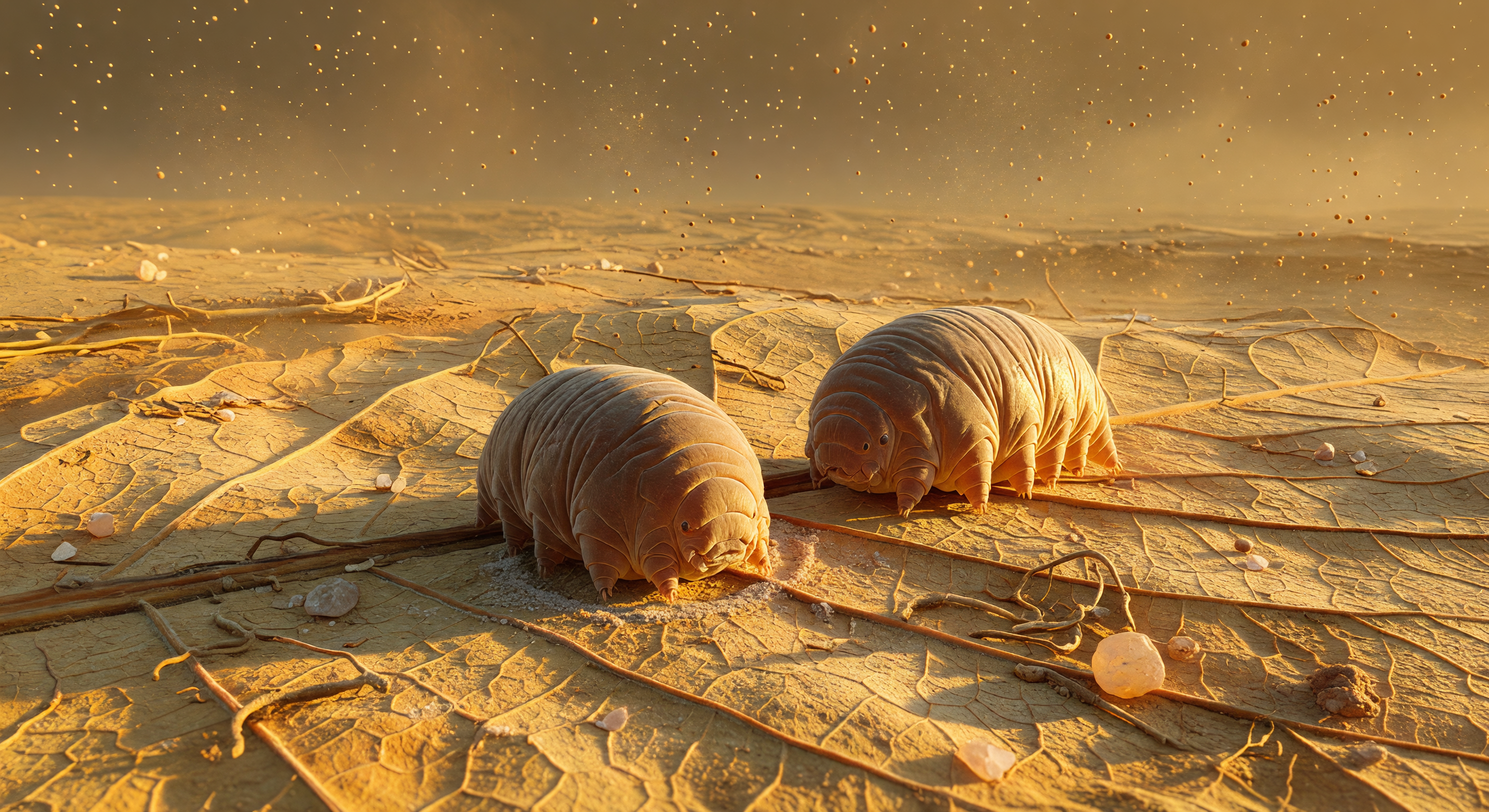
A vast, desiccated terrain fills the field of view — the collapsed cellular architecture of a single moss leaf transformed by drought into a crinkled, honey-gold continent, its buckled cell walls casting long ochre shadows under a raking amber sidelight that makes the entire microscopic world feel ancient and scorched. At the center of this parched landscape rests the tun: a tardigrade fully committed to anhydrobiosis, its 200-µm body contracted into a dense barrel of concentrically folded cuticle, the chitin compressed into concentric rings like a dried prune, opaque rust-amber at the deepest creases and faintly glowing where the oblique light catches the outermost ridges. Beside it, a second individual is mid-contraction — posterior legs already retracted into dimpled sockets, flanks beginning to crease, the cuticle still marginally translucent where residual hydration has not yet been surrendered, the paired ocelli visible as faint rust-red pinpoints flanking a contracting cerebral ganglion. This transition represents one of biology's most extraordinary survival mechanisms: anhydrobiosis, during which the tardigrade expels nearly all free water, synthesizes vitrifying sugars and intrinsically disordered proteins, and suspends metabolism into a glass-like stasis capable of enduring decades of desiccation. Fungal spore beads drift slowly through the thick amber air column, and crystallized solute rings mark where the last water films evaporated, leaving these two animals — one already sealed, one in the final seconds of becoming — suspended in a silence that could last a century.
Tardigrades